
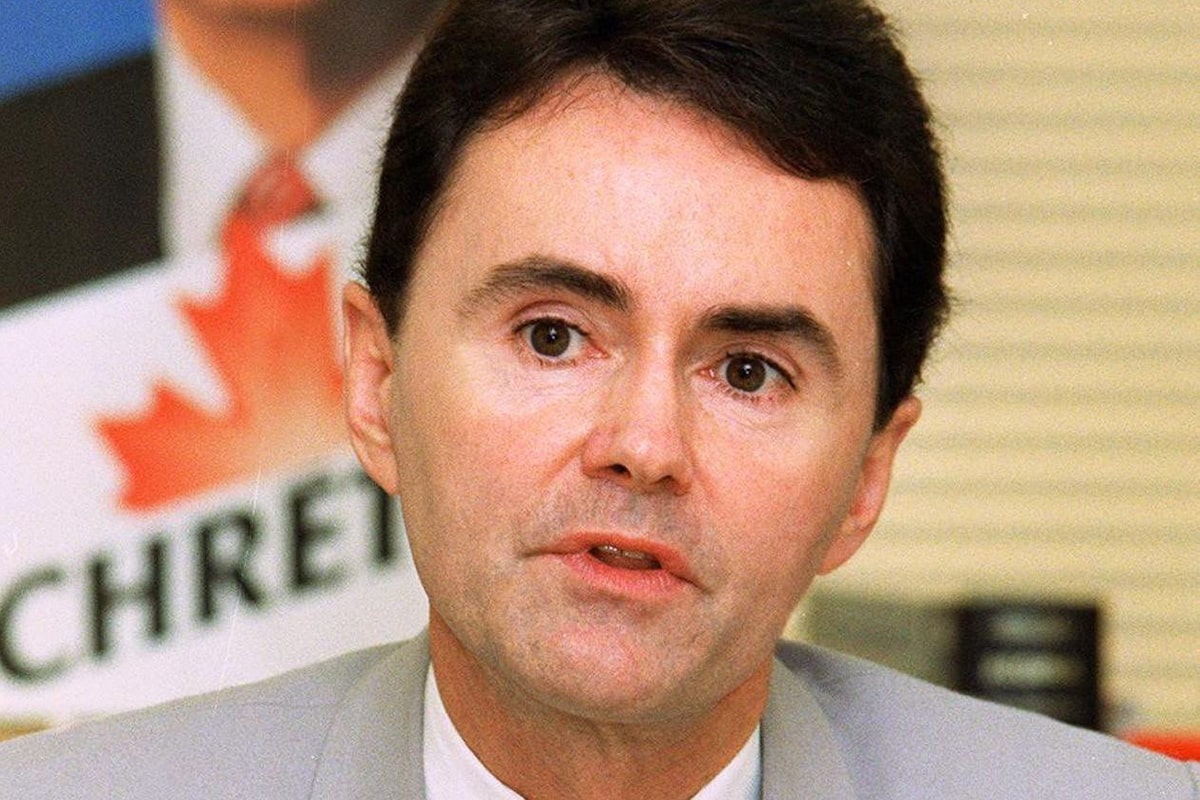
Many words have been used to describe Tony Merchant. He’s been called “the king of class action” (Regina Leader-Post), “living proof of the maxim that there is no such thing as bad publicity” (Maclean’s magazine), “The Merchant of Menace,” (Globe and Mail), “quite possibly the last guy you want to see across from you in a court of law” (Canadian Lawyer Magazine), “a god in my eyes” (former client Flora Northwest), a man of “sleazy standards” (former PC MP Jim Balfour) and “candid, intelligent, loyal, organized, goal-organized and productive, made for television” (Tony Merchant).
Tony Merchant.The Canadian Press
One of Canada’s best known and arguably most controversial lawyers, Mr. Merchant was a politician, radio host, and pugnacious litigator who filed reams of class-action lawsuits on everything from asbestos to breast implants, repeatedly battled allegations of unethical behaviour and financial impropriety, and ultimately became the single biggest advocate for – and beneficiary of – the federal government’s settlement payout to survivors of Indigenous residential schools.
Mr. Merchant died of cancer at his home in Regina on Oct. 13, six days short of his 81st birthday. He and his wife, Pana Pappas Merchant, had three sons: Evatt, Joshua and Matthew.
Tony Merchant was born in Yorkton, Sask., on Oct. 19, 1944, one of twin sons born to Captain Evatt Merchant and Maria Margharita Sally Merchant (née Smith). Mr. Merchant was given his father’s full name, Evatt Francis Anthony Merchant, but would be known throughout his adult life as Tony.
Capt. Merchant was killed about a month after his sons’ birth, while serving with the 5th Cameron Highlanders in the Netherlands toward the end of the Second World War. Tony’s twin brother, Michael Vincent Reynolds, died four months later.
Sally Merchant raised Tony and his sister, Adrian, as a single mother, and in their youth she became a television personality in Saskatchewan, hosting a syndicated talk show called Sally Time.
Mr. Merchant was a Navy cadet as a young man, and later in the reserves. At the University of Saskatchewan he worked on the student newspaper and became captain of the debate team. (He once boasted to a reporter from Maclean’s about having a lifetime record of 102 wins and two losses as a debater.)
Mr. Merchant was admitted to the bar in Saskatchewan in 1968, and began practising in Regina. While establishing his name as criminal lawyer, Mr. Merchant rose to prominence outside the courtroom as the host of a local radio call-in show, Talk Back. When the Law Society of Saskatchewan tried to sanction him, on the grounds that the call-in show violated a prohibition against lawyers advertising their services, Mr. Merchant appealed and won.
The Law Society then changed its rules to bar lawyers from taking part in radio or television programs more than once a month, and Mr. Merchant quit the show and turned his eye to politics.
Tracing the path of his mother and grandfather – Sally Merchant was elected a Liberal MLA in Saskatoon in 1964, and her father, Vincent Smith, in 1934 – Mr. Merchant was elected to represent the Liberals in Regina Wascana in 1975.
He later ran unsuccessfully to become Liberal leader, and failed in multiple bids to represent the party federally, despite aggressive campaigns that included delivering truckloads of flowers to supporters. When he was seeking the nomination in 1993, Mr. Merchant’s team recruited more than 1,068 high school and university students to support him, promising free pizza and beer after they voted for him. The ensuing 1993 nomination convention was described in the Saskatoon Star-Phoenix as “one of the most chaotic nominations in Saskatchewan political history.”
Mr. Merchant began to pursue class-action litigation with vigour, filing large-scale lawsuits on subjects including, but not limited to, car recalls, tainted meat, breast implants, diabetes medication, the birth control pill, airplane safety, school fees, cellphone charges, asbestos, scratch tickets and data breaches.
His clients included a former outlaw biker turned police informant, victims of a tax shelter later declared by a court to be a “sham,” and the family of a woman who fell to her death in a hotel laundry chute. Among his targets were Home Depot, Winners, Walmart, Molson, General Motors, Facebook, Toyota, Sony and Sears. As a 2017 story in the Regina Leader-Post noted, “If you name a big corporation, the Regina-based lawyer’s firm has probably sued it.”
In one case, Mr. Merchant sued Saskatchewan Government Insurance for $1,450 on behalf of his wife, Pana, over damage caused to the inside of her car by their son Matthew’s dog.
Mr. Merchant (left) and former Progressive Conservative MLA Colin Thatcher during a court appearance, on March 4, 1983.STF/The Canadian Press
Mr. Merchant also filed numerous lawsuits against the federal and provincial governments, many of which had to do with the government’s treatment of Indigenous people, including the Sixties Scoop (when Indigenous children were taken away from their families for adoption), medical experiments conducted on Indigenous people, the government response to cases of Missing and Murdered Indigenous Women, and the landmark Indian Residential Schools Settlement Agreement.
Protracted argument over Mr. Merchant’s fees led to delays in payouts to survivors. He and his firm, Merchant Law Group, ultimately received $25-million for work on the residential schools lawsuit, far less than Mr. Merchant said he was owed, and far more than the federal government believed was due.
(The government paid Mr. Merchant but later unsuccessfully tried to get the money back, accusing Mr. Merchant and his firm of inflating bills and legal fees, and falsifying documents “as part of a scheme to deceive and defraud Canada.” Mr. Merchant denied the allegations, and sued the government in return.)
Mr. Merchant was known for a punishing work schedule, operating on a few hours’ sleep and eating just one meal a day (dinner) to save time. In interviews, he said he worked every day including Christmas, and particularly enjoyed working on vacation. He billed an eyebrow-raising 5,300 hours in 2005, the equivalent of working about 14½ hours every single day of the year.
“He is a unique book, there’s no doubt about it,” longtime friend and Saskatoon lawyer Douglas Richardson told The Globe in 2007. “There’s only one Tony. There’s no mould, before or since.”
Or, as Leader-Post columnist Murray Mandryk wrote in 1997, “You love him or you hate him. Indifference is not an option.”
In 1983, Mr. Merchant, who had represented Progressive Conservative MLA Colin Thatcher in contentious divorce proceedings, was charged with abduction for taking Mr. Thatcher’s nine-year-old daughter from the home of one of her friends, the day after the murder of Mr. Thatcher’s ex-wife, JoAnn Wilson. Mr. Merchant claimed at the time that he had been looking out for the girl’s welfare on behalf of his client.
Mr. Thatcher was subsequently convicted of his former wife’s murder. Mr. Merchant pleaded guilty to mischief, and was given an absolute discharge.
“I know it hasn’t affected my practice,” he told reporters at the time. “It certainly hasn’t affected my clients’ estimation of me.”
Mr. Merchant testified in Mr. Thatcher’s defence at trial, saying he reached Mr. Thatcher by phone at his home in Moose Jaw 15 or 20 minutes after the murder.
In 1996, Mr. Merchant narrowly averted a plane crash, when the landing gear malfunctioned on a chartered plane he was in heading to court in North Battleford, Sask. According to newspaper reports at the time, the pilot was preparing for a crash landing in Regina when Mr. Merchant climbed into the cockpit and used his legs to free the gear.
“I kept trying to think: There’s got to be some way to work our way out of the problem, and indeed there was,” Mr. Merchant said then, adding that: “If you get into emergencies you’ve got to keep your head and worry about solutions. That’s what surviving is about.”
Mr. Merchant’s survival story was ultimately overshadowed by his explanation for why he had been traveling with his white Siberian husky, Yipshi. “My theory is … you sleep with the dog for the first couple of days, and then eat him on the third and fourth day.” It was never clear whether he was joking.
Throughout his professional life, Mr. Merchant was the subject of thousands of news articles, and received reams of awards, medals and honours, alongside persistent questions about his business practices and ethics.
In 2007, B.C. Supreme Court Justice Barry Davies released a highly critical decision against Mr. Merchant and the Merchant Law Group, in which the judge said there was “striking evidence of the extent to which Mr. Merchant was prepared to go to further his own self-interest and the extent to which his testimony cannot be relied upon.”
He found Mr. Merchant attempted to mislead the court in the proceedings, and described Mr. Merchant as having “a willingness to resort to unethical and obstreperous conduct” to advance his aims.
In 2013, Mr. Merchant was named as part of an international investigation into offshore tax havens, and was accused of having put nearly $2-million into offshore accounts while his wife was a federal senator, and while he was under investigation by Revenue Canada. The Merchants sued CBC for libel over the reporting.
Mr. Merchant was temporarily suspended from practising law in 2020 for withholding money from a residential school settlement to cover unrelated legal bills accrued by the woman’s son. Mr. Merchant appealed, and the Saskatchewan Court of Appeal later overturned the sanctions.
“People think I’m unusual in some ways, because of work and my interests. But I don’t really think they think that. They just think I’m more driven than they are,” Mr. Merchant said, speaking to the Leader-Post in 2017.
In that interview, he said he recognized that “the things I’m doing are stepping on a lot of people’s toes a lot of the time.”
But, he said: “I’m happy in my own self. I’m happy with the things I do. And I think I’m relatively fun to be around.”
You can find more obituaries from The Globe and Mail here.
To submit a memory about someone we have recently profiled on the Obituaries page, e-mail us at obit@globeandmail.com.