
Head of Conservation Sudbury hopes local offices and expertise aren’t lost as provincial plan aims to merge Ontario’s 36 localized conservation authorities into seven massive ones
Should the province proceed with amalgamating Conservation Sudbury with other Northern Ontario conservation authorities, Carl Jorgensen hopes they each retain their local focuses.
“The staff that work in Sudbury know the Sudbury watershed, they know the soils here, the water here and the landscape,” the Conservation Sudbury general manager told Sudbury.com on Thursday.
“They know their watersheds intimately because they’re there every day. … I don’t think the government wants that to go away. I think the intent is to keep that happening, but what that will look like, I don’t know.”
Jorgensen said he hopes local offices will remain open and local expertise isn’t lost in the shuffle to create larger organizations.
Sudbury.com caught up with Jorgensen following Thursday’s Future-Ready Development Services Ad-Hoc Committee meeting of city council at the Lionel E. Lalonde Centre in Azilda.
During both this and Jorgensen’s Conservation Sudbury budget presentation to city council members the previous night, he clarified that the organization’s future is up in the air.
“For 2027, I have more questions than answers,” he said during Wednesday’s budget presentation, noting that although an amalgamation of some sort has been proposed, “We don’t know exactly what that looks like, but we expect it to start to happen in 2027.”
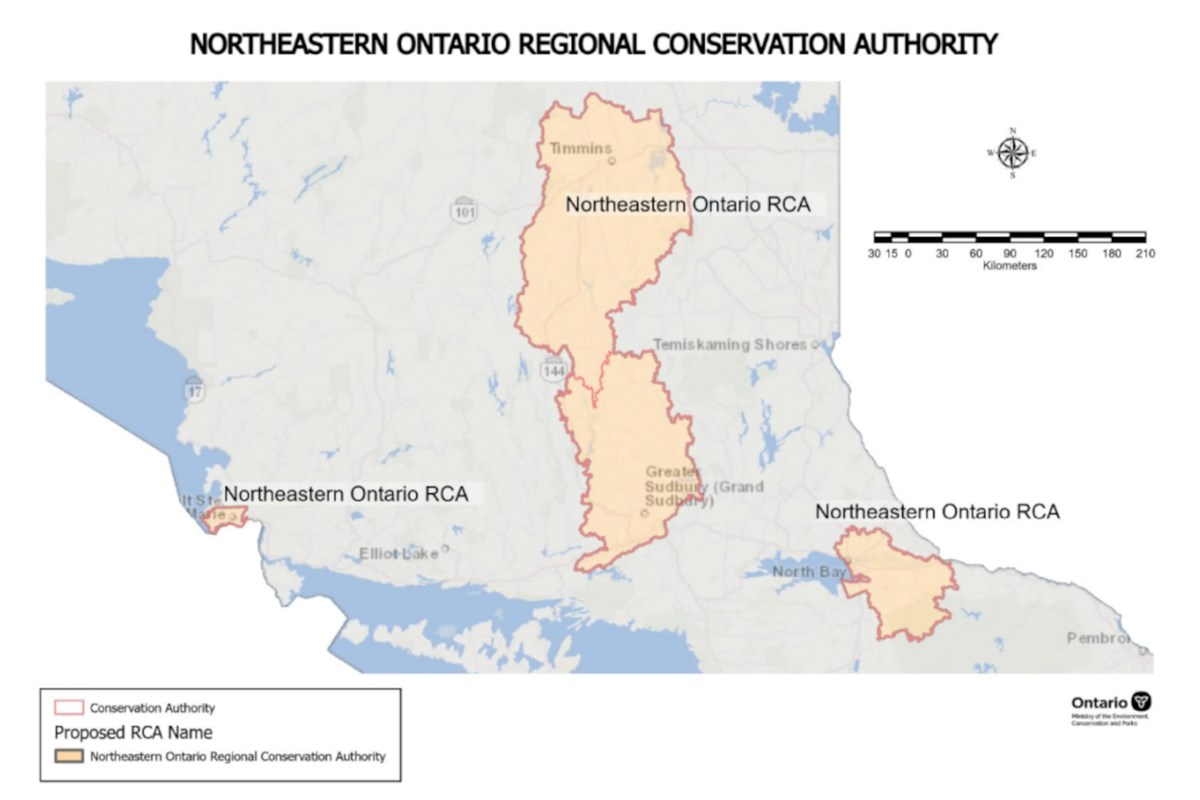
As currently proposed, Conservation Sudbury (also known as the Nickel District Conservation Authority) would amalgamate with the Mattagami Region (north, including Timmins), Sault Ste. Marie and North Bay-Mattawa conservation authorities.
The Sudbury and Mattagami conservation authorities connect, while Sault Ste. Marie and North Bay-Mattawa conservation authorities are separate pockets.
The province’s stated goal behind the amalgamation is to “provide centralized leadership, efficient governance, strategic direction and oversight of all conservation authorities,” and “free-up resources for front-line conservation and ensure faster, more consistent and transparent permitting, while supporting conservation authorities in their core mandate of managing watersheds and protecting people and property from natural hazards in an efficient and consistent manner.”
Conservation Sudbury’s coverage area as it currently stands is approximately 9,000 square kilometers in size. Although it extends beyond the City of Greater Sudbury’s boundaries, Jorgensen said the vast majority of their work is done within Greater Sudbury.
They look at approximately 1,000 building permits from the city each year, of which six per cent turn into development projects that require a permit under the Conservation Authority Act.
“At a regulatory role it’s keeping people and properties safe,” Jorgensen said of Conservation Sudbury, which, alongside its 35 counterparts throughout the province is credited with playing a “vital role in watershed management and protecting communities from natural hazards like floods.”
Carrying a full-time staff of 13, which jumps to more than 20 during the summer, Jorgensen said Conservation Sudbury’s work includes such things as undertaking groundwater monitoring, monitoring the quantity and quality of the city’s 13 communal wells, maintaining Lake Laurentian land they own, maintain local adherence to the Clean Water Act (a response to the Walkerton E. coli contamination of 2000 which killed seven people), plant trees, oversee a day camp for kids aged six to 12, conduct educational programming and flood forecasting.
They also operate dams, weirs and berms, and own and maintain the underground box culvert which plays a pivotal role in preventing flooding within the city’s downtown core.
Although there’s a great deal of uncertainty as to Conservation Sudbury’s future, Jorgensen said that staff are still busy doing what they’ve always done.
“We’re still at work and continuing to do our flood forecasting, our water sampling; all of that work is still happening, so there’s really no change from the front-line side of things,” he said.
As for the province’s proposed amalgamations, the province is only a few days into a 45-day public consultation period, during which more information and an opportunity to submit comments will remain open until Dec. 22 by clicking here.
Although there are some local concerns regarding a potential loss in local voices, Jorgensen said he also has some room for optimism.
Aligning with the proposed amalgamation, there has been some talk around providing conservation authorities with more tools, technology and guidance.
Much of what conservation authorities currently use is out of date, Jorgensen said, particularly when it comes to such things as wetlands, which the province “haven’t really provided useful tools to conservation authorities for decision-making,” leading them to seek out their own expertise.
He’d like to see the province provide whatever incarnation of conservation authorities which come out of the current review process with updated reference documents, which each authority can use to develop their own localized policies.
“Having a one-policy approach is, I think, not realistic,” Jorgensen said. “The landscape in Sudbury, or anywhere on the shield, is vastly different from the landscape in the St. Lawrence Lowlands … so you need some flexibility to localize the policy.”
While Environment, Conservation and Parks Minister Todd McCarthy has called the province’s current collection of 36 conservation authorities “fragmented,” Jorgensen said he prefers the word, “localized.”
Jorgensen’s hope is that each existing conservation authority maintains a localized focus throughout whatever amalgamation process ends up taking shape.
With the province’s public consultation process now open, he told city council members on Thursday that it’s “not fait accompli, we will see where it ends up,” whether it’s status-quo or any number of conservation authorities throughout Ontario. “We don’t really know where it’s going.”
Tyler Clarke covers city hall and political affairs for Sudbury.com.