

A higher proportion of Island Health residents use alcohol, tobacco and cannabis regularly than the B.C. average, according to a new report by the health authority.
On Thursday, Island Health released its Population Health Status Report for 2025, which aims to give a snapshot of health data in the region, particularly among youth.
This year’s report found that while the number of people who use alcohol, tobacco and cannabis regularly fell this year in the Island region, the rate is still higher than the provincial average.
Watch the full report below:
It also found that a higher percentage of adults reported seriously contemplating suicide in Island Health (16 per cent) compared to the B.C. average (12 per cent), while many people struggle to find a family doctor (70 per cent) – also above the provincial average (65 per cent).
It’s not all bad news, however. Some gains were made, particularly among youth.
The number of youth in Island Health who have ever used alcohol, tobacco or cannabis has declined over the past five years, and the admission rates for suicide and self-harm among all age groups have decreased since peaking in 2021.
Meanwhile, the number of youth reporting “good” or “excellent” mental health has increased each year since a low was recorded during the pandemic in 2021 and 2022, though rates have yet to recover completely to pre-pandemic levels.
“I think there’s an opportunity to invest in their development, recognize what happened and make sure we create the opportunities and programming for them so they do have the long term health, productivity, and wellbeing in general that we enjoyed and that future generations will enjoy,” said Dr. Réka Gustafson, vice president of population and public health and chief medical health officer at Island Health, who oversaw production of the report.
Substance use in Island Health
While alcohol, tobacco and cannabis consumption rates are declining in Island Health, they still number higher than the provincial average, according to Island Health’s latest report.
Some 64.6 per cent of Island Health residents reported regularly consuming alcohol within the past 12 months, above the provincial average of 60.7 per cent, according to Island Health’s latest data from 2023.
Meanwhile, 8.6 per cent of Island Health residents reported being current tobacco users in 2020, above the provincial average of 7.8 per cent, with a higher proportion of daily smokers in the North and Central Island region at rates of almost double compared to the South Island.
However, Island Health notes that there are 50 per cent fewer people who smoke in the Island Region overall today than a decade prior.
When it comes to cannabis use, some 32 per cent of residents in Island Health reported using cannabis regularly within the past year, significantly higher than the B.C. average of 22 per cent, according to the health authority’s latest data from 2020.
Declining life expectancy
It may be surprising to learn life expectancy has actually decreased in recent years in Island Health, partially due to unregulated toxic drug poisoning.
The average life expectancy of someone living in Island Health is 81.3 years, just below the provincial average of 82 years.
North Islanders lives are statistically shorter
The report found that the more north you are in the health authority, the shorter you live.
“The difference is nine years. The Island’s not that big! That’s a big difference,” said Gustafson. “You kind of see a gradient. And I want to be really clear, these are all consequences of the social determinants of health, so it’s not individuals or the population itself.”
Gustafson says as a result, Island Health is disproportionately investing in some services in Central and North Island.
“So that people have the opportunity to achieve the same length and quality of life that some others enjoy,” said Gustafson.
Improvements to youth health
The report noted that there was good news when it came to the health of youth and children on Vancouver Island.
Between 2016 and 2021, the proportion of youth living in low-income households decreased by 41 per cent, from 19.2 per cent in 2016 to 11.3 per cent in 2021.
“That should be lifted up and celebrated,” said Gustafson. “And then that has be contrasted with the number of kids still going to bed hungry.”
One in five living in the health authority have worried about having enough to eat in the past year.
Meanwhile, more kids in Island health are getting vaccinated.
The proportion of children up to date on their immunizations at two years old was 73.8 per cent in 2024, above the provincial average of 69.5 per cent. Meanwhile, the immunization rate at seven years old was 69.6 per cent, above the B.C. average of 63.8 last year.
The number of youth who have tried alcohol, tobacco, and cannabis at least once also declined in Island Health over the past five years, though the totals are still above the provincial average.
READ MORE: Nearly 1-in-3 youth in B.C. have tried vaping, many using within past month: Study
In 2018, some 44 per cent of youth reported trying alcohol at least once across B.C. That total dropped to 38 per cent in 2023.
In the South Island, the total fell from 48 per cent to 45 per cent – in the Central Island it dropped from 52 per cent to 45 per cent – and in the North Island it declined from 54 per cent to 48 per cent over the same time period.
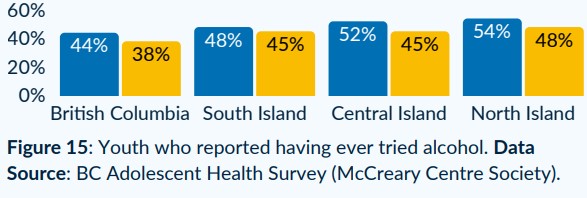 The figure on the left in blue is from 2018, while the bar on the right in yellow is from 2023. (Island Health)
When it comes to tobacco, the number of youth who reported ever smoking went down to from 18 per cent in 2018 to 15 per cent in 2023 across B.C. In the South Island, the total declined from 21 to 19 per cent, in the Central Island it fell from 26 to 20 per cent, and in the North Island it dropped from 27 to 19 per cent.
Cannabis use also declined from 25 per cent provincially in 2018 to 22 per cent in 2023. In the South Island, the proportion fell from 30 per cent to 27 per cent – in the Central Island it declined from 33 to 29 per cent – and in the North Island it dropped from 37 to 31 per cent.
Health issues are community challenges
Gustafson says while the issues in the report present as health issues, they’re really community challenges.
“By the time we’re counting disease, we’ve missed the boat,” said Gustafson.
She says the best way to curb substance use and improve mental health issues is by focusing and investing, on the root causes of death and disease like poverty, housing instability and lack of community connections, to improve overall health.
“Having positive childhood experiences, having food security, financial security, they’re almost like a vaccine against future mental health issues,” said Gustafson.
“So much of health happens outside of the healthcare system. We focus so much on treating disease, rather than creating health. So these kinds of reports hope to maybe focus some of the conversation around creating health.”
The report, Gustafson says the report shows progress is possible, and happening, but serves as a reminder to governments and other organizations, of the important role they have in the health of those living in the health authority.
“We must continue investing in upstream prevention, develop a comprehensive system of care, and address the root causes of health inequities,” she added. “By equipping communities with evidence to shape policy and promoting healthier public attitudes and policies around substance use, we can begin to shift the culture.”
The full 2025 Population Health Status Report can be found on the Island Health website.
With files from CHEK’s Kori Sidaway
READ MORE: