
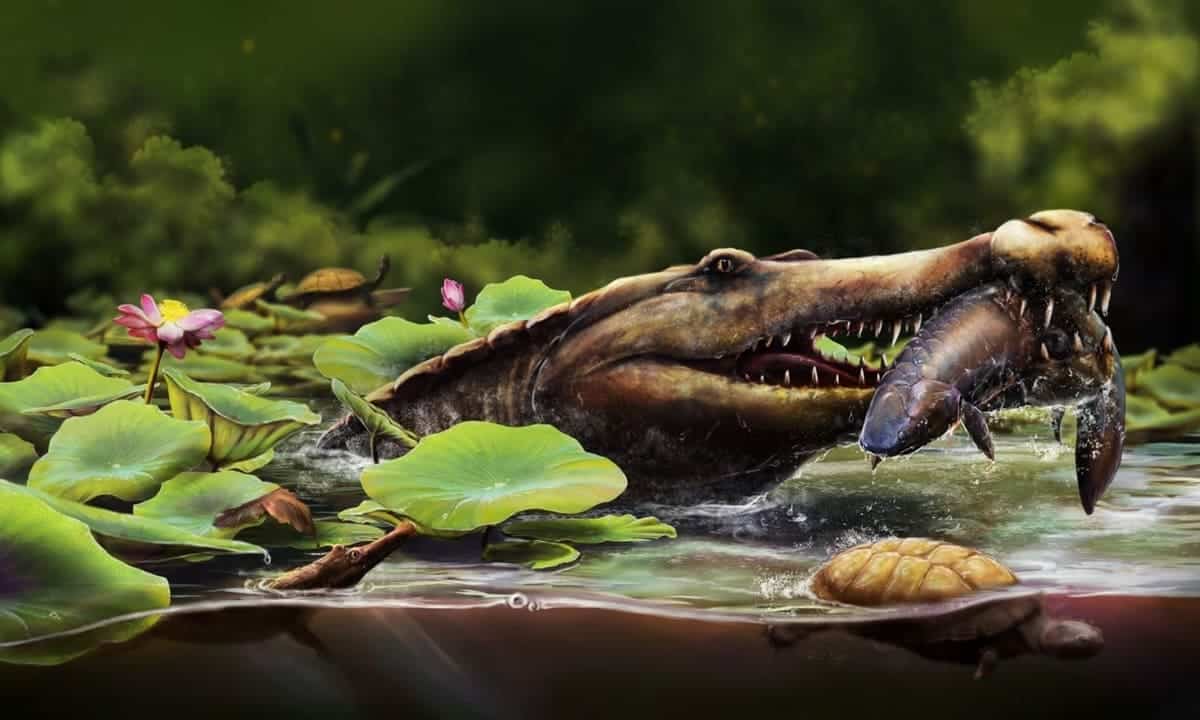
An Egyptian team of paleontologists has uncovered Wadisuchus kassabi, a long snouted marine crocodile that lived 80 million years ago. This rare fossil sheds new light on the early evolution of the Dyrosauridae and reveals that North Africa played a major role in their diversification before these marine reptiles spread to South America.
A team of Egyptian paleontologists recently unearthed remarkable fossils in Egypt’s Western Desert, near the Kharga and Baris oases.
The discovery involves a new species of long snouted fossil crocodile, named Wadisuchus kassabi, which lived around 80 million years ago. It offers a fresh perspective on the early evolution of the Dyrosauridae, a group of marine crocodyliforms that thrived after the extinction of the dinosaurs and were widely distributed from the Late Cretaceous to the Paleogene.
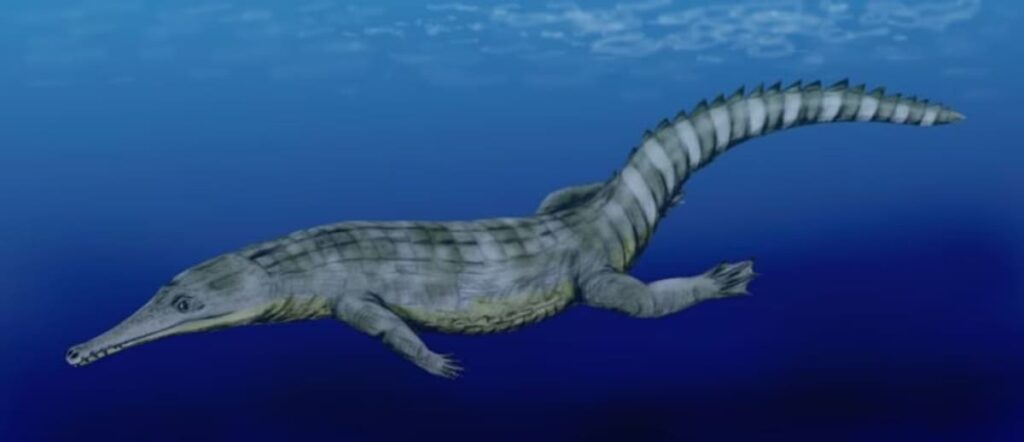
Dyrosauridae, like Guarinisuchus, are characterized by a long and thin snout. © Nobu Tamura, Wikimedia Commons, CC BY 3.0
A long snout that appeared early in this crocodile family’s evolution
Unlike modern crocodiles, dyrosaurids had elongated snouts and slender teeth, perfect for catching slippery prey like fish and turtles. The fossils including two partial skulls and the ends of snouts representing four individuals at different growth stages were analysed using high resolution CT scans and 3D models.
These analyses revealed previously unknown anatomical details, including differences in dentition and the position of the nostrils, pointing to a gradual adaptation in dyrosaurid biting mechanics. These features confirm that the elongated snout emerged early in the evolution of this group.
North Africa, a key region for Dyrosauridae diversification
This discovery provides valuable insight into the evolution of marine crocodiles and their adaptation to coastal environments. Phylogenetic analyses place Wadisuchus as the oldest known representative of the Dyrosauridae. This pushes back the timeline of the clade and suggests that the transatlantic dispersal from Africa to South America occurred earlier than previously thought.
Wadisuchus kassabi is a crucial piece of the puzzle for understanding the diversification, paleobiogeography, and cranial evolution of the Dyrosauridae, highlighting the importance of North Africa as a key region for their origins.
Published in the Zoological Journal of the Linnean Society, this discovery underscores both Egypt’s rich paleontological heritage and the significance of the region for tracing the history of prehistoric marine crocodiles.
If you’d like any adjustments in tone, style, or emphasis, feel free to ask!

Morgane Gillard
Journalist
As a child, I dreamed of being a paleontologist, an astronaut, or a writer… and ultimately, my heart led me to geology. After years of studying to gain deep knowledge, I now share it with you, the readers of Futura!
Looking back, I realize that my passion for Earth and science in general started very early! My first spelunking expedition was at the age of 4, my first scuba dive at 7, fossil hunting all across France, nighttime outings to watch the stars… With a father who was a chemistry teacher and an avid cave diver, and a mother who was the first female commercial diver in France, my childhood was filled with adventure and discovery! One memory in particular stands out: observing the Hale-Bopp comet in 1997, in the middle of the night, standing in a field while my parents whispered the countdowns for the exposure times to photograph that strange celestial object lighting up the sky. That image is forever etched in my memory, a moment filled with a certain magic—and even today, I still get chills when I gaze up at the stars. Head in the stars, feet on the ground. It was probably during our travels in an old Volkswagen van, between Andalusia and the barren lands of the North Cape, that I discovered the incredible beauty of nature and the stunning diversity of landscapes our planet has to offer.
Discovering Earth and Its Inner Workings
After high school, pursuing scientific studies felt like a natural choice, so it came as no surprise when I enrolled at university for a full degree in Earth Sciences. But I struggled to stick to just one field. During my studies, I explored all areas of geoscience: from geodesy to electromagnetism, from mineralogy to field geology… I loved learning about Earth and its complexity, its beauty, its strength, and its fragility. So when I was offered the chance to start a PhD in geodynamics in 2011—studying the development of the Australian and Antarctic margins—I didn’t hesitate. More things to learn and discover!
One of the most fascinating aspects of geosciences is how you juggle both vast timescales and spatial scales. You never stay still—you’re constantly zooming in and out. In a single day, you might shift from looking at the oceanic crust to analyzing a tiny mineral. You might be discussing tectonic plate movements and then chemical interactions between minerals. What could be more exciting?
From Continent to Ocean: The Incredible Journey of a PhD
Over those three years, I gradually specialized in seismic interpretation. Like a detective, I learned to read those striped black-and-white images and reconstruct a story—the story of plate tectonics and the opening of an ocean. Specifically, I worked on the development of detachment faults in the continent-ocean transition zone and the sedimentary record they produce. I had the opportunity to present my work at many international conferences and built a strong scientific identity. Three years of hard work, amazing discoveries, and incredible encounters shaped me into who I am today. After defending my thesis in 2014, I completed several years of postdoctoral research with CNRS and in collaboration with oil companies interested in these increasingly strategic zones for petroleum exploration.
Science, Always and Forever
But… academia is demanding, requiring full-time commitment—something not always compatible with starting a family. So I made the tough decision to shift career paths and turned to scientific writing. It turned out to be a great choice, as it allows me to keep talking about science, especially geology. Working with Futura is a real opportunity because it lets me share the world of Earth Sciences—an often-overlooked field—with a broad audience. After all, what could be more important than understanding the planet we live on?