
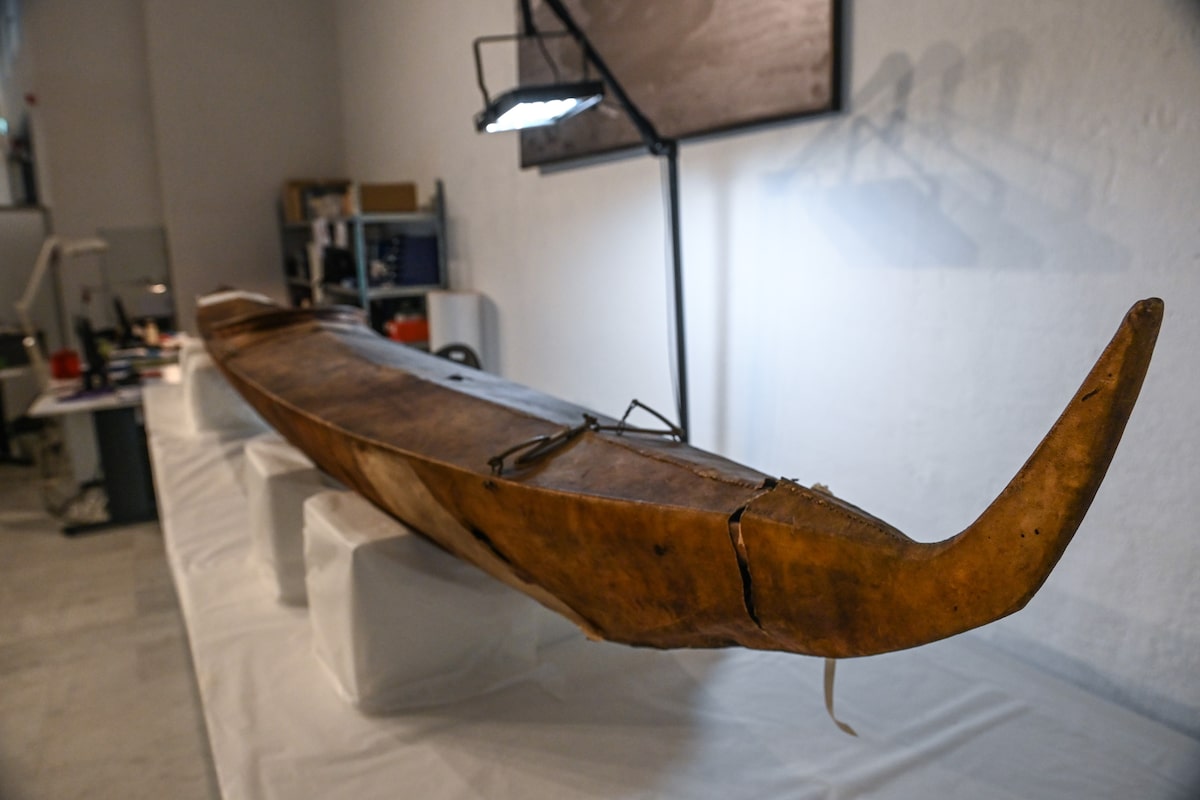
The release of the objects, including a rare Western Arctic sealskin kayak, came after a meeting Saturday between Pope Leo and senior representatives of the Canadian Conference of Catholic Bishops.Chris Warde-Jones/The Globe and Mail
Pope Leo XIV formally handed possession of an historic collection of Indigenous objects held by the Vatican Museums for a century to representatives of the Catholic Church in Canada, which will return them to Indigenous groups across the country.
The objects include a rare Western Arctic sealskin kayak, the highest-profile item among the hundreds that were put on display in the Vatican in 2025 during a missionary exhibit.
For several years, the Métis National Council, the Assembly of First Nations and the Inuit Tapiriit Kanatami have been putting pressure on the Vatican to repatriate the objects as part of the residential schools reconciliation process.
The release of the objects came after a meeting Saturday morning Rome time between Pope Leo and senior representatives of the Canadian Conference of Catholic Bishops, including Pierre Goudreault, Bishop of Sainte-Anne-de-la-Pocatière and CCCB president.
“During the audience, the Supreme Pontiff gifted to the CCCB sixty-two artefacts belonging to the ethnological collections of the Vatican Museums,” the Holy See press office said in a statement.
“… His Holiness Pope Leo XIV desires that this gift represent a concrete sign of dialogue, respect and fraternity. This is an act of ecclesial sharing, with which the Successor of Peter entrusts to the Church in Canada these artefacts, which bear witness to the history of the encounter between faith and the cultures of the indigenous peoples.”
The Pope supports restitution of Indigenous items to Canada. So why haven’t they come home?
The objects, many of them highly delicate, will be carefully packaged before their journey to Canada in early December. After reaching Montreal, they will be taken to the Canadian Museum of History in Gatineau, Que. The museum’s curators will examine and catalogue the objects before they are delivered to Indigenous groups across the country.
“This is historic, something Indigenous communities have been asking for,” said Joyce Napier, Canadian ambassador to the Holy See. “A big part of the mandate of the Canadian embassy to the Holy See, when I took on this job, was to advance reconciliation with Indigenous peoples. It was a priority for the government. Today’s announcement is a significant step towards reconciliation.”
In November, 2021, The Globe’s Eric Reguly toured the Vatican Museums’ collection to learn more about where the ‘Pope’s Kayak’ and other Indigenous artifacts came from. (Video from December, 2021)
The Globe and Mail
The Holy See statement did not identify the objects destined for Canada, though the Canadian embassy to the Holy See confirmed that the kayak was among them.
It was not immediately known whether another high-profile object, the 229-centimetre Wampum Belt, which the Vatican Museums’ catalogue books say was “donated” to Pope Gregory XVI in 1931, was among the objects to be returned. The 200-year-old beaded belt, made from shells, is from Kanesatake, Que., and briefly appeared at a Montreal museum in 2023.
The kayak and some 200 other Indigenous items have rarely been seen since they first appeared at the Vatican’s missionary exposition in 1925. Pope Pius XI asked missionaries from Australia to Zambia to collect religious and non-religious artifacts made by Indigenous peoples and send them to Rome. More than 100,000 pieces arrived.
The return of the kayak and other objects marks a long-delayed victory for the Métis, Inuit and First Nations associations. While the Vatican has always been open about the collection from Canada, the Indigenous groups appeared largely unaware of it until a 2021 Globe and Mail article about their existence. Since then, they have put pressure on the Vatican and Pope Francis, who died in April, for their return.
In 2023, Pope Francis, who visited Canada the year before to apologize for the Catholic Church’s role in residential schools, agreed on the importance of the objects’ return. “The restitution of Indigenous things: This is going on, with Canada, at least we were in agreement to do so,” he told reporters who were travelling with him on a papal visit.
A year later, then-Prime Minister Justin Trudeau met with Pope Francis during the G7 meeting in Italy and urged him to follow through on his vow to return Indigenous objects to Canada. On social media, Mr. Trudeau said: “I thanked His Holiness for visiting Canada in 2022 to meet Indigenous Peoples on their ancestral lands and for taking up the work of Reconciliation. I also advocated for the next step in this work — returning cultural artefacts from the Vatican to Indigenous Peoples in Canada.”
Former foreign affairs minister Mélanie Joly, now Industry Minister, also lobbied for the artifacts’ return when she met with Vatican Secretary of State Pietro Parolin in April, 2024.