
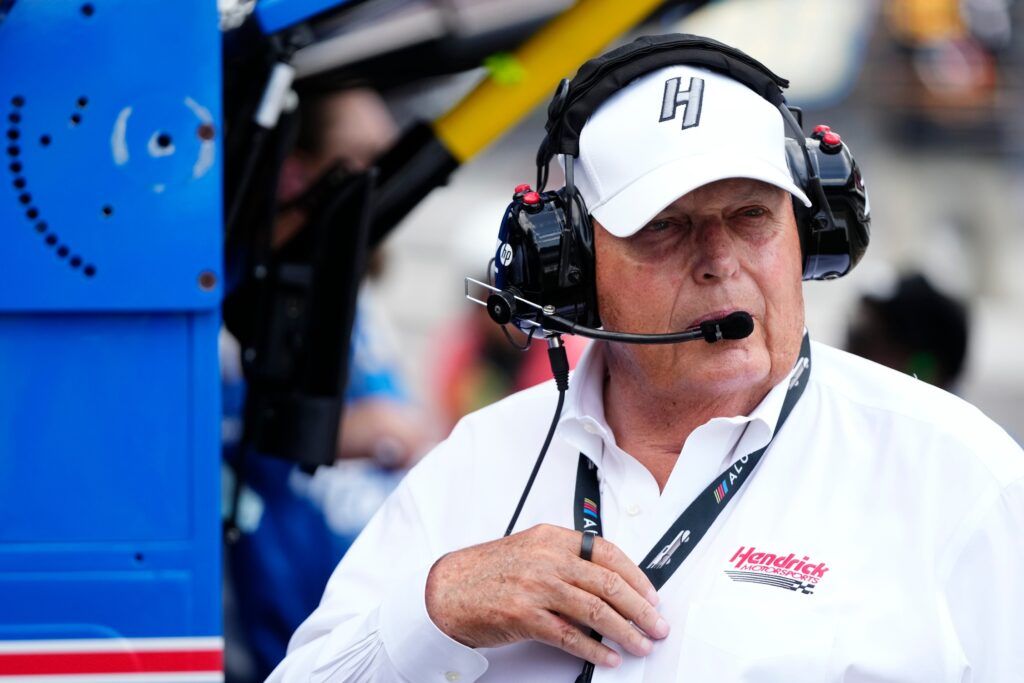
As the NASCAR vs. 23XI Racing/Front Row Motorsports legal showdown barrels toward its high-stakes Dec. 1 trial date, the tensions only continue to escalate. The latest twist? Cup Series teams are now urging the court to block testimony from one of the sport’s most powerful figures, Hendrick Motorsports boss Rick Hendrick.
NASCAR fired back immediately, pushing against the bid despite Judge Kenneth D. Bell’s ruling on Tuesday that the teams can depose both Hendrick and Roger Penske without the restrictions the sanctioning body had sought. This sets the stage for another explosive courtroom clash, one that could forever reshape the sport’s future.
Teams Move To Block Rick Hendrick’s Testimony As NASCAR Fights Back
NASCAR itself pulled Mr. H and Mr. Penske into the lawsuit early on, submitting written declarations from both team owners to reinforce the sanctioning body’s stance on preserving the charter system. In their filings, the two industry heavyweights testified that the current structure remains essential to the sport.
Hendrick, in particular, emphasized that charters have given teams guaranteed access to every Cup Series event, creating financial stability and a clearer business roadmap. He explained that this security has strengthened operations at HMS in multiple ways, particularly in attracting and retaining sponsors, a vital lifeline for any NASCAR organization.
The lawsuit filed in October 2024 centers on NASCAR’s charter system, which 23XI and FRM argue is being used to stifle competition and maintain a monopoly over the sport. Refusing to sign the new charter agreement, the teams accused NASCAR of abusing its power.
The organization then put two of the sport’s most prominent power players, Hendrick and Roger Penske, on its witness list. Seeing the significance, 23XI and FRM immediately sought full, unrestricted depositions, saying both owners hold crucial knowledge about revenue distribution and the true inner workings of charter negotiations.
But Hendrick and Penske quickly pushed back, filing motions to limit what they can be asked, request remote testimony, or delay their appearance until the trial. NASCAR backed them, insisting that questioning should be restricted to the general themes already covered in their earlier statements.
Now, firing back at the teams’ attempt to limit Hendrick’s testimony, NASCAR’s attorneys pushed back hard. They argued there was no valid reason to bar or restrict the HMS owner, noting:
“Mr. Hendrick is scheduled to testify in NASCAR’s case, which likely will not begin until the week of Dec. 8. And NASCAR can further accommodate Plaintiffs by calling him later in NASCAR’s case. Thus, even after trial begins on Dec. 1, Plaintiffs will have numerous days to secure Mr. Hendrick’s deposition, including two non-trial days on Dec. 6 and 7.”
Note that the organization put Hendrick and Penske on its witness list at the request of chairman Jim France, who is himself a defendant in the 23XI and Front Row lawsuit. However, the two teams fired back, accusing NASCAR of “sandbagging” the process by adding the powerhouse owners only a month before trial, after the window for fact discovery had already closed.
According to Matt Weaver’s reporting for Motorsport.com, NASCAR’s attorneys rallied back even harder in their filing, stating:
“Mr. Hendrick’s counsel diligently alerted the Court to the possibility of the deposition needing to occur on December 1 or later, but noted that the situation is in flux, and other members of the law firm representing Mr. Hendrick are available to assist.”
“Additionally, Mr. Hendrick’s counsel has provided numerous options to accommodate the deposition, including the possibility of a virtual deposition. Plaintiffs, however, have refused such accommodation and insisted on the take-it-or-leave-it Tuesday, November 18 deposition.”
In essence, the battle over Hendrick’s testimony underscores just how high the stakes have become. As one of the sport’s most influential power brokers and a longtime ally of the France family, his words could tip the scales dramatically. That’s why securing (or limiting) his deposition has become one of the most pivotal flashpoints in a lawsuit that could reshape NASCAR’s entire competitive landscape.