
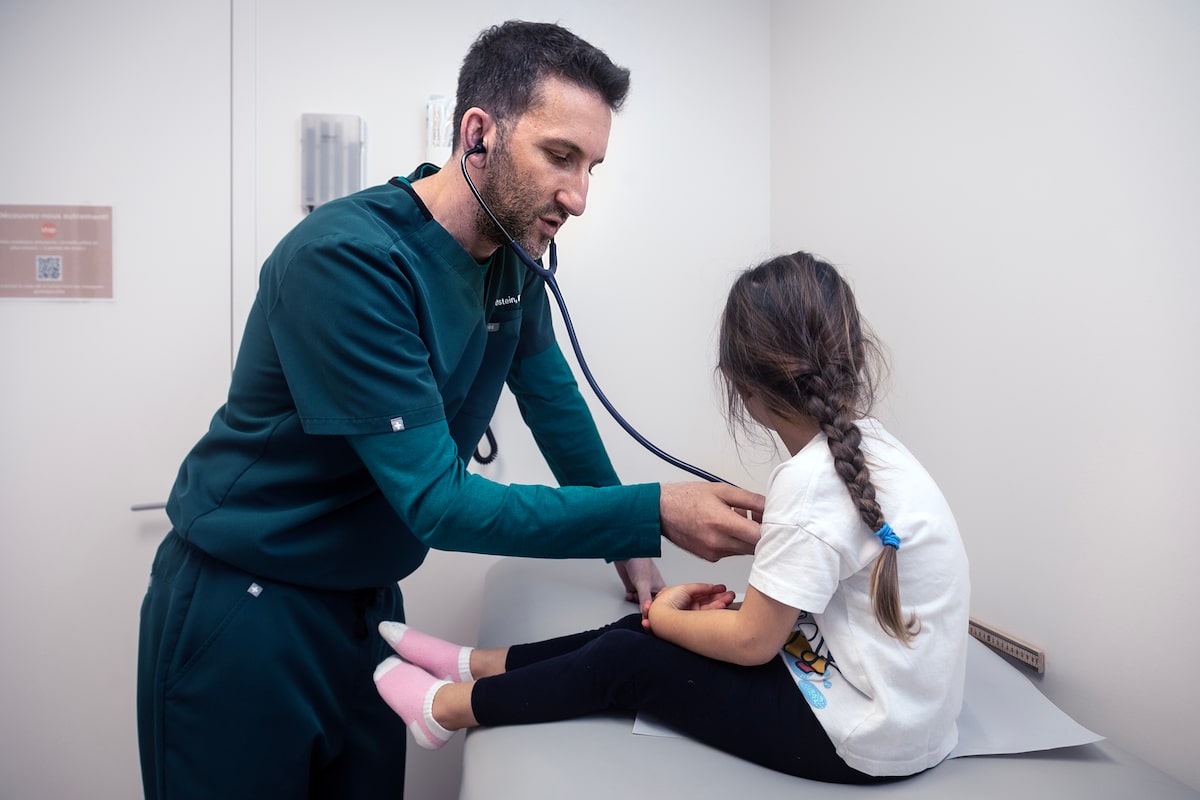
Dr. David Rothstein, a Montreal family doctor who mainly sees pediatric patients, says Bill 2’s changes could cause clinics to fail, drive GPs from Quebec and lead babies to miss important checkups.ROGER LEMOYNE/The Globe and Mail
Quebec pediatricians are warning that a new law on physician pay will reduce children’s access to health care by making it more difficult for doctors to see young patients, part of a bruising standoff with the government that has seen hundreds of medical professionals apply to work outside the province and thousands demonstrating against the legislation.
Bill 2, as it’s known, moves Quebec from a largely fee-for-service model to a system known as capitation, where general practitioner pay is linked to how many patients they enroll. The government’s stated goal is to get every Quebecker a family doctor, up from one of the lowest rates of primary-care coverage in Canada. The bill was passed on Oct. 25 and is scheduled to go into effect in January.
But in its haste to pass the reform – including using the parliamentary tactic known as closure to bring it to a vote – physicians argue that government has included a potentially disastrous loophole: healthy children, even newborns, have been classified as among the least vulnerable patients, bumping them down the priority list for care and remunerating doctors relatively little for taking them on.
That could cause clinics to fail, drive GPs from the province and lead babies to miss crucial checkups, said David Rothstein, a family doctor who mainly sees pediatric patients and co-owner of the Clinique Médicale Step in the Montreal suburb of Côte Saint-Luc.
André Picard: Quebec cracks down on doctors – but will imposing a contract improve patient care?
“They neglected the pediatric population, children, entirely,” he said. “They’ve told Quebeckers that kids aren’t important.”
The Health Ministry counters that in determining vulnerability levels it depended on the methodology of the non-profit Canadian Institute for Health Information. A sick child, with chronic asthma, for example, could be considered higher risk, ministry spokesperson Marie-Claude Lacasse said in a statement.
But medical associations from outside the province have raised the alarm as well. An open letter by the heads of the Pediatric Chairs of Canada and the Canadian Paediatric Society said Bill 2 could turn children’s lives into “collateral damage” and pose a “severe threat” to the health of Quebeckers.
The rest of the country may also be affected by the law if it causes an exodus of doctors from Quebec. About 290 physicians from the province applied to work in Ontario between Oct. 23 and Nov. 13 alone, according to the College of Physicians and Surgeons of Ontario; another 90 have applied for a medical licence in New Brunswick since September, its college said. About half of the total 380 are family physicians.
On the ground in Quebec, the anxiety among front-line medical practitioners is acute, said Dr. Rothstein. He thinks his clinic will be forced to shutter if the law remains unchanged, leaving 21,000 patients – 90 per cent of them children – without a doctor.
At issue is the province’s new pay model under Bill 2. Family doctors will now receive a flat rate for every patient they enroll, with the amount ranging from about $9 to $160 a year, depending on how “vulnerable” the patient is judged to be by government guidelines.
The law classifies healthy children in the lowest risk level, even newborns. That is a serious mistake, given how important it is to monitor kids’ health and development, said Dr. Rothstein, who also teaches family medicine at McGill University. Other provinces that use a capitation model, such as Ontario and B.C., classify children as being more vulnerable, he added. At $9 per pediatric patient, it will be hard for his clinic to “keep the lights on.”
The showdown between physicians and the government continues to escalate, with more than 10,000 protestors packing the Bell Centre in downtown Montreal last Sunday, and Premier François Legault chiding them for having “fun” at the home of the Montreal Canadiens instead of returning to the negotiating table.
Konrad Yakabuski: François Legault’s battle with Quebec doctors could be his last fight
The Legault government has already seen one resignation over the law, when social services minister and trained neurologist Lionel Carmant stepped down from caucus after being unable to convince his wife and daughter, also doctors, of the bill’s virtues.
Embattled Health Minister Christian Dubé has said he will not amend the law but vowed not to enforce certain controversial provisions related to surveillance of doctors’ work habits, a move perceived as an olive branch to physicians.
Marie-Joëlle Doré-Bergeron, a pediatrician at Montreal’s Sainte-Justine hospital and a professor at the University of Montreal, said the provisions of the law related to children’s health need an overhaul.
As doctors are required to take on more nominally vulnerable patients, many babies born in 2026 likely won’t have a checkup for the first year or two of their lives, she said. She says she believes that will have a serious impact on the health of children in Quebec.
“Things like developmental delays or an inability to gain the right amount of weight, that will be missed.”