
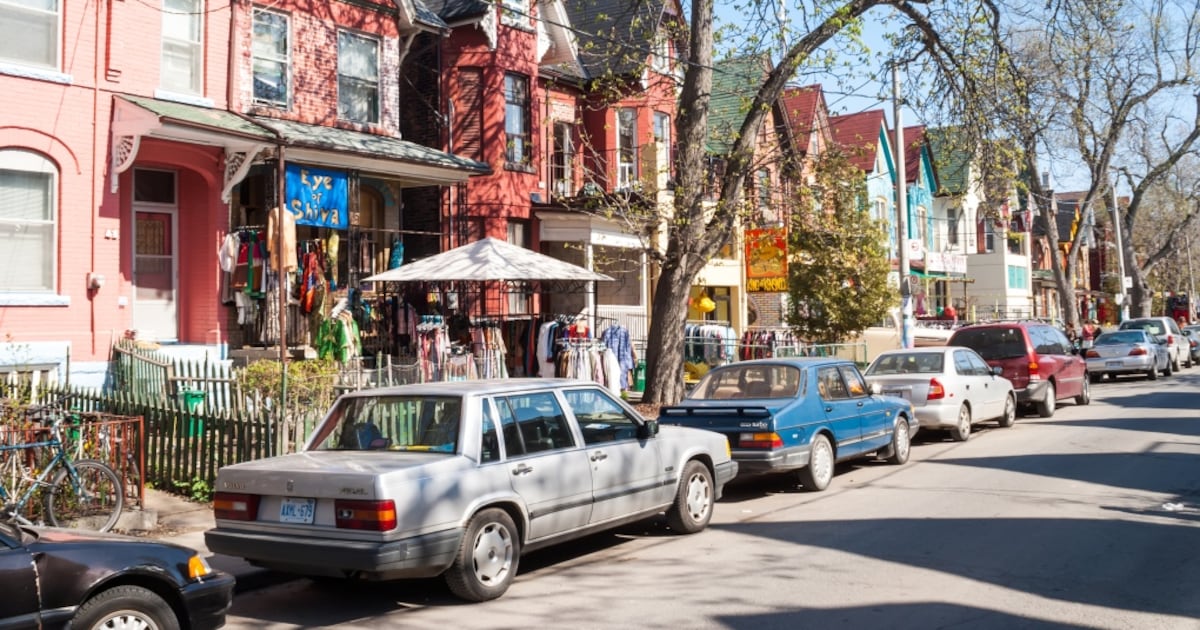
Cafes and corner stores can once again pop up in a handful of Toronto’s neighbourhoods, after council voted overwhelmingly in favour of their operation on Thursday.
Whether more kinds of businesses should be allowed within residential areas throughout Toronto created a powder keg debate in recent weeks, reaching a boiling point during the last planning and housing committee meeting in October, when one Beaconsfield Village Residents Association member voiced concerns.
Pointing to Pizzeria Badiali as a proverbial stick of dynamite, she used it as an example of how it would adversely impact local residents, as patrons of the pizzeria leave litter and long lines in its wake after the restaurant exploded to international acclaim.
“I suppose different people have different thresholds of what constitutes a problem in their neighbourhood,” Gord Perks, councillor of Parkdale-High Park and chair of Toronto’s Planning and Housing Committee, said in an interview Thursday afternoon.
“I would say, just as a person who lives in the neighbourhood, that it’s the traffic on Dovercourt that is the problem, not the people going to pick up a slice of pizza. It’s an order of magnitude different impacts.”
During a council meeting on Thursday, with a 23-2 vote, restaurant-style kitchens were not considered in the approved permissions for these residential areas. The shops that can now sell food can only do so if it has been cooked and prepared off-site and preparing espresso-made beverages like lattes and cappuccinos would also be allowed, paving the way for cafes to open.
There are eight wards that will now allow these kinds of businesses in their residential neighbourhoods: Davenport, Parkdale-High Park, Spadina-Fort York, Toronto-Danforth, Toronto-Centre, Toronto-St. Paul’s, University-Rosedale and Beaches-East York.
These businesses also need to meet certain criteria in order to be approved, like being on a corner lot on a community street, abutting a park or public school that faces the same street, and being commercially zoned.
Council also voted in favour of allowing more kinds of businesses on major streets — though this will not be seen all across the city, as some councillors want to keep residential areas that way. The city defines major streets as roads that may already have high traffic and are zoned for residential buildings.
“Some people are saying, ‘Oh, this is an urban, suburban divide.’ That’s just nonsense,” Perks said, adding that what was passed in council Thursday will expand permissions throughout the city.
“There aren’t two Torontos, there are 200 Torontos, and what we are doing with this is trying to create access in all 200 Torontos.”
These types of neighbourhood shops are ‘as old as Toronto’
Matti Siemiatycki, director of the University of Toronto’s Infrastructure Institute, said it is likely to see an older mom-and-pop shop on a residential street as “that’s how Toronto was built.”
“I mean, these types of neighbourhood shops, they’re actually as old as Toronto,” Siemiatycki said.
So, why were new ones barred from setting up shop on a residential street? Siemiatycki says the answer is two-fold: economics and zoning rules.
Economically speaking, Siemiatycki says they didn’t generate as large of a consumer base as they served a hyper-local community and the dominance of big-box stores impacted local retail.
“Then the zoning in many parts of our city just made it illegal to have these types of shops,” Siemiatycki said. “So, the neighbourhoods grew up without them and people got used to not having those types of stores, and in many cases, both didn’t know what they were missing.”
While Perks said there has been three camps of views for this study — one who wanted dramatic expansion of retail permissions, a coalition of some residents associations against retail permissions, and the third an “overwhelming majority of Torontonians who just sort of are shrugging and getting on with their daily lives” — a founding director of the Centre for Urban Research and Land Development at Toronto Metropolitan University says there’s only two sides to this.
“If you’re looking at intensification, there’s a need for a greater kind of community and service retail in areas and having it within these densified areas does make a lot of sense,” David Amborski said. “It also creates a complete community because they have all the facilities within very close proximity and walking distance.”
On the other side of that coin, Amborski said, are those who are concerned about the impact on their property values as well as the implementation and scale of these new facilities.
“You want to make sure that they truly are community benefit kind of services,” Amborski said. Though based on what Amborski saw in the study, he says it appears city planners are implementing regulations to “safeguard the community” by mitigating the negative impacts.
The City of Toronto is anticipating at least 700,000 new Torontonians to move to the city by 2051, and the implementation of these neighbourhood shops is just one of the ways the city is looking to support the daily needs of all residents, current and prospective.
“I think we’re at a point where we’ve become a big, busy city, and it’s a city in transition,” Siemiatycki said. “We’re trying to decide which way we’re going to go. Are we going to become more urban and more lively and more vibrant, and have these mixing of uses, or is it going to continue to have some of the aspects of its more suburban history?”
What kind of Toronto would you rather see? Share your thoughts by emailing us at torontonews@bellmedia.ca with your name, general location and phone number in case we want to follow up. Your comments may be used in a future story.