
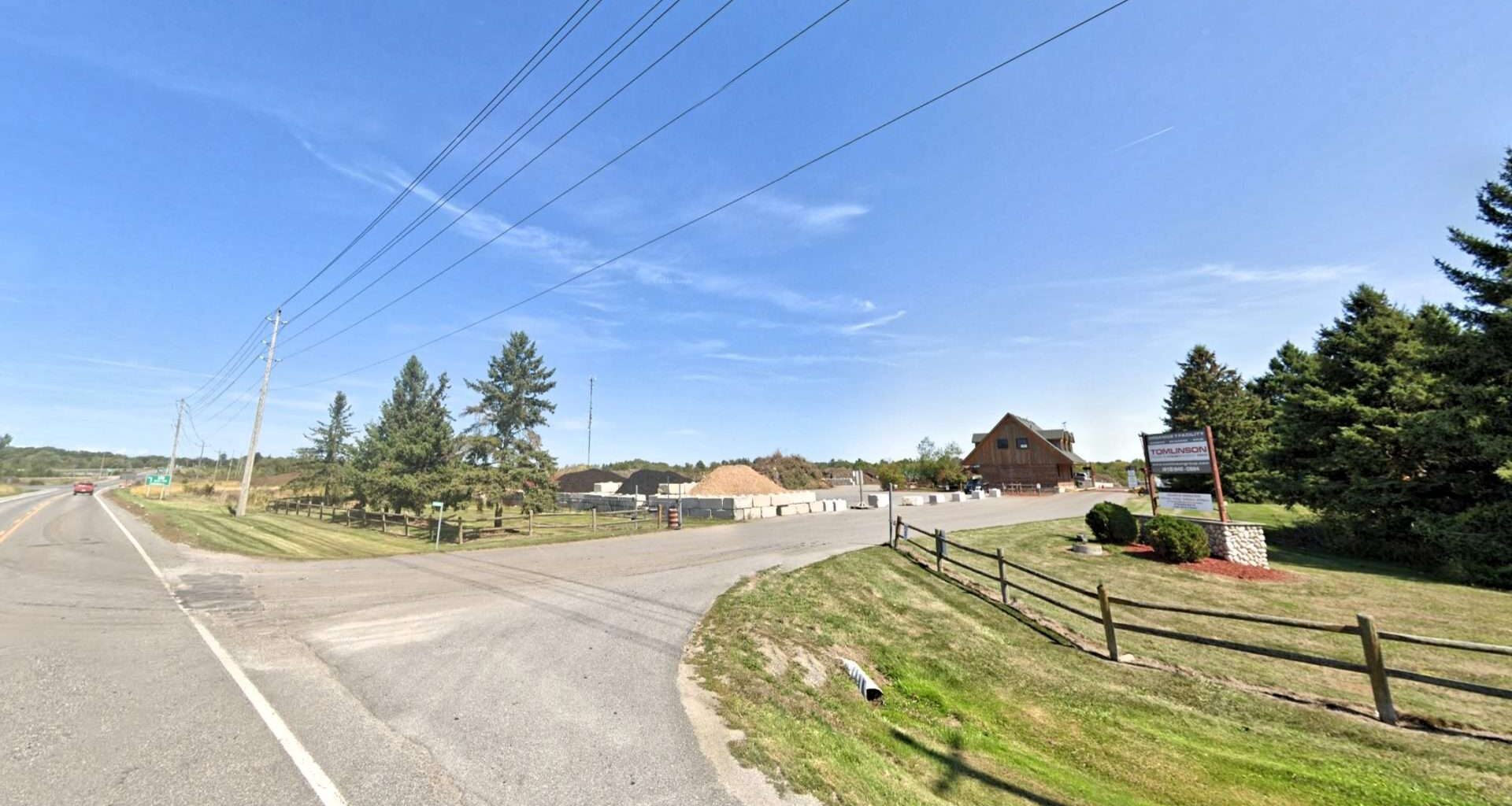
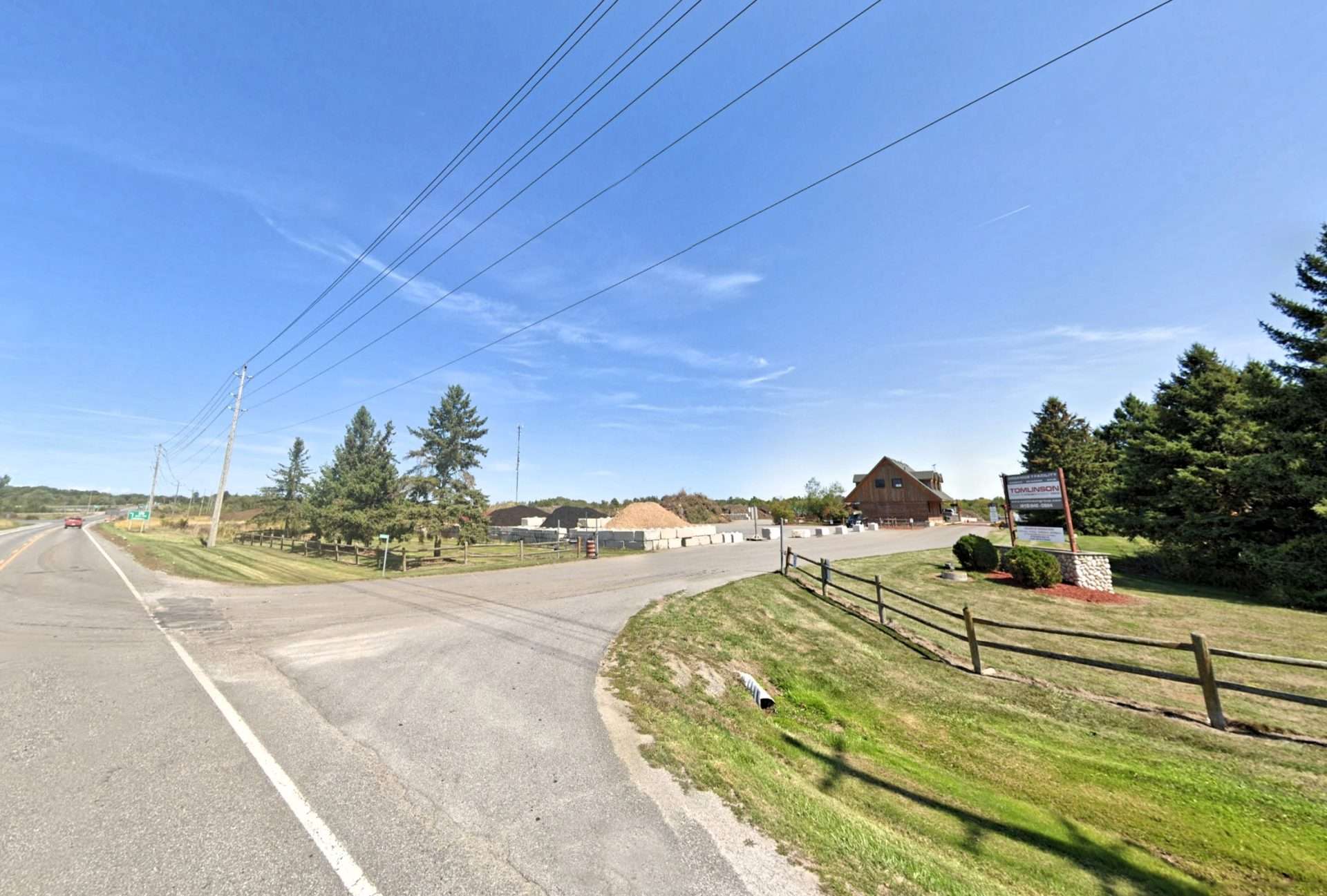
 The vacant property just north of Tomlinson Organics on Joyceville Road could be the location of a waste transfer and biogas facility operated by Tomlinson. Photo via google Maps.
Your kitchen scraps could soon be used to power vehicles.
An Ottawa-based environmental service company is proposing to build a sprawling complex to incorporate a waste recycling and transfer facility and a renewable energy plant on 16.4 hectares (40 acres) of vacant land across from the Husky truck stop at Joyceville Road and Highway 401.
But the so-called clean energy project generated its own environmental concerns, including the potential impact on nearby marshlands, source water contamination, odours, and truck traffic.
Tomlinson Environmental Services Limited addressed those and other concerns that were raised at a public meeting on Thursday, Nov. 6, 2025, hosted by the City of Kingston’s Planning Committee.
“This will not be a dump site. It’s a transfer site,” stated Vince Deschamps of MHBC Planning, the consultant hired by Tomlinson, which is seeking Official Plan and municipal Zoning Bylaw amendments to permit the facility at 2081 Joyceville Road.
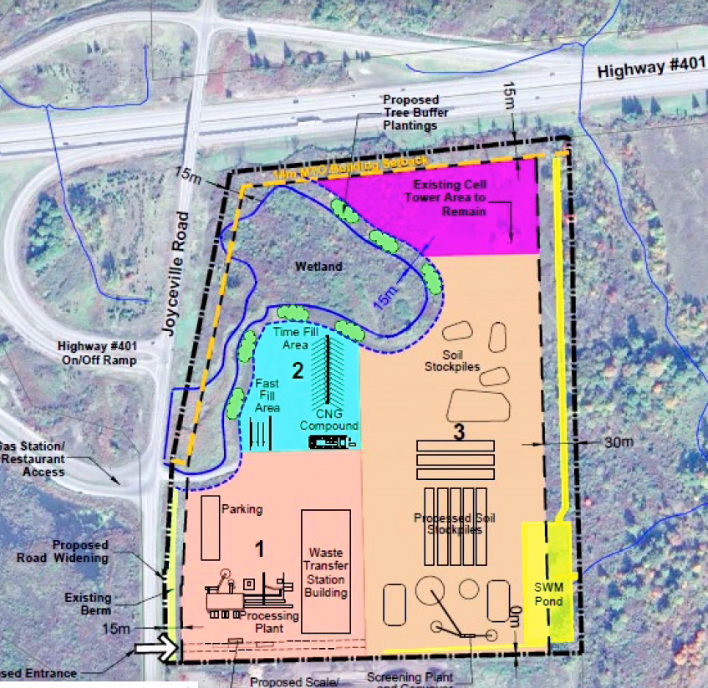 Waste Transfer Station conceptual site plan. Image via Tomlinson Environmental Services Limited.
Tomlinson already owns a large organics storage and processing facility, with a contract to take the City of Kingston’s green bin waste, which is adjacent to the proposed waste transfer and biogas facility.
Company officials said they intend to send the food waste next door to the proposed new facility and then feed the material into anaerobic digesters — a system that breaks down organics in the absence of oxygen — to produce clean natural gas that will be used to fuel Tomlinson’s own fleet of vehicles, instead of diesel.
The facility would also accept soil and construction waste to produce renewable energy.
The project sounds similar to what Utilities Kingston had proposed, and later rejected late last year, to construct its own biogas facility.
However, key differences are that Tomlinson’s waste recovery plant is on a smaller scale, and it won’t accept sewage sludge from any sources to create natural gas.
“There are no bio-solids coming to this facility,” Lee Timmins, Tomlinson’s General Manager of Environmental Services, told the committee meeting.
Members of the public also raised questions about the industrial facility’s potential impact on groundwater and a nearby wetland.
Sandra Diaz, with the Friends of Butternut Creek local conservation group, questioned a proposed buffer zone between the facility and a nearby wetland that occupies part of the property.
“This is going to be an industrial waste site. I don’t think 15 metres is appropriate at all,” Diaz said.
Tomlinson officials said the facility’s layout has been moved away from a wetland, situated on the northwest corner of the site, to include a 15-metre setback from the industrial operation along with a berm to protect against any contamination, while a ditch and storm water pond will be located on the property’s eastern flank to capture runoff.
They said the site changes were made following initial concerns that were raised at a public meeting in July 2024.
Kingston resident and former City Councillor Vicki Schmolka questioned the wisdom of the City’s municipal environmental policies that would allow a facility that produces methane gas.
However, company officials stressed that the material that will be used to create biogas, or methane gas, essentially comes from decaying food waste, and that this form of renewable natural gas is actually cleaner than electricity.
“The idea is this facility would fuel our own vehicles. It potentially could fuel a third party but it would not be like a public fuelling station,” Timmins explained.
 Lee Timmins, Tomlinson’s General Manager of Environmental Services. Screen captured image.
He said the organics facility that Tomlinson already operates next door would be harnessed to create biogas, and that the site would not take contaminated soils or sludge.
“That (organics) site is currently a compost facility, so you’re using the food waste from the City of Kingston to create a renewable energy source that’s going back into your vehicles.”
He said the facility’s goal is to keep waste products out of landfills and “do something better with them.”
But it will lead to increased traffic along Joyceville Road.
Tomlinson’s own studies indicate up to 74 trucks a day will arrive at the proposed waste transfer station, with up to 16 trucks an hour during peak times.
The trucks will carry additional non-hazardous waste and organics from other places around the region that will be part of the biogas process.
“Nothing is being discharged to the natural environment,” stated Nick Mariani, an Environmental Project Coordinator with Tomlinson.
The project received a generally positive response from members of the committee, though some had questions about how big the facility could grow in the future, what happens if Tomlinson ever loses the City’s competitive contract to accept household organics, the potential loss of over 150 trees for accommodate the facility, and the resulting loss of available bio-rich fertilizer for public purchase (though leaf and yard waste compost would still be available).
Tomlinson operates a similar waste transfer facility in Ottawa, accepting a broader range of materials, and hailed its proposed Joyceville Road organics plant as a way to reduce landfill waste.
“It is a lot easier to bury all this stuff in the ground than it is to recover the resources out of it. The purpose of this facility is to get as much out of the landfill as possible,” Mariani stated.
City planners said they have not yet formulated any recommendations on the Official Plan and Zoning Bylaw request. However, they said they would take the public and political feedback into consideration to craft specific and permitted uses as part of a final staff recommendation on Tomlinson’s application, expected at a future meeting of the Planning Committee. City officials said the proposed waste transfer/recycling and biogas facility is subject to approvals from three regulatory bodies: the City of Kingston, Cataraqui Region Conservation Authority, and Ontario’s Ministry of the Environment, Conservation and Parks.
The agenda for the meeting, as well as full video footage of it, can be viewed on the City of Kingston’s website.