
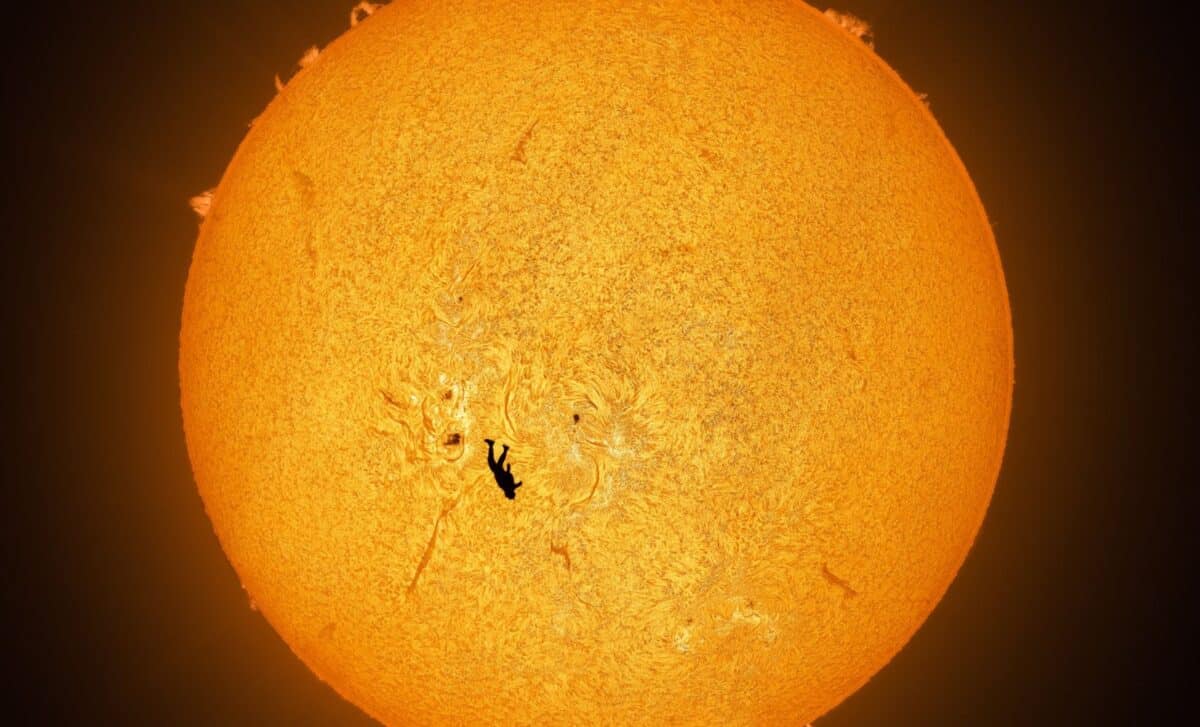
A skydiver has been captured mid-fall, suspended in stark silhouette against the fiery surface of the Sun. The image, titled The Fall of Icarus, is the result of an ambitious collaboration between astrophotographer Andrew McCarthy and skydiver Gabriel C. Brown, and it is entirely real. The full story behind the shot was first reported by the science news outlet IFLScience.
This visually arresting feat has turned heads not just in the astrophotography community but across the wider public. The photo was taken using a hydrogen-alpha filter, revealing the churning solar surface and sunspots, with Brown’s figure falling cleanly through the frame.
Six Attempts, One Perfect Silhouette
Getting the shot wasn’t easy. It took six separate jumps before McCarthy could finally capture Brown framed neatly between active sunspots on the Sun’s surface. In an interview with IFLScience, Andrew McCarthy explained that he coordinated the shoot using multiple cameras and a live three-way call between himself, the paramotor pilot, and Gabriel C. Brown.
The technique was simple in concept but demanding in execution. The pilot had to watch his shadow as the aircraft climbed, then glide through the correct trajectory while McCarthy directed positioning from the ground. Only when the silhouette lined up did he give the command to jump. “This was quite tricky,” emphasizing how tight the coordination needed to be.
“It was a narrow field of view, so it took several attempts to line up the shot,” he added. “We only had one shot at the jump, as repacking the parachute safely would take too long for another.”
The margin for error became obvious during the first five attempts, which were plagued by malfunctions, as Brown later explained on an Instagram post. Still, the team recalibrated each step until all three were perfectly synchronized.
“You can see the excitement on my face in the videos,” McCarthy told Live Science. “Seeing it perfectly captured on my monitors was exhilarating.”
The Science Behind the Image
The photograph was taken through a hydrogen-alpha filter, which isolates a very specific wavelength of light. This allows astrophotographers to capture the turbulent hydrogen layer just above the Sun’s surface, including solar prominences and sunspots, which appear as darker, cooler patches.
This filter is commonly used in solar imaging, but rarely does it serve as the background for a falling human. The Sun’s surface in the image isn’t just decorative, it’s detailed enough to reveal the star’s granular texture, which makes Brown’s silhouette even more striking. Sunspots, visible in the image, are active regions caused by intense magnetic activity.
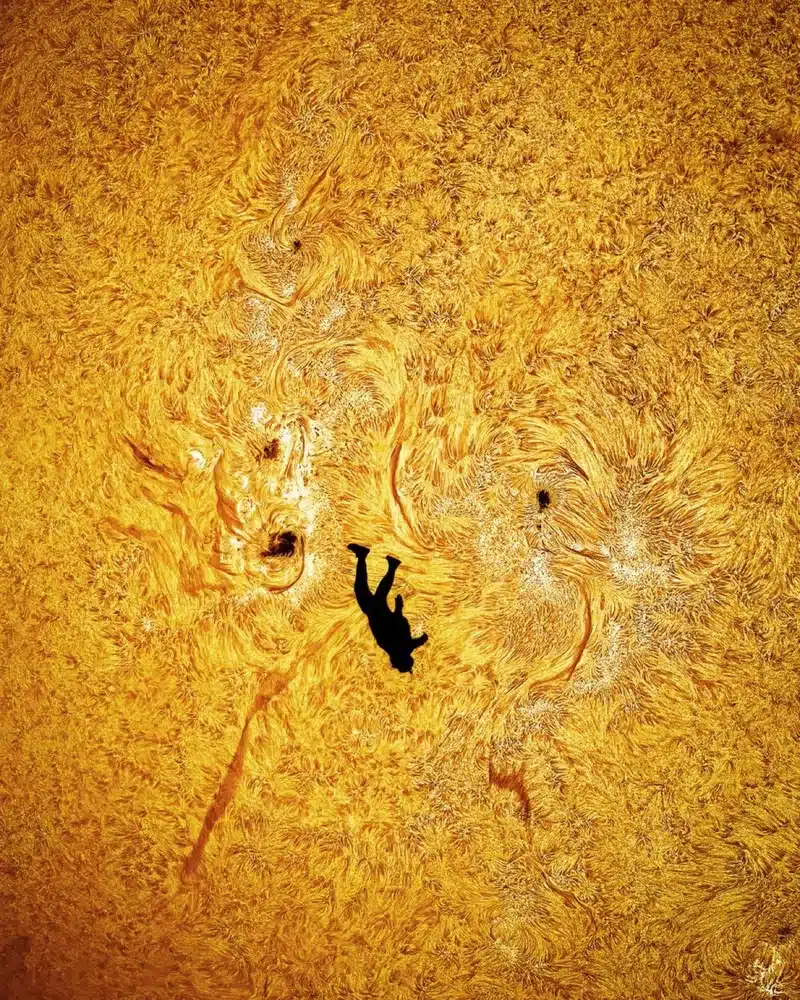 A close-up version of The Fall of Icarus. Credit: Andrew McCarthy
Setting New Standards in Astrophotography
The success of The Fall of Icarus may mark a turning point for creative astrophotography. While the field has long been known for technically precise and visually stunning representations of the night sky, this image introduces a human element in a way that’s both dramatic and thought-provoking.
According to McCarthy, the idea developed gradually after he and Brown discussed combining their respective skills. Instead of imagining astrophotography as static observation, they treated it as a stage for performance.
“Gabe and I met up to skydive a few months ago, and afterwards we had breakfast and were talking about how we could incorporate skydiving into astrophotography,” he said.
The image has since gained wide attention and is available in limited edition prints on McCarthy’s website.