
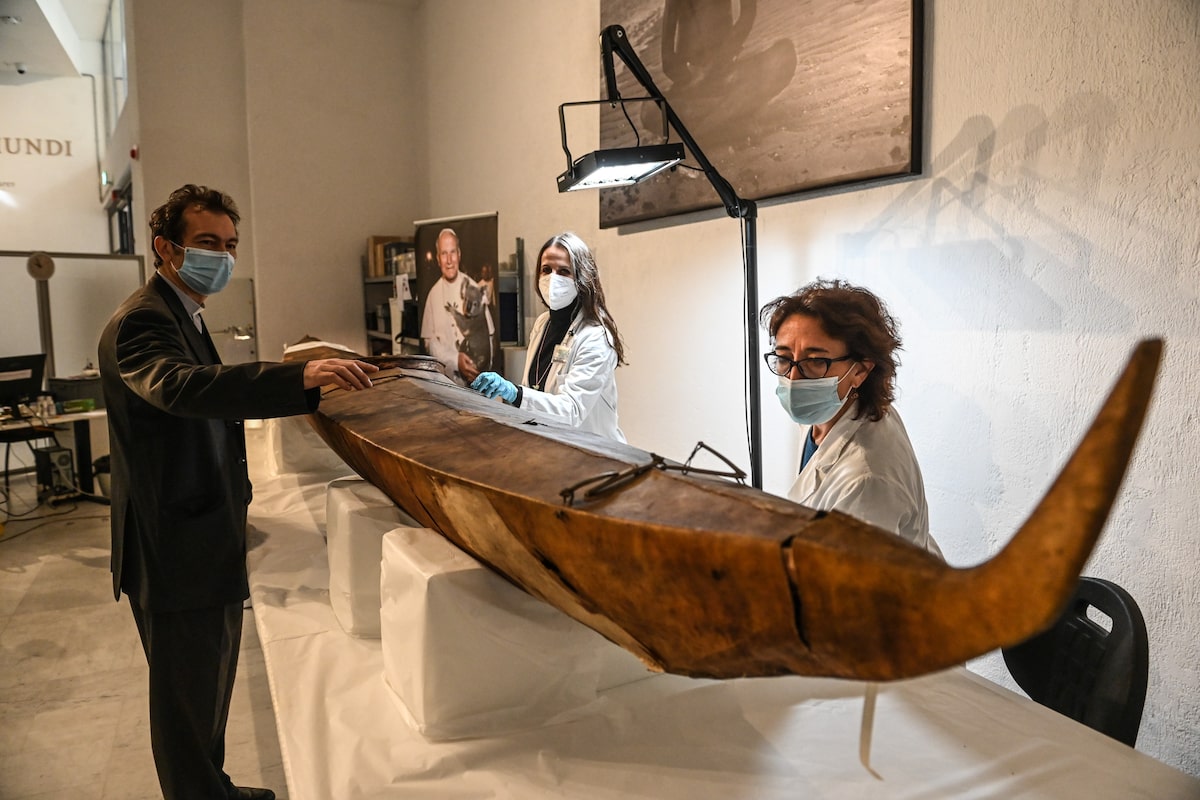
Father Nicola Mapelli, left, director of Anima Mundi, the Vatican’s ethnological museum, inspects an Inuit kayak with art restorers in November, 2021.Chris Warde-Jones/The Globe and Mail
A valuable collection of Indigenous objects will return to Canada in December after a long campaign to secure their release from the Vatican Museums, beginning the complicated, culturally sensitive process of restoring them to their original stewards.
On Saturday morning, in what the Vatican called an “ecclesial sharing,” Pope Leo XIV formally handed over 62 objects, including a rare Western Arctic sealskin kayak, to senior representatives of the Canadian Conference of Catholic Bishops, who will oversee the cross-Atlantic delivery.
“This is a long time coming,” said Cody Groat, an assistant professor in the Department of History and Indigenous Studies at Western University. “Now it is important to make sure communities have a clear say in what happens to them.”
The objects, many of them extremely delicate, were among hundreds displayed in the Vatican during a 1925 missionary exhibit and rarely seen since.
They now begin a circuitous journey – first to Montreal, then to the Canadian Museum of History, in Gatineau, to be examined and catalogued, before being delivered to Indigenous communities across the country.
Pope Leo formally returns Indigenous objects held by the Vatican Museums to Canada
But those final resting places may not include climate-controlled glass cases to preserve the objects in stasis for another 100 years, said Dr. Groat, who is Kanyen’kehaka and a band member of the Six Nations of the Grand River.
Dr. Groat explained that for many communities, the returning items are viewed as ancestors, imbued with a life and history of their own. In certain cases, a Western approach to preservation may not be desired, he said. Instead, some communities may prefer to allow their artifacts to age and decay naturally.
“It will be essential for these to be recognized as ancestors instead of artifacts,” he said. “Taking that approach from the moment of their arrival will shift our interpretation of their overall significance.”
The Canadian embassy to the Holy See confirmed that the highly treasured kayak was one of the objects returning home.
But the Vatican has not specified what other items were included in the Pope’s hand-over. It was not immediately clear whether another high-profile object, a 200-year-old, beaded wampum belt from Kanesatake, Que., is included. The Vatican Museums’ catalogue books say the belt was “donated” to Pope Gregory XVI in 1931. It briefly appeared at a Montreal museum in 2023.
Indigenous artifacts at Vatican Museums heading back to Canada after repatriation campaign
The Vatican’s action – called “historic” by Canada’s Holy See ambassador Joyce Napier – marks a long-delayed victory for Métis, Inuit and First Nations associations. They have pushed the Vatican for several years to repatriate the objects as part of the reconciliation process for the abuse and cultural devastation suffered at church-run residential schools in Canada.
“His Holiness Pope Leo XIV desires that this gift represent a concrete sign of dialogue, respect and fraternity,” the Holy See press office said in a statement. Entrusting the items to the Church in Canada is an “act of ecclesial sharing,” the statement explained, which bears “witness to the history of the encounter between faith and the cultures of the Indigenous peoples.”
While the move is meaningful, Dr. Groat suggested that these words and the action behind them have been carefully scripted to maintain control of the flood of repatriation requests that could now come from Indigenous communities around the world.
A clear return process is required, he acknowledged, because many of the objects held in Rome are poorly labelled, leaving their origins currently unclear.
But he pointed out that “ecclesial sharing” makes the returns a more controlled church-to-church exchange, rather than a process of dealing directly with Indigenous communities.
Indigenous groups eager to see Pope Leo XIV continue reconciliation work
And he noted Pope Leo’s intentional use of the word “gift” – both to describe how the church came into possession of the objects, and how the Vatican is now returning them – language that deflects from the coercive power the church held over Indigenous peoples in Canada.
“The Vatican is aware that the global Indigenous people and other groups will be watching what’s happening here in Canada,” he said.
The Vatican has always been open about the collection from Canada. Since a 2021 Globe and Mail article about its existence, Indigenous groups have put pressure on the Vatican and Pope Francis, who died in April, for their return.
In 2023, Pope Francis, who visited Canada the year before to apologize for the Catholic Church’s role in residential schools, agreed on the importance of the objects’ return. “The restitution of Indigenous things: This is going on, with Canada, at least we were in agreement to do so,” he told reporters who were travelling with him on the papal visit.
A year later, then-prime-minister Justin Trudeau met with Pope Francis during the G7 meeting in Italy and urged him to follow through on his vow to return Indigenous objects to Canada. On social media, Mr. Trudeau said: “I thanked His Holiness for visiting Canada in 2022 to meet Indigenous Peoples on their ancestral lands and for taking up the work of Reconciliation. I also advocated for the next step in this work – returning cultural artifacts from the Vatican to Indigenous Peoples in Canada.”
Then-foreign-affairs minister Mélanie Joly, now Industry Minister, also lobbied for the artifacts’ return when she met with Vatican Secretary of State Pietro Parolin in April, 2024.
As the first items begin their journey back to Canada, Dr. Groat hopes that the decision by Pope Leo to act so early in his tenure as first North American head of the Catholic Church suggests an openness to future repatriations.
“This is an ongoing dialogue,” he said, “not a conclusion.”