
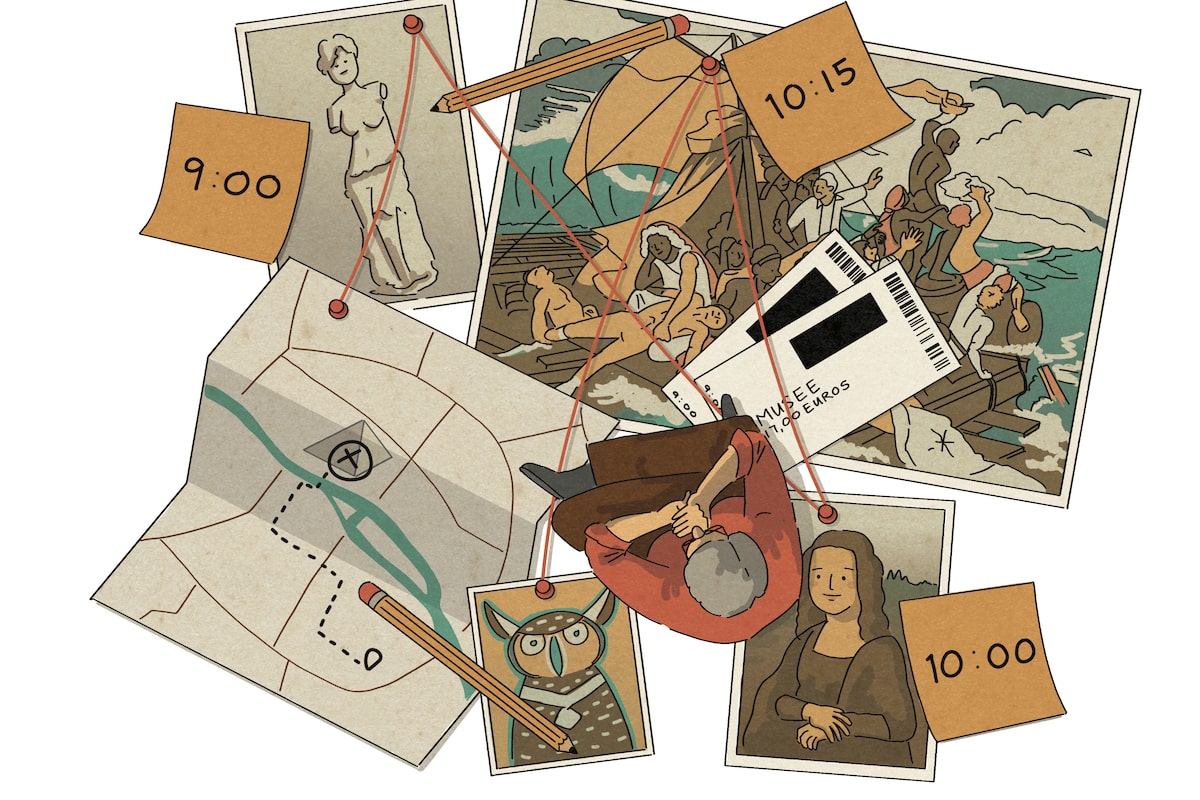
Illustration by Catherine Chan
First Person is a daily personal piece submitted by readers. Have a story to tell? See our guidelines at tgam.ca/essayguide.
Earlier this year my partner suggested a trip to Europe at his expense. There was no refusing such a generous offer.
If we are in Paris, we are visiting the Louvre, s’il vous plaît.
As an artist, I began to ponder how to get my art into a famous museum. Why not finally make a name for myself after bleak decades of poverty and ostracism, like Mendelson Joe and Vincent van Gogh?
My scheme began to take shape. It would be an art heist in reverse. Instead of stealing art, I would sneak a painting into the (presumably) high-security world of the Mona Lisa and the diamond-studded head gear of Napoleonic kings and queens.
But wait. There is probably a law against taking art into such hallowed halls. Great European tourist attractions have strict protocols on visitor conduct. Nudity, for example, is expressly prohibited, despite walls buckling under the weight of paintings of naked people cavorting with angels.
I revealed my plan to a friend. She expressed concern about a possible news headline: “Canadian artist arrested for sneaking art into the Louvre.”
Let’s be clear. I’m the last person who would barge into the Louvre’s Richelieu Wing and bang a nail into the wall next to Christ Detached From The Cross (No. 201 on the museum map) and leave my painting twisting in the wind for security staff to deal with. I value my art just like the next guy. Also, the Louvre is an open invitation to burglars.
My mission was merely to have a photograph of me holding one of my own canvases, so I could say with all honesty, “My art has been in the Louvre.” It would capture a historic moment in time, and I would make a gracious exit.
This required some comparison shopping in the “rules for visitors” department. I hoped the Louvre would be the most inviting, versus the Musée d’Orsay. Everybody’s heard of the Louvre – at least now they have – but fewer know of its smaller yet magnificent cousin the Orsay, housed in a fancy former railway station on the Seine.
First I went to the Q&A on the Louvre’s website.
Can one draw in the galleries? Indeed. Pencil sketching on paper is allowed, but its size cannot exceed 50 x 40 cm. You must not obstruct the view of others. Photos for personal use are allowed, without lights, flash, or selfie sticks.
The Louvre was looking very promising for my painting.
The Orsay, however, is a tough customer. You start with their Tolstoy-length riot act. Their priority access includes: pregnant women, those with a Louvre Abu Dhabi card, professional artists, members of the European Parliament and personalities on official visit.
I know it’s tempting, but the Orsay’s Article 4 prohibits the climbing of scaffolding, barriers, low walls, railings, bases and statues. Do not expect to sit on a statue or painting either, or there will be hell to pay.
Article 14 says access to the museum is prohibited to any visitor: carrying an unauthorized object as listed in Article 16; or dressed in swimwear, underwear, naked, shirtless or barefoot. Further down, handymen and picture-framers beware: It is unlawful to bring tools, cutters, screwdrivers, pliers, secateurs; explosive, inflammable or volatile substances, illegal products or substances, dangerous and foul-smelling objects.
Also forbidden: works of art and antique objects.
Seems the Orsay frowns upon you sneaking in your child’s art class pottery should it sully its Renaissance sculptures with a lack of “provenance.” The Louvre’s rules make no such objection.
Decided! I’m taking my little battle axe of a painting into the Louvre.
It seemed prudent, then, to arrive at the Louvre with equipment befitting an artist seeking to sketch. So I bought some artsy-fartsy pencils and a sketch pad, and “disguised” my 8×8 inch painting among the pages.
Surprisingly, going through security was a breeze. Nobody asked about the small owl canvas that accompanied me. No security guard batted an eye when I was having my picture taken, painting in hand, with a backdrop of The Raft of the Medusa by Théodore Géricault (circa 1818).
It was concerning that my picture-taker might break all the basic photography rules, as in the past. Don’t have a tree growing out of the subject’s head. Don’t put your finger in front of the lens. Get the horizon straight. But he did a stellar job, worthy of a Yousef Karsh.
For distribution far and wide – and to cheer up Canada’s maligned postal workers – I had the image made into a postcard. How else to celebrate the career milestone of having one’s art in the Louvre?
You never know how a small act by an engaged citizen can change history. Had my canvas been in the Louvre’s permanent collection, it could well have been the crown jewel of the famous October, 2025, art heist.
Anne Hansen lives in Victoria.