

Competition
With this latest generation, the Realme GT Pro has graduated into what’s looking like a true flagship market position – and it’s got a price tag to go with it. We expect the phone to be priced at €1,100 for the base 12GB/256GB version and €1,200 for 16GB/512GB). In this segment, the Realme GT 8 Pro’s battles aren’t necessarily going to be easy, but it just might be well-equipped to take on its competitors.
We’re thinking a vivo X300 might be a solid alternative to the GT 8 Pro. It’s at least as good a cameraphone and it’s got that compactness advantage, plus it’s a bit less expensive. You could, of course, opt to pay a little more and go for the X300 Pro and have nicer cameras than on the Realme, but you’d be sacrificing battery life in the process.
We’re almost debating whether OnePlus and Oppo phones can count as competitors, seeing how they’ve been engineered across the hallway. Still, if you’re contemplating between the Realme and the OnePlus 15, we’d be inclined to steer you towards the GT 8 Pro on account of its better telephoto camera, though we can also see how pocketing €150 and living with the OP’s even better battery life can be an option. The Oppo Find X9 Pro will also set you back a little more than the GT 8 Pro but that one is a true camera powerhouse, though it might be somewhat harder to find than the Realme.
Of course, you could entertain more conventional (boring?) options. By this point, a Galaxy S25 Ultra can be had for under €1000 from reputable vendors and that’s pretty hard to argue with, even if the Galaxy is a very different breed compared to the Realme. Similarly, a Pixel 10 Pro (or even a Pro XL in these months that skew prices) could be had for what Realme is asking for the GT 8 Pro.






vivo X300 • vivo X300 Pro • OnePlus 15 • Oppo Find X9 Pro • Galaxy S25 Ultra • Pixel 10 Pro
Verdict
The Realme GT 8 Pro isn’t exactly a new GT 7 Pro – it’s looking like a slightly different kind of a proposition. This time around, Realme paid some special attention to the camera system – in addition to improving on the lineup’s usual strong points. So yes, we have a super bright display that’s even brighter than before, an extra large battery that’s larger than last year, and, well, by definition, a better chipset.
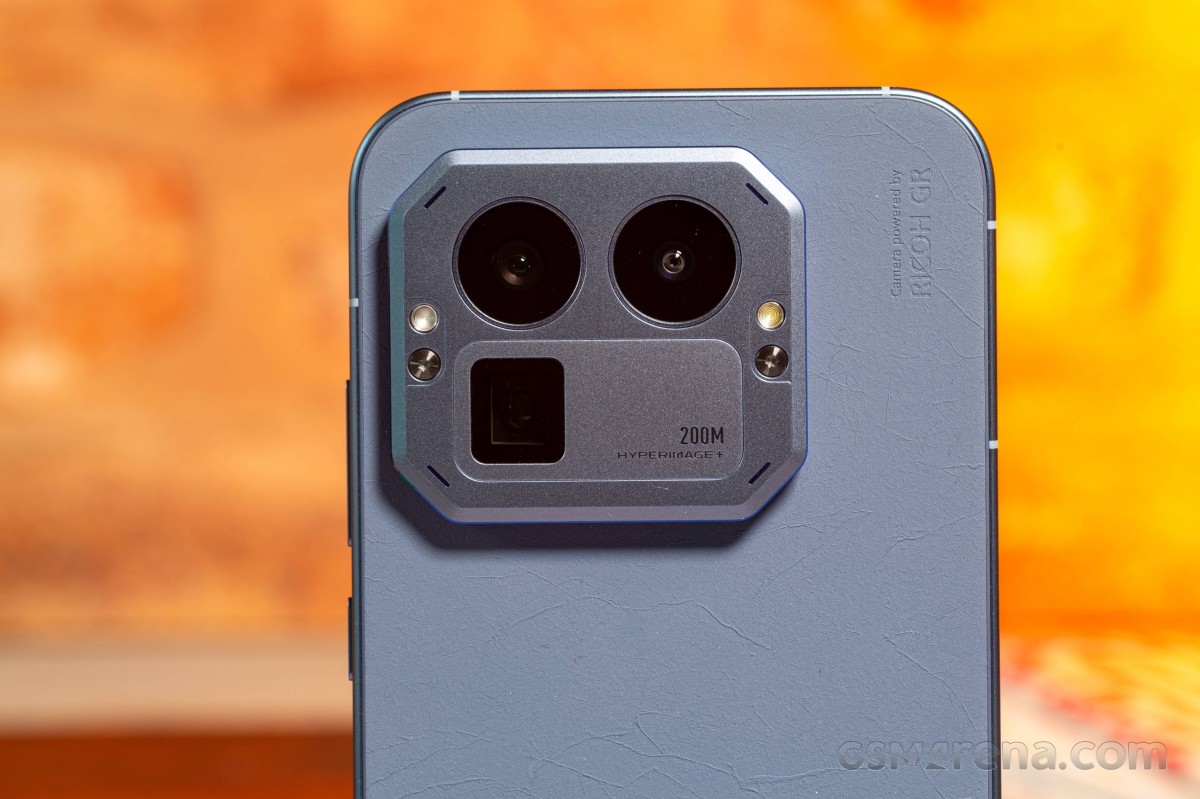
But on top of that, we also get a high-end telephoto camera that’s equally adept at closeups and distant subjects, and an ultrawide camera that doesn’t look like it’s coming from the previous decade (not that its lack of autofocus doesn’t drag it down, but still). Realme chose a collaboration with Ricoh to spice things up and maybe that will draw in a customer or two, but we’re not really seeing it as any sort of a real selling point.
Perhaps the most serious misstep of the GT 8 Pro is in its video stabilization, but it’s not too bad? You could probably find a way to rationalize around that.
We’re not sure how we feel about the whole camera bump accessorizing concept. It’s unique, that’s for sure. And the sampler set we received didn’t strike us as particularly tacky or weird looking – maybe it’s almost intriguing to be able to change things up a bit on what’s by now become an extension of your hand.

Admittedly, however, the GT 8 Pro feels expensive. We’re not necessarily saying that it’s overpriced or that it’s not worth what Realme is asking for it, but it doesn’t immediately strike us as great value. Maybe a little bit of a discount in the coming months will make it a lot more appealing.
Pros
Interchangeable camera bump caps can be cool; the IP68/IP69-rated body is premium and nice to the touch.
Super-bright high-res OLED display, Dolby Vision capable too.
All-round excellent battery life, speedy charging.
Loud and great-sounding speakers.
Snapdragon 8 Elite Gen 5 is fast.
Thoroughly capable camera system; excellent stills, day and night; great for portraiture, nice closeups.
Cons
Heavy GPU throttling under continued load.
Ultrawide camera lacks autofocus, so does the front-facing one.
The Ricoh GR photo mode has limited appeal to us.
Video stabilization is suboptimal.