
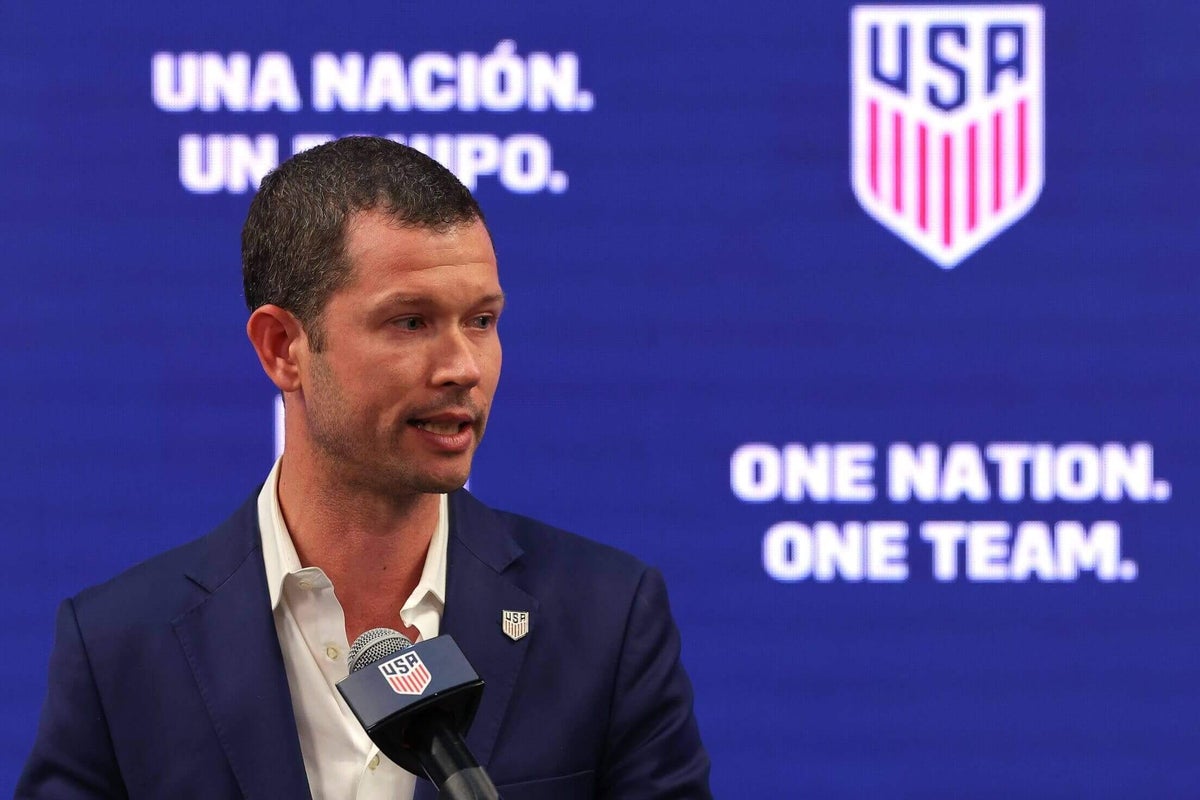
The United States Soccer Federation is launching a new strategy to try to create more world-class players, win World Cups, reduce the cost for young people to play the game and make soccer the highest participation sport in the country.
In an interview with The Athletic, U.S. Soccer chief executive JT Batson revealed the “Pathway Strategy” has buy-in from key components of the country’s soccer ecosystem, including MLS, NWSL, USL, youth soccer organizations, key sponsors and community organizations. While many details and methods are still to be publicly disclosed, he said that early-stage memorandums of understanding have been signed, with timelines and deadlines for actions to come into effect.
Batson said the landmark moment of the 2026 FIFA World Cup, which will be co-hosted by the U.S., Canada and Mexico, provided impetus for key stakeholders to work together.
He said: “We’re all here because we want to win World Cups and we want millions of kids to be able to play soccer. We want people to believe that U.S. Soccer is supporting them in their soccer journey, whether it’s a fan, a player, coach or a family member. We know we have more work to do on that on the men’s side.
“At the Women’s World Cup in New Zealand and Australia, we did not achieve what we wanted (the U.S. women’s national team went out in the round of 16). We did the hard work to understand what actually needs to be done, so that we are the No. 1 played sport in the country and so tens of millions of people are in love with our teams.
“We have talked to anyone we could learn from. We did research, we took data, we had thousands of conversations with people within the U.S. and outside the U.S. to understand our environments, opportunities or challenges, and to ultimately put forward a real plan that we think can be successful.
“It is not the one you slap on a bumper sticker. We’re committed to doing the long, hard work here.”
The research undertaken by U.S. Soccer included consultations with soccer experts around the world. Batson says the legendary former Arsenal coach Arsene Wenger, now in a role as FIFA’s chief of global development, “deserves a lot of credit” for the generosity of time and insights provided by him and his team in outlining ideas and practices. The U.S. Soccer sporting director, Matt Crocker, has also brought insights from his extensive time with the English Football Association and Premier League.
The federation has also enlisted the support of the Twenty First Group, a sports intelligence consultancy. They are working to benchmark how many players out of the top 1,000 in the world would, on average, be required in a squad at a World Cup for a team to go to the quarter-finals or beyond in the competition, providing the federation with one method of benchmarking its future talent development.
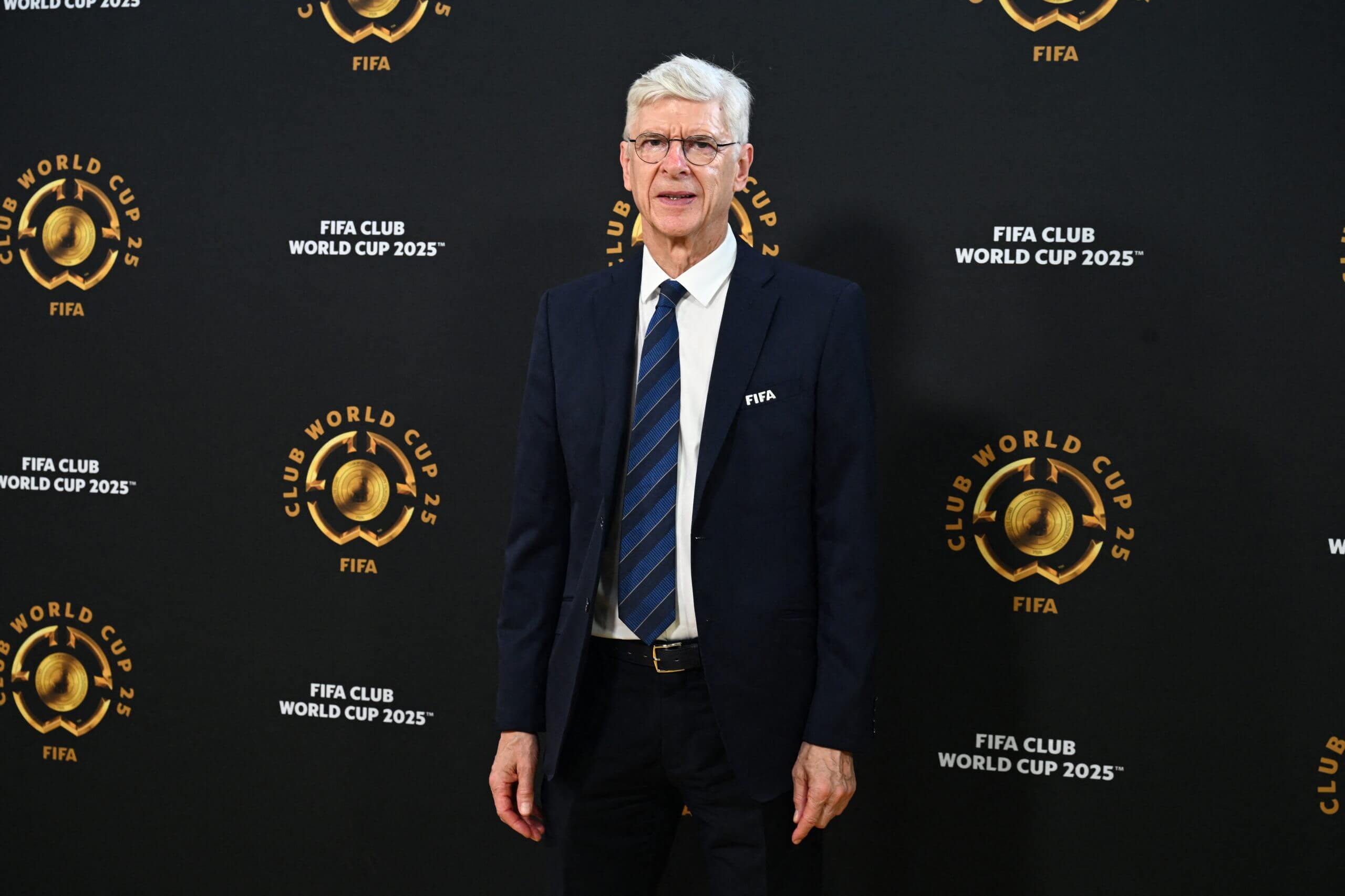
Former Arsenal manager Arsene Wenger has provided his insight. (Roberto Schmidt / AFP via Getty Images)
Batson said the objective is to get U.S. teams, at all levels, into a position to win major tournaments. “On the women’s side, we have proven we are there,” he added. “But the rest of the world is not sitting around hanging, so we have to keep pressing. On the men’s side, we have ambitions of proving we are there too.”
One of the previous challenges has soccer stakeholders disagreeing about the issues and solutions for the game. Batson says the consensus has moved closer.
“We agree we need to work together,” he said. “We agree we need to make soccer more accessible. We agree we need easy, simple-to-understand pathways for kids to decide what journey they should go on. We agree that we need to get some of the funding and resourcing models right. There’s a belief that there needs to be a whole lot more opportunities for kids to play soccer close to home, and local models and regional models that provide an opportunity for kids to play much longer, much easier and much cheaper than what exists today.
“There’s buy-in around the U.S. way: a sporting strategy around player-centric development and best practices. Clubs can have different playing styles, but it is about having a core philosophy around how we make sure that every kid is put in a position to be successful.”
Batson warned that the size and geography of the U.S. mean there is no “copy and paste” solution from other countries. The federation has taken learnings from outside of the soccer and sports world to understand how to bring greater agreement and uniformity.
The federation has studied the smoking cessation efforts within the United States, which drastically reduced the number of smokers in the country, as well as public information campaigns that persuaded many people of the risks of driving under the influence of alcohol.
That level of buy-in will be required to smooth access and participation, particularly costs, for children to play soccer in the country. Many current and former U.S. national team players have bemoaned the financial risks taken by their families in pursuit of their soccer dreams.
Batson said, “This is going to be a long-term journey. But for a country as wealthy as we are, with the resources that we have, beyond monetary, these are solvable things. With people in the room, working together, it’s possible.
“Our task is to use the big moments of ’26, ’28 (Olympic Games in Los Angeles) and ’31 (bid to host the Women’s World Cup) to get governments to invest in fields, to get schools to put soccer in, because it’s not just one thing, it’s all of the things. You’ve got this incredible base of strength and support.
“The commercial market of soccer in this country is growing. MLS owners now spend nine figures a year on free-to-play youth soccer opportunities as part of their player development efforts. Ten years ago, that was essentially nothing. That alone is massive. Part of what we will be calling out is how soccer is a more affordable way to impact way more kids than, say, baseball or football, where equipment is way more expensive.”
In 2024, 31.9 million Americans over the age of six participated in basketball versus 17.3 million in baseball, according to the Sports and Fitness Industry Association (SFIA). In football, across flag, tackle, touch and 7-on-7, the combined participation was 18.8 million. Soccer’s participation across indoor and outdoor in 2024 was 20.5 million, which is a rise of more than three million since 2019.
The plan has major backing. MLS Commissioner Don Garber has said the Pathway Strategy “represents an important step toward a more unified development system in this country.”
Emma Hayes, head coach of USWNT, told The Athletic: “We want to be the most inclusive sport in the U.S. and give players opportunities to have the most fun and enjoy maximum growth, as people and players, regardless of their background or where they live.”
Her men’s team counterpart, Mauricio Pochettino, added that he is “so happy to see that U.S. Soccer is taking the right steps forward in this process.”
Plenty will ask where the money will come from to bring the strategy to fruition. Batson said, “Part of this is realizing the soccer market in the U.S. is actually really big. There are already billions of dollars being spent. Taking the existing market and resourcing it more effectively frees up a lot of resources.
“Additionally, there are big untapped dollars from school districts and local governments that today still are spending way more on football than they should be based on participation numbers. There are continued opportunities as Major League Soccer, USL and NWSL grow for this to flow back into youth development.
“Look at the revenue growth of U.S. soccer over the last few years — we’ve more than doubled in that time period — and have opportunities to continue to grow. There’s a lot of money that, if organized, we’ll be able to unlock a lot of opportunity.”
Ticketed fans to get expedited visa appointments
As the World Cup edges into view, FIFA received one concession this week from the Donald Trump administration when it was announced that ticket holders for the tournament next summer will be granted expedited visa appointments. This is important due to lengthy wait times for nationals of several countries, such as Colombia, Ecuador and Morocco, who have qualified already for the tournament.
Another plan to reassure fans is to use “FIFA legends” (famous ex-players) to put out videos to their local markets back home to tell supporters the U.S. remains a cuddly and welcoming place to visit.
The Republican congressman Darin LaHood, who attended the Oval Office news conference on Monday in which FIFA president Gianni Infantino and President Trump unveiled the expedited visa appointments plan, recently spoke at the “Going for Gold: America’s Tourism Opportunity in the Mega Decade of Sports” conference in Washington, D.C.
While speaking on a panel event, Rep. LaHood, co-chair of the Congressional Soccer Caucus, said, “We have to have a strong welcoming message to the United States — we are going to partner with our FIFA legends in all the countries around the world to have messaging that will go out probably in December or January, welcoming people to the United States for soccer, for sport, for the World Cup. And that will be an important PR, communications mechanism that we’re working on in the White House now.”
Host cities executives are exasperated by FIFA’s reaction to Trump’s threats
On Monday, President Trump again reiterated his threats to relocate World Cup games — this time from Los Angeles and Seattle — to other cities he deems to be “safer.” In the same news conference, he also did not rule out launching strikes in World Cup co-hosts Mexico against drug cartels. FIFA president Infantino stood behind him throughout.
While host city executives are by now accustomed to the United States president’s broadsides, several, speaking on the condition of anonymity to protect relationships, are growing exasperated with FIFA’s refusal to stand up for host cities, with Infantino once again deferring to the Trump administration on Monday.
Trump said, “If we think there is going to be a sign of any trouble, I would ask Gianni to move that to a different city. We have a lot of cities who would love to have it and would do it very safely. If we think there is a problem in Seattle, where there is a liberal, communist mayor. I watched her (Katie Wilson) over the weekend, wow, that is another ‘beauty’ we have got there. Gianni, can I say we will move the event to some place it will be appreciated and safe?”
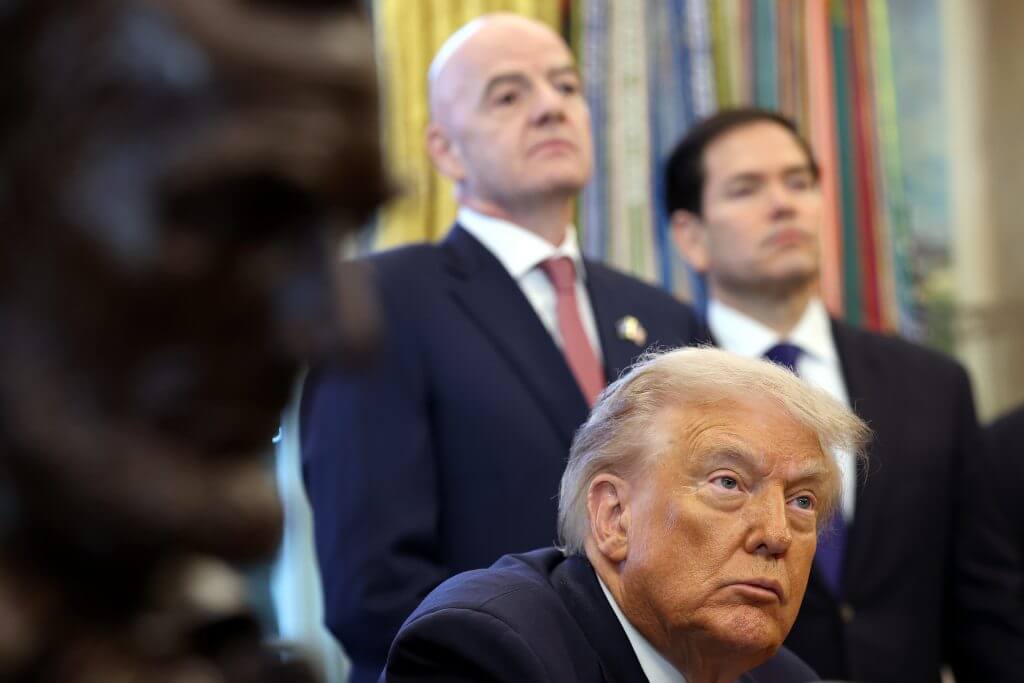
Donald Trump and Gianni Infantino in the Oval Office on Monday. (Win McNamee / Getty Images)
Infantino answered: “Safety and security are the No. 1 priority for a successful World Cup. We can see people have trust in the United States because we have record-breaking ticket sales. Tickets are almost two million sold already. People know they will be coming here to experience a safe and secure World Cup. This, of course, is the responsibility of the government and obviously we will discuss, we are working together, we must ensure all fans coming from abroad can experience a celebration of coming together of the sport and with 100 per cent safety.”
Host cities, which are seeking to sell sponsorship packages for fan festivals around the tournament, are hoping for more backing from FIFA, particularly because the governing body’s contracts are directly with host cities, rather than the federal government. Some host city executives are even privately questioning why they should bother continuing to invest money into FIFA’s events when the sporting body’s officials appear so reluctant to defend them publicly, according to people familiar with discussions.
In a recent statement to Sky News, FIFA reiterated that “safety and security are obviously the governments’ responsibility, and they decide what is in the best interest for public safety.”
FIFA declined to comment for this story, but did point to comments made at the Global Citizen Festival in September shortly after Trump first discussed the possibility of relocating games, where Infantino said there are “16 beautiful host cities” across the three countries hosting the World Cup.