
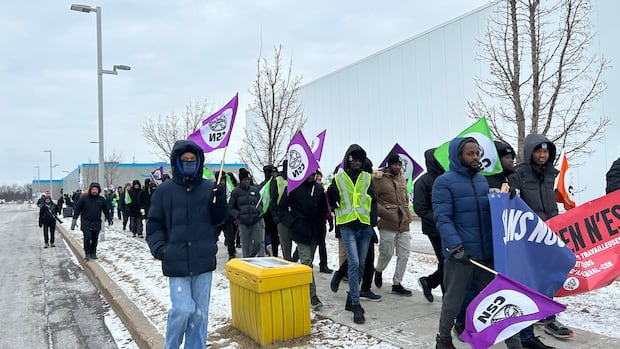
Just as a new union — the first of its kind in the country — was solidifying at one of its distribution centres, Amazon abruptly fired thousands of workers and closed its seven facilities in Quebec.
The retail giant insisted the move was tied to cost savings and not the recent unionization of about 300 employees at a Laval, Que., warehouse.
Now, that fledgling union is looking for retribution in court.
The workers’ union under the Confédération des syndicats nationaux (CSN) federation is asking Quebec’s labour tribunal to overturn Amazon’s warehouse closures and recall employees to work.
They are also seeking moral and exemplary damages, in addition to job-loss compensation for each affected employee — about a year’s salary.
But any victory could prove slow to come and modest in its real-world impact.
Long fight expected
A Quebec labour tribunal began hearing witnesses in the case against Amazon in September.
Jasmin Begagic, president of Amazon Canada Fulfillment Services, has been the only person to testify so far. He’s maintained that the company’s return to a third-party delivery model is less expensive than having its own fulfillment centres.
There will be another series of hearings in April, May and June 2026, where the parties will present evidence, question witnesses and argue the case. After those hearings, the labour tribunal will deliberate and issue a decision.
Caroline Senneville, president of the CSN union federation, said this will be a long fight and it’s costing the federation money, but “that’s why people unionize.”
“We’re backing these workers because they deserve to be backed,” she said.
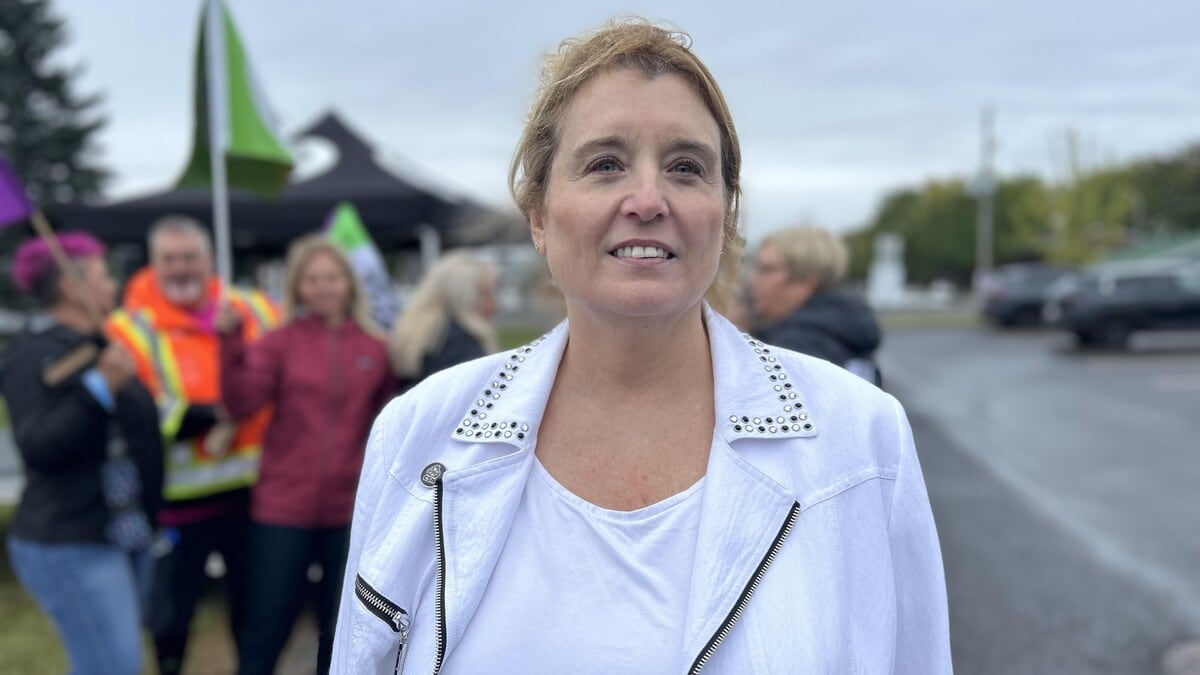 Caroline Senneville heads the CSN, Quebec’s second largest union federation. She says her union is ready to fight Amazon (Charlotte Dubois/Radio-Canada )
Senneville said Amazon was putting pressure on workers and their safety at risk, so they formed a union for support. That support will continue, she said, because “we know that Amazon would rather spend millions on lawsuits than living wages.”
Senneville said the union will use examples from around the world showing Amazon’s treatment of employees and handling of unionization efforts, citing similar issues like those in Sweden and India.
This comes as workers, unions and politicians are watching the situation in British Columbia with bated breath. The Labour Relations Board ruling confirmed union certification at a Delta, B.C. warehouse earlier this year, and many are wondering what Amazon will do next.
When CBC News asked Amazon about this, spokesperson Steve Kelly said there are no current plans to change the company’s operations footprint in British Columbia.
Charter right lacks enforcement
During the labour tribunal hearings, it will be up to Amazon to prove it did not violate Section 2(d) of the Canadian Charter of Rights and Freedoms, according to Andrea Talarico, assistant professor at the University of Ottawa’s Faculty of Law.
That’s freedom of association, which has been interpreted by the Supreme Court to cover unionization and certain forms of collective bargaining. Talarico said the Amazon case is reminiscent of Wal-Mart Canada’s 2005 decision to close a store in Jonquière, Que., six months after the workers won union certification.
The complaint filed by the union was submitted under Section 12 of the Quebec labour code, claiming Amazon shut down its Quebec operation in response to the union forming, explained Talarico, who specializes in labour law.
If Amazon fails to prove it shut down for economic reasons and the labour tribunal rules the company acted unlawfully, there still is little that can be done, she said, as forcing it to reopen isn’t really an option.
Amazon could be fined, or it could be sanctioned, she added, and the tribunal could publicly critique the company’s actions. From there, it falls to consumers to react.
“Wal-Mart ultimately was found not to have acted in violation of a different section of the labour code by the Supreme Court of Canada, but that’s not to say Wal-Mart in Quebec didn’t have consequences for its actions,” she said, noting residents boycotted the company for years afterward.
“It wouldn’t be surprising if something similar happens to Amazon, especially since Amazon is operating in uncertain economic times at the moment. There’s a lot of reluctance to support large U.S. businesses,” said Talarico.
The Wal-Mart workers’ union won its second attempt at legal action in 2014. The Supreme Court ruled that the employees who were terminated when the store was closed were entitled to compensation.
Amazon has opted for a risky strategy legally and economically, said Talarico.
Amazon still in Quebec despite closure
Senneville said a key difference between the Wal-Mart case and that against Amazon is that shoppers in Jonquière no longer had an option to shop there because the store was gone.
In Amazon’s case, the company is still operating and customers across Quebec can still use the service — even though it has no employees or operational facilities in the province.
“So it’s trying to do business in ways that go around dealing with the union,” she said. “And our case, before the court, is that’s illegal.”
While forcing Amazon to reopen may be difficult to achieve, she said the first step is to try.
Mostafa Henaway, an organizer with the Immigrant Workers Centre in Montreal, has been showing his support for the employees who lost their jobs.
“A lot of people didn’t get the proper severance that they were supposed to get,” he said. “A lot of people are still in the courts individually.”
WATCH | Quebecers plan to boycott Amazon: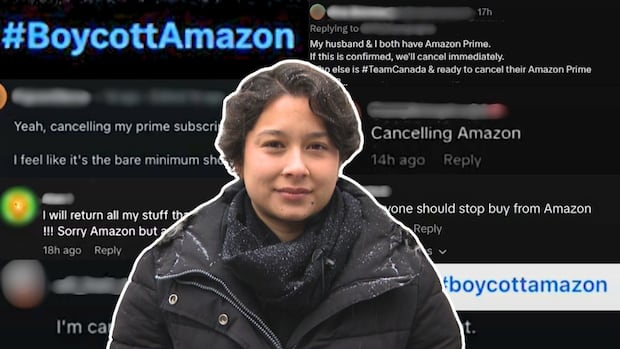
Threats to boycott Amazon are gaining momentum online. But could it actually happen?
Following Amazon’s decision to close its Quebec facilities, some have vowed to stop shopping with the company in protest, return recent purchases and cancel their accounts.
McGill professor Barry Eidlin, who specializes in labour movements and policy, said this is a company that is trying to present a new model for the modern workplace — a workplace that is based on workers having little voice, poor working conditions, higher rates of injury and substandard wages and benefits.
He called it a “churn and burn” labour model where the company makes no long-term commitment to their workers.
“If that model is allowed to diffuse throughout the labour market, that’s going to be very bad news not just for Amazon workers, but for Canadian workers more generally,” said Eidlin.
Senneville said a strong victory in this case will cost Amazon financially, and send out a warning to employers that it is easier to work with unions than fight them.
“That’s why workers’ rights have improved over the years, because we keep fighting those fights,” she said.
In an email, Amazon spokesperson Kelly said the company’s decision to return to a third-party delivery model, which was used in Quebec up until 2020, has allowed it to “provide the same great service and even more savings to our customers over the long run.”
Kelly said the decision wasn’t made lightly, and the company provided impacted employees a package that includes up to 14 weeks’ pay after facilities closed, as well as transitional benefits, like job placement resources.
“Throughout this process, we’ve complied and will continue to comply with all applicable federal and provincial law,” he wrote.