
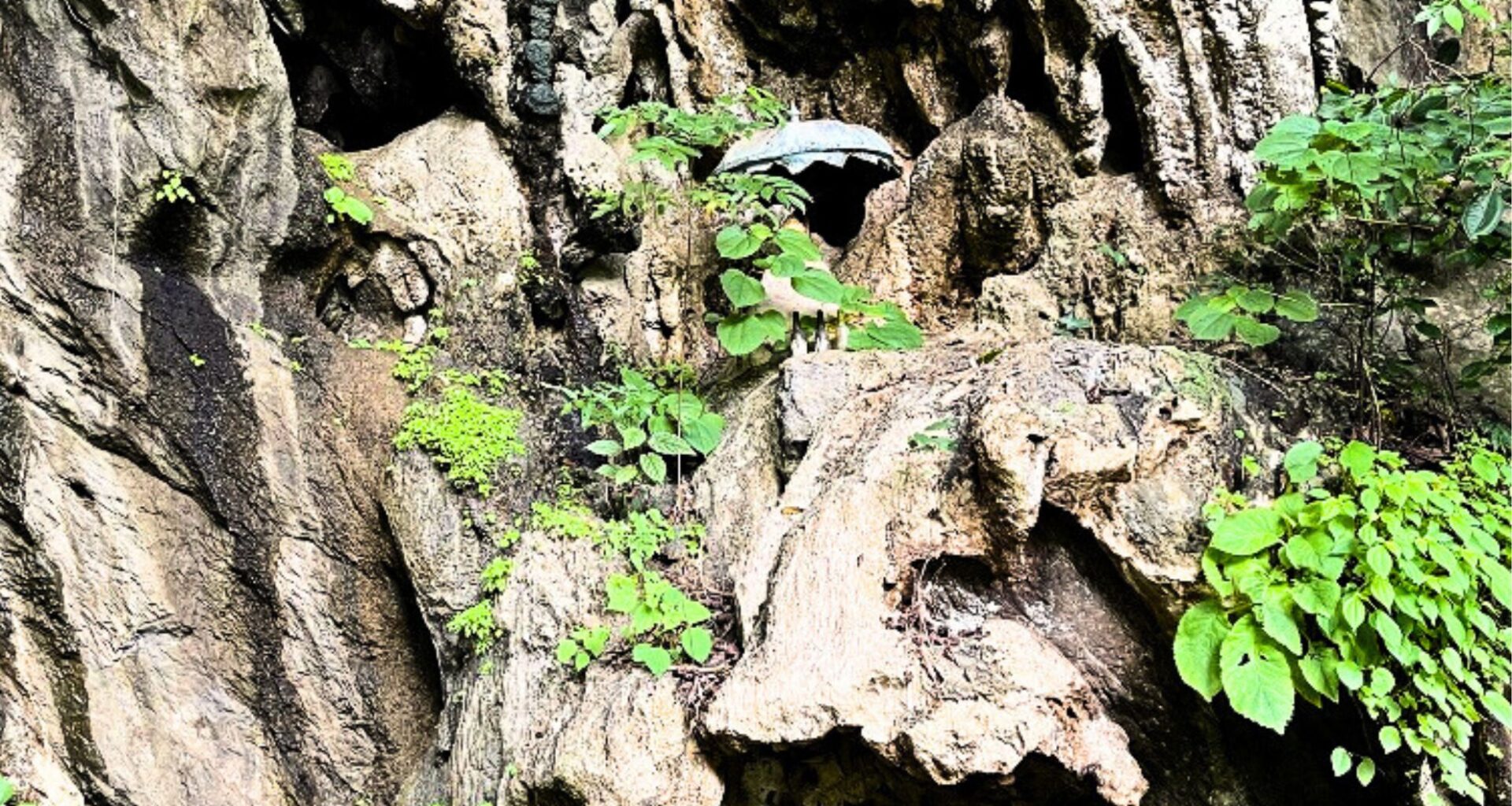
In a dim, moss-covered cave in the mountains of northern Thailand, a team of biologists stumbled upon a creature unlike any they’d seen before. Small, armored, and jagged along its sides, the millipede crept across the wet rock wall — nearly indistinguishable from the humid limestone around it. Only when it moved did it betray its presence.
Nearby, another millipede approached. The two were mating. That rare behavioral snapshot helped confirm what the researchers had begun to suspect: this wasn’t simply a variation of a known species — it was something new.
Documented during a 2024 expedition to Pha Daeng Cave in Mae Hong Son Province, the discovery has now been formally described in the October 2025 issue of Tropical Natural History. The species, Desmoxytes chaofa — nicknamed the princess dragon millipede — belongs to a genus already known for its sharp, spiny forms and vivid appearances.
This one blends into rock but bears all the hallmarks of evolutionary adaptation to life in the damp, closed-in darkness of karst habitats. The researchers named the species in honor of Princess Maha Chakri Sirindhorn of Thailand, a nod to her support of biodiversity research and environmental conservation.
Spikes, Segments, and a Life on Stone
The princess dragon millipede reaches just over an inch in length and has about 20 body segments. Each segment is equipped with pronounced, wing-like spines. Its antennae are slender, and its long legs give it a distinctive silhouette. The study describes its coloration as “dark brown,” allowing it to visually blend with the black and brown stone surfaces of its habitat.
The new species was found moving along vertical rock walls and mating in damp microhabitats. These surfaces were covered in moss and supported small herbaceous plants emerging from narrow crevices. According to the authors, this likely contributes to the moisture-rich environment critical to the millipede’s survival.
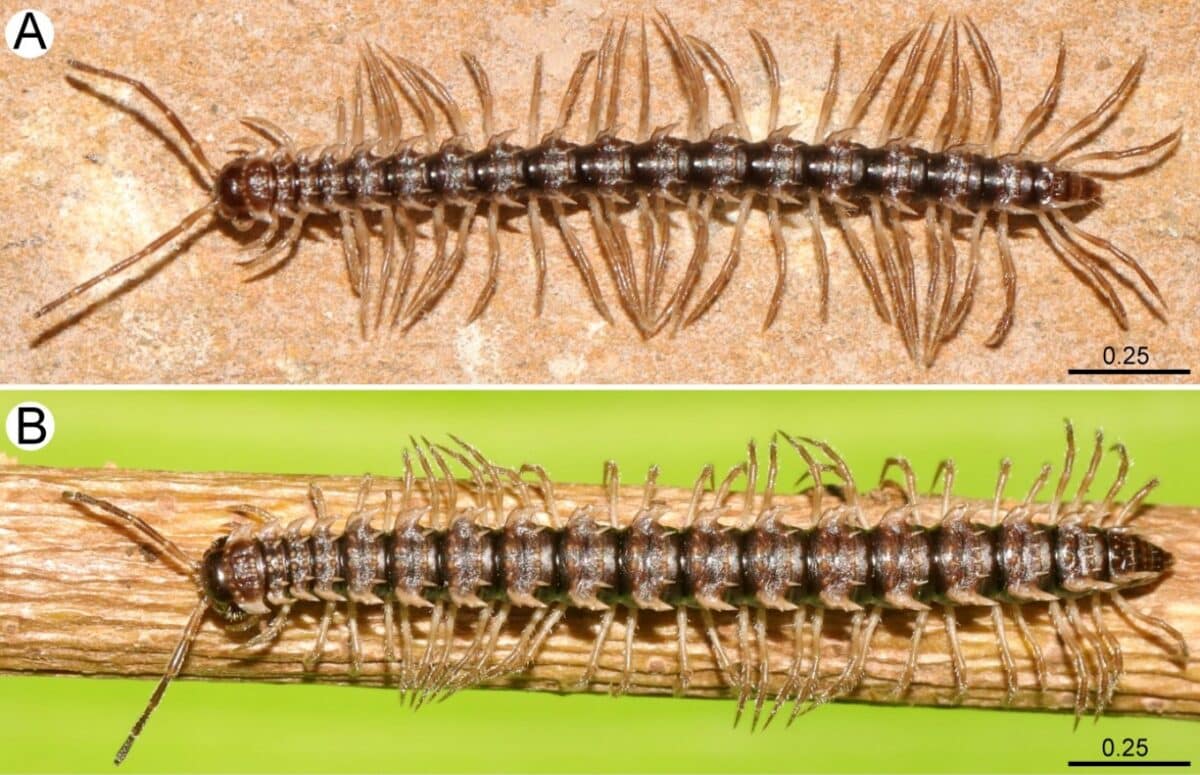 Two Desmoxytes chaofa, or princess dragon millipedes. Photos from Ruttapon Srisonchai via Srisonchai, Srikampha, Benchapong and Panha (2025)
The species was discovered using an integrative taxonomic approach, combining both morphological characteristics and DNA barcoding. The researchers analyzed three gene fragments — COI, 16S rRNA, and 28S rRNA — to assess genetic divergence. Results confirmed the species’ distinctiveness, with COI gene divergence from its nearest relatives ranging between 10.67% and 18.67%.
The study further reports that D. chaofa is most closely related to D. octoconigera, another Thai species described in 2018, but differs significantly in body coloration and genital morphology.
Karst Landscapes: Biodiversity in the Balance
Limestone karsts, like those of northern Thailand, are globally recognized as biodiversity hotspots. Formed by erosion over millions of years, these rugged formations harbor highly specialized and often endemic species — organisms that live nowhere else on Earth.
In their study, the researchers emphasize that Desmoxytes chaofa has only been recorded in Pha Daeng Cave and a few nearby locations. Its apparent micro-endemism — limited to a single province bordering Myanmar — makes it highly susceptible to environmental change or human impact.
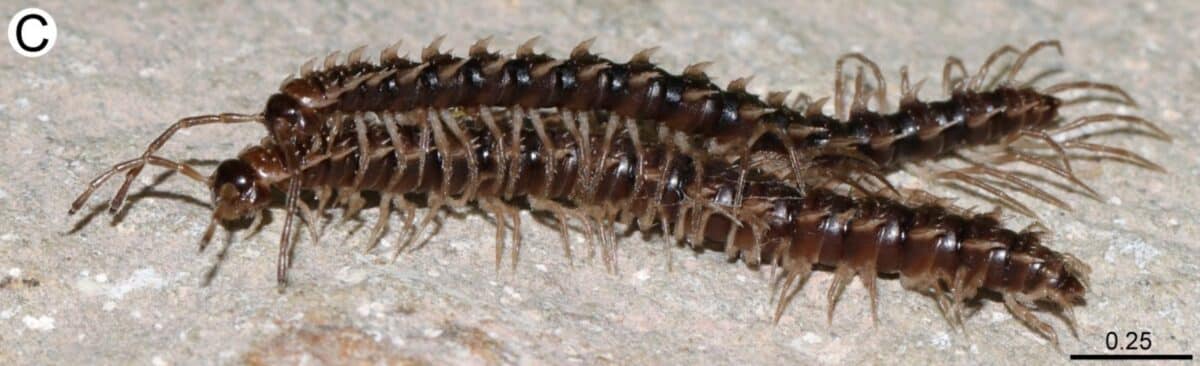 A mating pair of Desmoxytes chaofa, or princess dragon millipedes. Photo from Ruttapon Srisonchai via Srisonchai, Srikampha, Benchapong and Panha
The authors also note that the creature’s reliance on moist rock walls within karst systems places it within an ecosystem already under pressure. In Southeast Asia, limestone extraction for cement and construction materials has destroyed hundreds of karst formations, wiping out unknown numbers of species in the process.
The 2006 paper Limestone karsts of Southeast Asia: Imperiled arks of biodiversity (BioScience, Clements et al.) warns that conservation planning has historically ignored these ecosystems, despite their scientific and ecological significance. Karsts, the paper argues, are “among the most threatened ecosystems on Earth.”
A Name With Royal Resonance
The species’ formal name, Desmoxytes chaofa, comes from the Thai word “chaofa”, which signifies a royal princess. The study states that the name honors Her Royal Highness Princess Maha Chakri Sirindhorn, “renowned for her dedication to biodiversity research and environmental conservation.”
This cultural connection underscores the importance of the find in Thailand’s national context. Princess Sirindhorn’s name has been associated with environmental efforts for decades, including support for scientific fieldwork and conservation across the country.
Naming a species after a public figure is not uncommon in taxonomy, but in this case, the tribute adds public visibility to a discovery that might otherwise remain buried in academic journals — much like the species itself.