
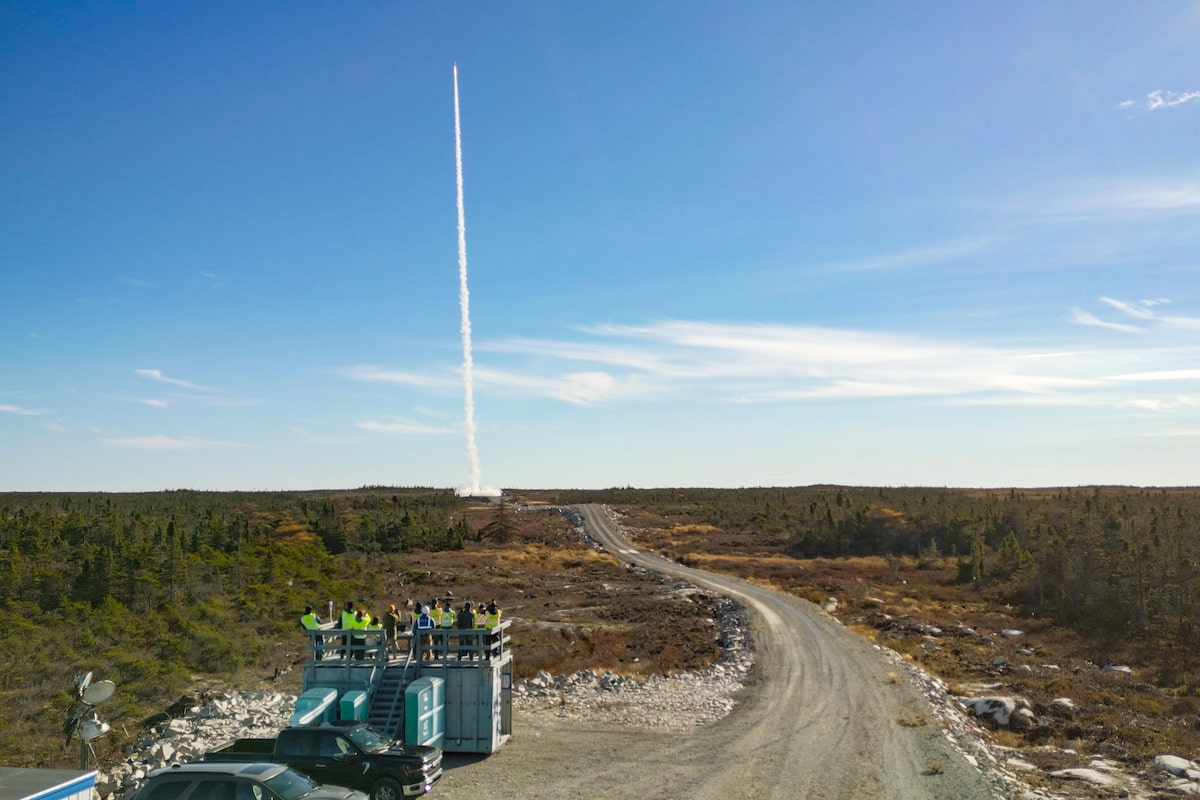
Team members at Maritime Launch Services and Dutch company T-Minus Engineering watch as a rocket takes off from an MLS launch pad near Canso, N.S., on Thursday.Warren Robertson/Supplied
A company aiming to provide access to space from Atlantic Canada has hosted its first commercial launch.
On Thursday, Maritime Launch Services Inc. announced the flight of a suborbital rocket from a site it is developing near Canso, N.S., about 200 kilometres northwest of Halifax.
The single-stage rocket, built and operated by T-Minus Engineering BV of Delft, in the Netherlands, did not achieve its intended goal of reaching 100 kilometres in altitude – a threshold commonly used to designate where outer space begins.
However, the launch proceeded successfully and set the stage for more activity at the MLS site.
Canada’s space companies make national-security pitch for chunk of defence dollars
“Everything just went flawlessly in building and conducting this launch,” said Steve Matier, president and chief executive of MLS, in an interview. “This is such a positive step for the future for us.”
The Halifax-based company ultimately aims to help its clients put payloads into orbit – an accomplishment that would be a first for Canada.
Mr. Matier said the rocket lifted off at 11:54 a.m. local time under a brilliant blue sky with crisp temperatures and calm winds. After a brief flight, the four-metre long rocket, which is designed for research applications at hypersonic speeds, fell into the ocean as planned.
The rocket’s journey was delayed for a few hours to allow two tanker ships located 20 to 30 kilometres offshore to move away from its intended trajectory.
Mr. Matier said Transport Canada was notified of the launch according to the procedures that are in place for the launch site. But he added that Thursday’s effort provided a test of how that information is communicated and received by vessels in the vicinity.
“You learn more from those kinds of things than you do from a complete success,” Mr. Matier said.
In recent years, MLS has cleared environmental and other regulatory hurdles to enable the building of four launch pads and support facilities at the Canso location.
While most of that construction is still to come, one pad is now available. It was used once before, for a rocket launched by a student team from the University of Toronto, but Thursday marked the first try at reaching space from the site.
Canada’s last successful space launch, a suborbital flight, took place in Churchill, Man., in 1998.
Remarkably, after so many years of inactivity, Thursday’s effort marks the third attempt in 2025 to reach space from Canada – a sign of growing interest in domestic space flight.
Moon revisited: NASA scientists prepare to unleash the human element
In August, a team of engineering students at Concordia University launched a rocket of their own design from northern Quebec that fell short of reaching space.
One month later, NordSpace Corp., a Markham Ont.-based startup, was set to launch a rocket from Newfoundland, but was thwarted by weather and other factors.
Mr. Matier said he expects that MLS will host one to two more suborbital launches in 2026.
“There is a potential for an orbital launch at the end of the year, more likely into 2027 though,” he added.
The recently tabled federal budget includes a $182.6-million allocation to the Department of National Defence to establish sovereign launch capability over the next three years.
At SpaceBound, a Canadian space industry meeting in Ottawa earlier this week, department representatives indicated that a portion of that funding will go toward supporting a rocketry challenge open to industry and academic teams.
According to Ahmad Khorchid, director of innovation operations at Defence Research and Development Canada, the challenge will focus on the launch of 200-kilogram payloads into low Earth orbit by the end of 2028. At stake will be $105-million in total funding for up to two successful applicants. Further details on the challenge may be issued as early as next week.
Another portion of the federal budget allocation will go toward infrastructure, including agreements with domestic spaceports, a development that Mr. Matier said he was “thrilled” to hear.
The funding commitments are a good signal that Canada intends to become a more serious contender in space, said Alex MacDonald, former National Aeronautics and Space Administration chief economist, who spoke at the SpaceBound conference on Tuesday.
However, he added, it’s a promise that still lacks the transparency private investors need to come aboard and grow the sector alongside government.
NASA’s Artemis II mission gets ready for closest lunar encounter in decades
By way of comparison, NASA’s annual budget plan shows a far greater degree of detail and clarity about how money will be distributed over time.
“That transparency helps the markets because when you know what is going on in five years. As an investor, you can say, ‘Oh yeah, looks like NASA plans to spend a billion dollars on that. Not now, but it’s going to get there, or they want to get there, so at least it seems like a good bet,’” Mr. McDonald said.
Canada’s space economy could be worth $21-billion by 2035, according to a new report by Royal Bank of Canada titled A Higher Orbit. But only if it can attract $12-billion in public and private capital, the report states.
Competition between companies will be key to ensuring Canada gets a top-notch launch capability. However, Mr. McDonald said $182.6-million may not be enough to incentivize companies to jockey for a top spot. It could be enough to pick a winner but not enough to become world-class, he said.
“At NASA we’ve always had this debate. If you choose one, you will almost certainly choose wrong. Not because you’re inherently going to choose wrong, but because the dynamic of competition is so critical to keeping both parties on target,” he said.