
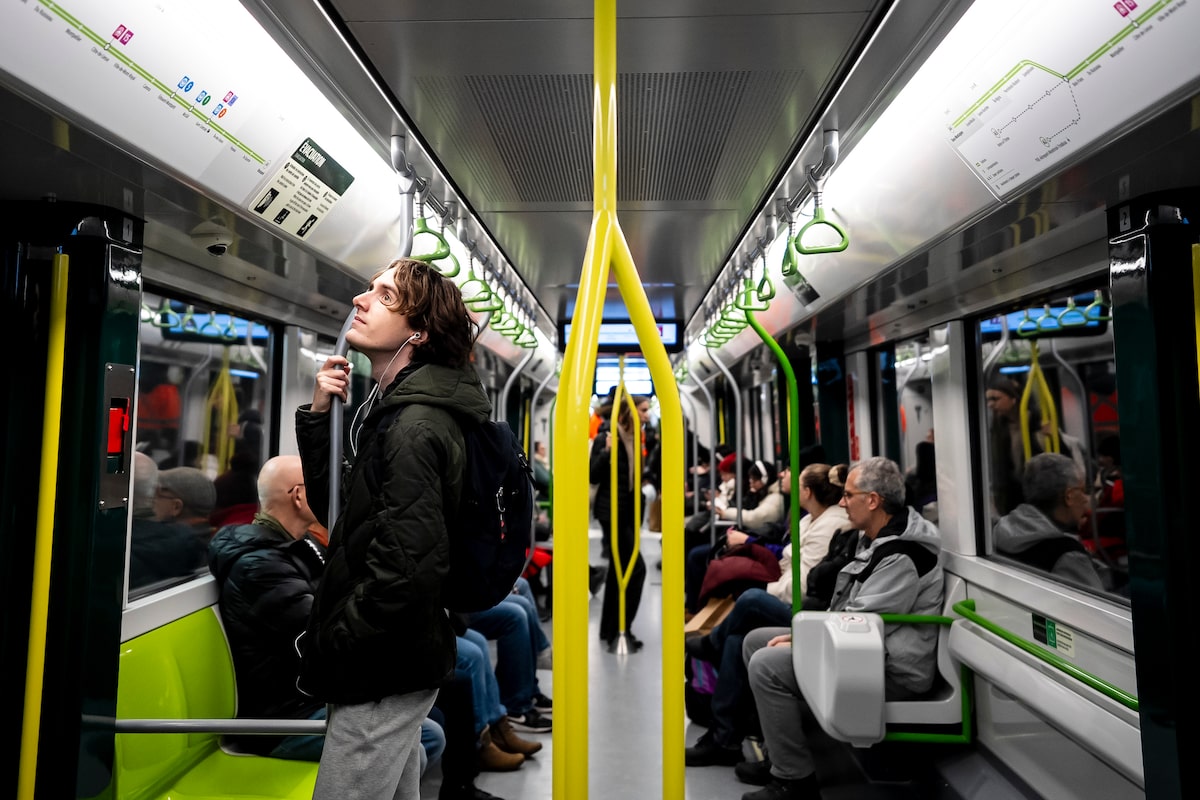
The REM light rail in Deux-Montagnes, Que., on Monday.Christopher Katsarov/The Canadian Press
Canada’s biggest public transit project in decades opened for business this week.
If you live anywhere west of the Ottawa River or east of the Quebec-New Brunswick border, you probably have no idea what I’m talking about.
The Deux-Montagnes branch of Montreal’s Réseau express métropolitain, or REM, went into regular operation on Monday. The 14-station line runs north from Central Station downtown to an off-island suburb. It joins a five-station line running south from downtown that opened two years ago.
A line on Montreal’s West Island is scheduled to open next spring, with an extension to the airport scheduled for completion in early 2027. The current light-rail network is 50 kilometres long with 19 stations; in a year-and-a-half, it will have 25 stations (plus possibly one new infill station) and 67 km of track.
By comparison, the existing Toronto subway system is 70 km long. Vancouver’s SkyTrain network is almost 80 km. The existing Montreal Metro is 69 km.
Quebec looking to Caisse investments, data centres to boost economy amid trade turmoil
Opinion: Build, baby, build: Here are three recent Canadian success stories
The REM has driverless and fully automated trains, with indoor stations and platform screen doors. The section in the centre of the city is underground, with the rest at grade or elevated. The service is high-frequency: The plan is for a train every 2.5 minutes in the core of the network at rush hour.
If you live in Quebec, especially Montreal, you’ve heard a lot about the project – mostly bad news about delays, cost overruns and mechanical issues.
The REM has had them. But they have to be put in perspective: graded on a curve, it’s at the head of the class. By a mile.
The REM’s promoter, an arm of the Caisse de dépôt et placement du Québec pension fund, said it could build an entirely new transit system absurdly quickly, at an insanely low cost. After the delays and cost overruns, what’s been the result?
An entirely new transit system built very quickly, at improbably low cost.
The Eglinton Crosstown LRT, a 19-km sort-of subway being built in Toronto by Ontario, broke ground in 2011 and still isn’t open. The REM didn’t break ground until 2018.
The budget for the Eglinton Crosstown is now $13.08-billion, or nearly $700-million per km. The 15.6-km Ontario Line, also being built in Toronto by the province, has an estimated cost of $27.2-billion – well over $1-billion per km.
Montreal’s Blue line metro extension, which is supposed to open in 2031, has a budget of $7.6-billion for five stations and 6 km of tunnelled track. That’s also well over $1-billion per km.
Most of the rest of the developed world builds transit for far less. Until recently, so did Canada.
The REM marks a return to that better past. Even after its cost overruns, Quebec’s Auditor-General expects the REM to cost $9.4-billion. That’s just $140-million per km.
The section of the line that’s been open for two years, from downtown to the South Shore, has had reliability issues, with snow sometimes shutting it down. The operator, a joint venture between train-maker Alstom and AtkinsRéalis (the former SNC-Lavalin) says it has taken steps to improve winter performance.
Snow delays on a Canadian transit line are obviously a problem, and improvements are clearly needed. But again, to put things in perspective: Airports across Canada regularly suffer flight delays due to snow. Nobody thinks that proves air travel is a failure, or that we should plough over the runways and turn Pearson International back into a farm.
The REM’s secret sauce is that its developer – the Caisse – has a long-term financial bottom line. It has to balance maximizing ridership and minimizing costs.
Politicians, by contrast, tend to have short-term political bottom lines. They have a habit of making politically driven choices on what transit to build, where and how. Only the next generation of office-holders see the financial fallout.
For example, politicians always want transit tunnelled because that’s what voters and drivers want. But tunnelling is expensive, complex and slow, and budgets are finite. Build as expensively as possible, and you can’t afford to build as much, or at all.
The Caisse pitched a follow-on project, the REM de l’Est, a 32-km line from Montreal’s downtown to the east end of the island. It was announced in 2020 – but when politicians demanded that some elevated sections be underground, the Caisse did its sums and pulled out.
That left provincial and municipal politicians free to resume blue-skying their expensive alternatives. What’s been built? Nothing.
Public transit needs a public subsidy. It also needs a cold, hard bottom line.