
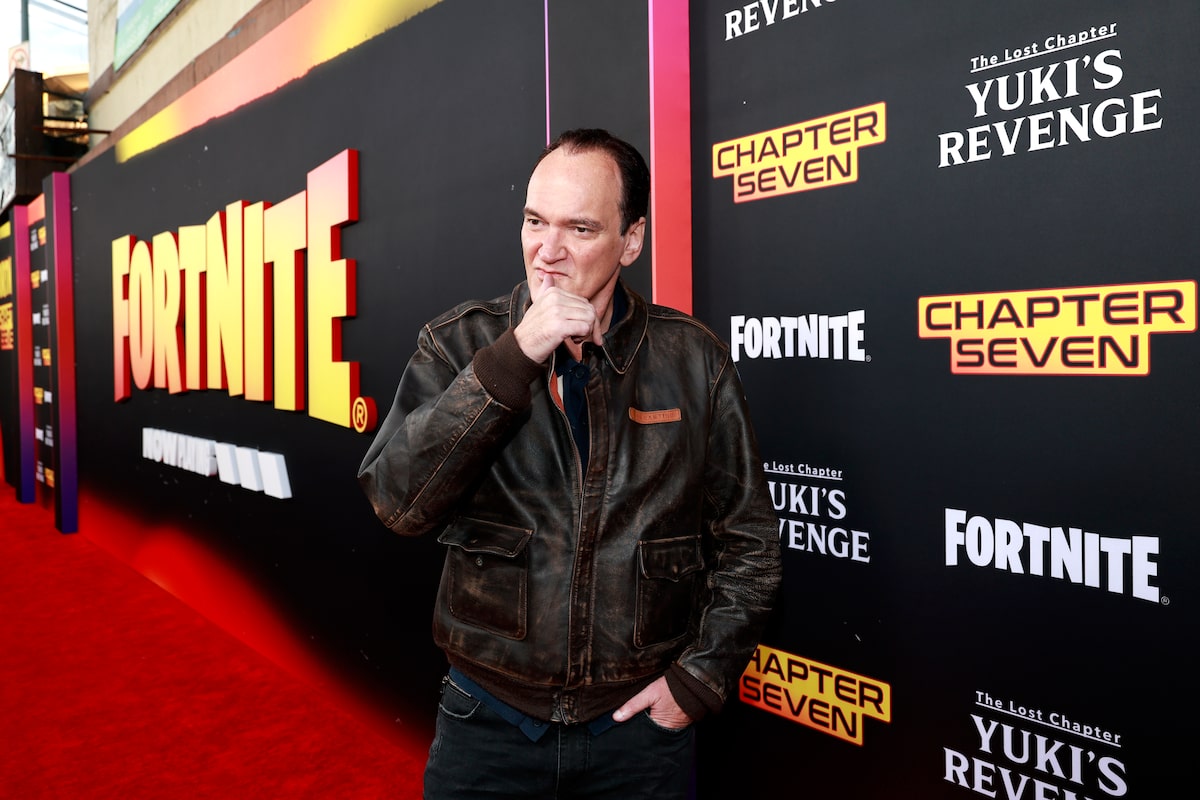
Quentin Tarantino attends Fortnite Now Playing on Wednesday. In December, a three-pound, 400-page book about the filmmaker’s pursuits by journalist Jay Glennie will hit shelves.Frazer Harrison/Getty Images
Despite not having made a new film in more than six years, this winter is proving to be the season of Quentin Tarantino.
On Dec. 5, theatres across North America will screen Kill Bill: The Whole Bloody Affair, the long-awaited stitching together of 2003’s Kill Bill Vol. 1 and 2004’s Vol. 2 (which Tarantino has always considered one complete film), complete with extra footage. At the same time, especially muscular Tarantino fans will be picking up The Making of Quentin Tarantino’s Once Upon a Time…in Hollywood, a three-pound, 400-page behemoth by veteran film journalist Jay Glennie that is so much more than a coffee-table book.
The first of 10 planned archival books chronicling each of Tarantino’s feature films – the director, whose Once Upon a Time is his ninth movie, has long said that he plans to retire after filming his 10th, the details of which are currently unknown – Glennie’s book is an exceptionally deep dive into not just Tarantino’s sensibility, but the mechanics of large-scale moviemaking. Given unprecedented access by Tarantino to his creative process and archives, Glennie has delivered a rich text for cinephiles of all stripes, complete with behind-the-scenes photos, concept art, script notes, and in-depth, unguarded interviews with all the major players, including stars Brad Pitt and Leonardo DiCaprio.
As the book makes its way to becoming a (very large, very heavy) stocking stuffer this Christmas, Glennie sat down with The Globe and Mail to talk about the process.
It feels like you landed the dream assignment of film writers. You were working on a book about Taxi Driver, got in touch with Tarantino to see if he’d write a foreword to that, and then had such a great conversation he asked for the Jay Glennie book treatment on all his movies.
We’re both doing a similar job, Barry, so I’m under no illusions that this was like manna from heaven. We got on really well during the initial meeting, and started cracking open bottles of wine on either end of the Zoom call. Then I booked a flight the next day to start work. He wanted to first publish a book about Inglourious Basterds, but this one picked up more steam toward the end, so I’ve written them almost simultaneously. I’m also now about two-thirds of the way through the book on Django Unchained.
Okay, so why start this collection with a book on Once Upon a Time…in Hollywood, his ninth film? Why not start at the beginning with Reservoir Dogs?
I haven’t really got a better answer other than to say that it’s because Quentin and I are both contrary bastards, and that’s just how it happened. Also, Once Upon a Time feels, and I know it’s an oft-used saying, but it feels like an instant classic. It doesn’t feel as if it’s only six years old. It felt like it could be thoroughly investigated.
And with Quentin onboard, you had no trouble securing lengthy interviews with Pitt, DiCaprio …
We’ve all been to press junkets and seen EPK [electronic press kits] and seen the participants dead behind the eyes. We’ve all been given five minutes to interview this person or that, and we’re trying to write a coherent story out of that. And they’ve been asked the same question over and over. That was the fear, truth be told, that it wasn’t going to be fresh. But it wasn’t the case at all. For so many of the people who worked on this film, it doesn’t matter whether you’re Brad Pitt or a day player, it was the peak of their working life.
Quentin Tarantino films Leonardo DiCaprio and Brad Pitt on the set of Once Upon a Time in Hollywood in 2019. Glennie’s book is the first of 10 planned novels looking at Tarantino’s filmography.ANDREW COOPER/Sony Pictures
What was one of the more surprising things you learned while talking with everyone involved?
I loved talking with all the Manson guys and girls, when they came together, and gave me their memories. Mikey Madison, she didn’t know she was going to be in Anora then. Austin Butler didn’t realize Elvis was going to happen. And then there was Victoria Truscott’s story, the young actress who played a hostess at the Musso & Frank restaurant. Her first call sheet has Brad, Leo and Al Pacino on it. I don’t care how grizzled a veteran you are, that must mess with your head.
What was the collaboration like with Tarantino on this? Was he reading over your shoulder?
He never once vetted it. To give you an idea, I visited him for a week and we talked about a myriad of subjects, just riffing, with the hope of zoning in on the film we’ve got to talk about. I then came home and invited all the collaborators to give me their stories. To Quentin, the biggest thrill was hearing and understanding everyone else’s memories. I don’t take his trust lightly, it comes with huge responsibility.
I imagine you can’t say anything about what his 10th movie might be. But process-wise, would you be in the mix on that project from its beginnings, for the eventual book? Or is this something you’d come to after the fact?
No, I don’t think I would actually. I don’t think I’d like to know the mechanics. I’m eager to take myself out of these stories. I don’t mean to be self-congratulating, but I feel I have to. I want everyone to feel as if they’re telling me their stories, rather than me telling mine.
This is going to be an annoying question, I’m sure, but what is your favourite Tarantino film?
Once Upon a Time is high up there. Basterds, too. It’s so hard, isn’t it? There aren’t many filmmakers who have made so few duffers in their careers. Also, I mean, when I watched Pulp Fiction, that changed so much. For me and everyone else.
The Making of Quentin Tarantino’s Once Upon a Time…in Hollywood by Jay Glennie is now available from Insight Editions.
This interview has been condensed and edited.