
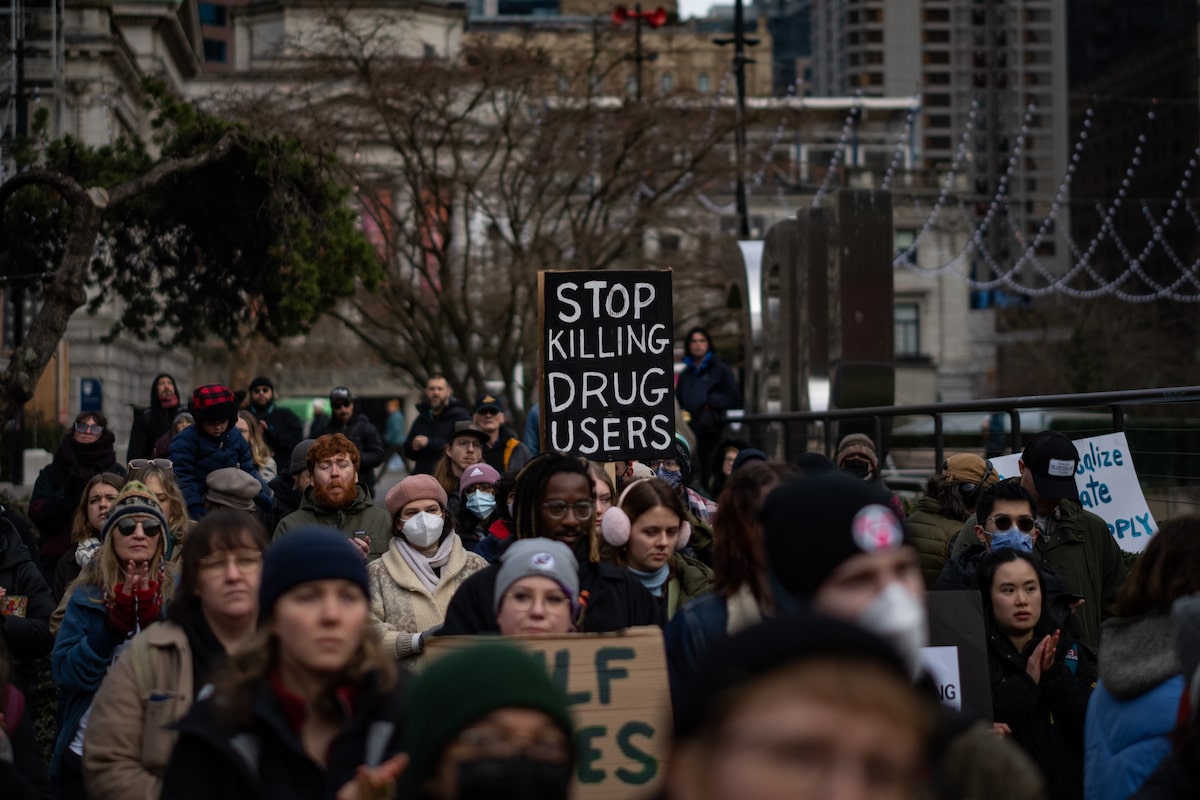
People gather outside the Provincial Court of British Columbia to support the Drug User Liberation Front in Vancouver, in January, 2024.ETHAN CAIRNS/The Canadian Press
The two organizers of an illicit-drug compassion club in Vancouver, convicted this month of trafficking for providing members with heroin, cocaine and methamphetamine, are back in court challenging Canada’s drug laws as unconstitutional for depriving users of safer options.
Jeremy Kalicum and Eris Nyx operated for more than a year as the Drug User Liberation Front, buying illicit drugs from the dark web, testing them at university labs for fentanyl and other impurities, and selling them at cost to their 43 members.
Their activities – a response to a toxic drug crisis that has killed nearly 18,000 British Columbians since 2016 – were widely known and supported by top health officials, until a shift in the political climate culminated in a police raid and the arrests of Mr. Kalicum and Ms. Nyx in October, 2023.
The constitutional challenge begins Monday in B.C. Supreme Court and is expected to conclude at the end of January. It will invoke sections 7 and 15 of the Charter, which guarantee the right to life, liberty and security of the person and equal protection under the law.
Poisoned: How opioid deaths are hollowing out the construction industry
Stephanie Dickson, co-counsel for the pair, said the drug crisis is driven by a street supply that has become highly unpredictable. Expert panels have urged federal and provincial governments to explore non-medicalized safer supply models, and Mr. Kalicum and Ms. Nyx’s compassion club was a response to government inaction, she said.
“Our position is that, by prohibiting the compassion club and denying people who use drugs this important means of keeping themselves safe, the federal legislation breaches their Charter rights and is unconstitutional,” Ms. Dickson told The Globe and Mail.
The entering of their convictions is on hold pending the outcome of the constitutional challenge.
Mr. Kalicum and Ms. Nyx went about their efforts openly. In her Nov. 7 judgment against the pair, BC Supreme Court Justice Catherine Murray noted that they met with police and health officials in 2021 to seek their support in applying for the Health Canada exemption from federal drug laws required to operate.
Vancouver Police Inspector Phil Heard “voiced support for their reasoning and motivation” but said police could only support what was legal, Justice Murray said. Patricia Daly and Mark Lysyshyn, respectively the chief and deputy medical health officers for Vancouver Coastal Health, provided letters of support for their exemption request.
Underexposed: Living and dying through B.C.’s overdose emergency
Health Canada denied the request in April, 2022, saying that acquiring drugs from the dark web is “not a viable option,” and that the group did not provide information on how an alternative model using legally sourced substances might work.
Jennifer Saxe, director-general of Health Canada’s controlled-substances directorate, concluded the notice of denial by saying the department “is committed to supporting efforts to expand access to a safer supply, including exploring alternative models that will remove existing barriers to access.” She also conveyed appreciation for the pair’s work, and their “willingness to think and act creatively in search of new solutions.”
Mr. Kalicum and Ms. Nyx filed for a judicial review of that decision, which was heard in Federal Court in March 2024. A judgment is pending.
Despite the denial, the two proceeded with plans for the compassion club under a separate exemption that allowed for drug checking and overdose prevention services but not the exchange of drugs. Vancouver Coastal Health provided the group with a storefront in the city’s Downtown Eastside and $200,000 in funding for drug checking and overdose prevention.
Mr. Kalicum and Ms. Nyx drew attention to the operation through news releases and public actions. At several protests, the Drug User Liberation Front set up a table to distribute the labelled boxes containing small amounts of each drug, arguing the need for a safer drug supply. Politicians and academics sometimes spoke alongside them, and police looked on.
The two also teamed with researchers to review the efficacy of the program. A report published in March said members reported improved overall health, reduced drug use and reduced reliance on criminal activity.
The tides turned in September, 2023, when the Economist magazine published an article on the pair titled The Ethical Drug Dealers of Vancouver, igniting what Justice Murray called “a maelstrom of activity.”
Federal Conservative Leader Pierre Poilievre, then-BC United MLA Elenore Sturko and other members of the political opposition rebuked the B.C. NDP government for supporting the illegal activity, successfully putting pressure on health officials to end funding and the site lease.
In October, 2023, Vancouver Police raided the site and arrested Mr. Kalicum and Ms. Nyx.
An expert panel struck by the BC Coroners Service that year noted the failures of drug prohibition and recommended that the province expand access to legal opioids and stimulants through non-prescription models – an idea the province immediately dismissed as a non-starter.
A separate expert panel struck by Health Canada similarly recommended that the government consider the sale of regulated pharmaceutical substances at legal compassion clubs and retail stores – a recommendation that was never released publicly. Meanwhile, Health Canada funding for more than 20 safer-supply programs ended earlier this year, with no indication of renewal.