
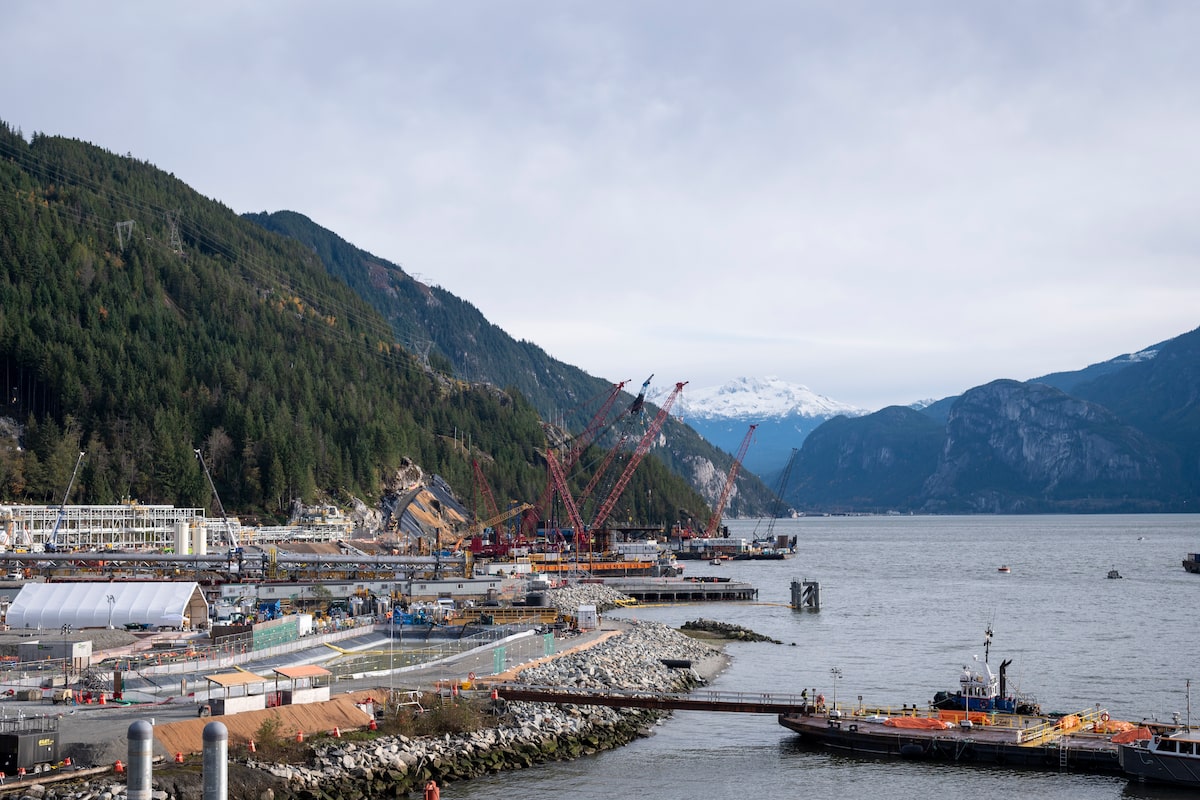
The Woodfibre LNG site near Squamish, B.C.Tijana Martin/The Globe and Mail
Luke Schauerte marvels at how Woodfibre LNG has surpassed the halfway mark for construction at a B.C. industrial site on the western shores of Howe Sound.
Reaching the construction milestone is an achievement that Mr. Schauerte, who became Woodfibre’s chief executive officer one year ago, doesn’t take for granted. It has been 12 years since the project received its licence to export liquefied natural gas from the site near the picturesque community of Squamish, about 65 kilometres north of Vancouver.
“You have a lot of moving parts you’re trying to bring together,” he said during a tour of Woodfibre’s site.
The turbulent history of Woodfibre serves as a lesson for how major projects can eventually get done in Canada. But the bumpy road toward construction also provides a cautionary tale of how market forces can disrupt best-laid plans.
Governments are vowing to speed up regulatory approvals, but proponents of energy projects must also deal with a range of other issues such as volatile commodity prices, cost overruns, court battles and protests from citizens’ groups and climate activists.
It has been 12 years since the project received its licence to export liquefied natural gas from the site near Squamish.Tijana Martin/The Globe and Mail
Mr. Schauerte is a former vice-president of LNG Canada, which became the country’s first export terminal for the fuel when it began shipping in June to Asia from Kitimat in northwest British Columbia.
As the U.S. trade war continues, Canada’s nascent LNG industry is looking to buyers in Asia to help reduce economic dependence on the United States.
Woodfibre plans to export 2.1 million tonnes a year of LNG to Asia, or roughly one-seventh the size of the capacity for LNG Canada’s first phase in Kitimat.
“This industry matters for the country, it matters for employment, it matters for long-term prosperity. Diversification of markets right now is absolutely critical,” Mr. Schauerte said.
Prime Minister Mark Carney has announced major projects to be considered for fast-track approval, touting what he calls infrastructure of national significance. The list includes LNG Canada’s Phase 2 and Ksi Lisims LNG.
Carney’s latest major projects include LNG terminal, nickel mine
Ksi Lisims, backed by the Nisga’a Nation in northwest B.C., would be an export terminal to enable LNG to be exported from Nisga’a territory.
Whether it’s a massive project such as LNG Canada or a smaller venture in the case of Woodfibre, there are layers of complexity to organizing everything from work-force accommodation to pipeline connections to liquefaction facilities.
Two years ago, there was still some cleanup work to do at the site of a former pulp mill.
In June, 2024, the arrival of a floating hotel for workers, a vessel dubbed a “floatel,” signalled the long-awaited start of extensive construction activity.
In May of this year, workers began assembling the first in a series of large modules delivered from manufacturing facilities and fabrication yards in China.
Woodfibre LNG makes application to add a second ‘floatel’ to house workers in B.C.
A second floatel is scheduled to be moored within days. Each floatel has more than 640 rooms, designed to accommodate about 900 workers on rotation. My Sea to Sky, a citizens’ group based in the District of Squamish, has vehemently opposed the floatels specifically and the project generally over environmental concerns.
Woodfibre’s liquefaction modules are being gradually assembled onshore while floating LNG storage tanks will be placed in the waters of Howe Sound. The project will use hydroelectricity from BC Hydro to power motors that would drive compressors in the liquefaction process, instead of the industry’s traditional reliance on turbines powered by natural gas.
A decade ago, Woodfibre was one of more than 20 competing plans to export LNG from the West Coast to energy-thirsty Asia. It had been touted by politicians as potentially the first B.C. LNG project to launch. To mark the project’s momentum, there was even a groundbreaking ceremony in 2016 at the remote site, located seven kilometres southwest of Squamish. Dignitaries in attendance included then-B.C. premier Christy Clark.
But Woodfibre found itself in 2017 still trying to determine when to proceed. It helped persuade the federal government in 2018 not to impose tariffs on imported modules from China that would have otherwise increased costs for the fabricated industrial steel components.
In 2019, low prices for LNG in Asia created market uncertainty in the energy sector and then the COVID-19 pandemic hit in 2020.
Political support for LNG gaining traction in Canada, Indigenous leader says
In hindsight, waiting for the perfect market conditions hindered the start of construction, said Byng Giraud, Woodfibre’s former country manager who left the project in 2019.
“I think the lesson for people who want to build in Canada is that timing your regulatory cycle with the commodity cycle is not a smart thing,” said Mr. Giraud, president of Sedgwick Strategies, a consulting firm in the natural-resources and infrastructure sectors. “When you get your permits, you should just build it.”
The industrial site is situated on the traditional territory of the Squamish Nation.
Wilson Williams, chairperson of the Squamish Nation council, said the Indigenous group has an independent regulatory role over Woodfibre. He said it is of paramount importance for the First Nations group to help ensure the environmental protection of its people, land and waters.
The Squamish Nation and B.C. and federal agencies have co-operated as joint regulators.
In 2022, Calgary-based Enbridge Inc. ENB-T acquired a 30-per-cent stake in Woodfibre, while the remaining 70 per cent is held by Pacific Energy Corp. Ltd. The latter is part of privately owned Singapore-based RGE Pte. Ltd., which is controlled by Indonesian businessman Sukanto Tanoto.
The start of a tunnel for the new underground pipeline at the Woodfibre LNG site.Tijana Martin/The Globe and Mail
Woodfibre, which anticipates that it will finish building by late 2027, announced in September that estimated costs have continued to rise and would reach US$8.8-billion in total, including construction of FortisBC’s Eagle Mountain-Woodfibre pipeline for natural gas.
In 2016, Woodfibre had cost estimates of $1.6-billion for its Squamish-area terminal and $520-million for the associated pipeline. In 2022, Enbridge said total estimated costs had soared to US$5.1-billion.
“They’re overrunning on costs,” said Tracey Saxby, executive director of My Sea to Sky, created in 2014 to protect Howe Sound.
The community of Squamish, surrounded by rugged mountain trails, has been an attractive place to live even after Vancouver-based Western Forest Products Inc. closed the pulp mill in 2006. Western Forest Products sold the site to Woodfibre in 2013.
Since the pulp mill shut down, the local population has almost doubled to 29,000 residents.
The median price of all types of properties sold on the Multiple Listing Service has exceeded $1-million in Squamish, more than tripling over the past two decades, according to real estate platform HouseSigma.
Woodfibre chief executive officer Luke Schauerte says the LNG industry matters for Canada’s employment and long-term prosperity.Tijana Martin/The Globe and Mail
Ms. Saxby questions the wisdom of having the two floatels for workers, saying that if there were instead accommodations built in Squamish, there would have been at least a legacy of much-needed housing supply.
But Selena Basi, Woodfibre’s vice-president of corporate relations, said the floatels make sense to avoid placing undue civic pressures and social ills on Squamish. “We consulted with the community over a period of years, and what was heard resoundingly was that the primary interest is to make sure that there isn’t a non-local work force in Squamish,” she said.
Climate activists say the world needs to focus on renewable energy, not on fossil fuels such as LNG. They also warn about methane leaks from the production of natural gas through fracking in northeast B.C.
“The planned buildout of LNG in B.C. doesn’t square with the province’s climate targets,” said Thomas Green, senior manager of climate solutions at the David Suzuki Foundation.
LNG Canada is mulling its Phase 2 expansion that would double capacity at the site on the Haisla Nation’s traditional territory in Kitimat.
The Haisla-led Cedar LNG project began construction last year in Kitimat and is aiming to start shipping LNG to Asian markets by late 2028.
Woodfibre’s Mr. Schauerte said he’s excited about projected growth in the sector: “For me, this industry getting bigger is a great thing and I’m looking forward to seeing more of that happen.”