
For most people, turning on the tap for a drink or to run a bath is effortless, something barely given a second thought.
But for Becky Balogh and her family in the Highlands, it’s anything but routine.
“When the kids want a bath, they have to ask if we have enough water,” she says.
While their home is connected to a private well, the family has instead been hauling in water from another property in Langford for over two years.
It’s a chore they repeat a couple of times a week, while carefully rationing every litre.
But it’s not something they do by choice.
Balogh says the extra work has become a necessity, driven by fears their well has been contaminated by a neighbouring septic system.
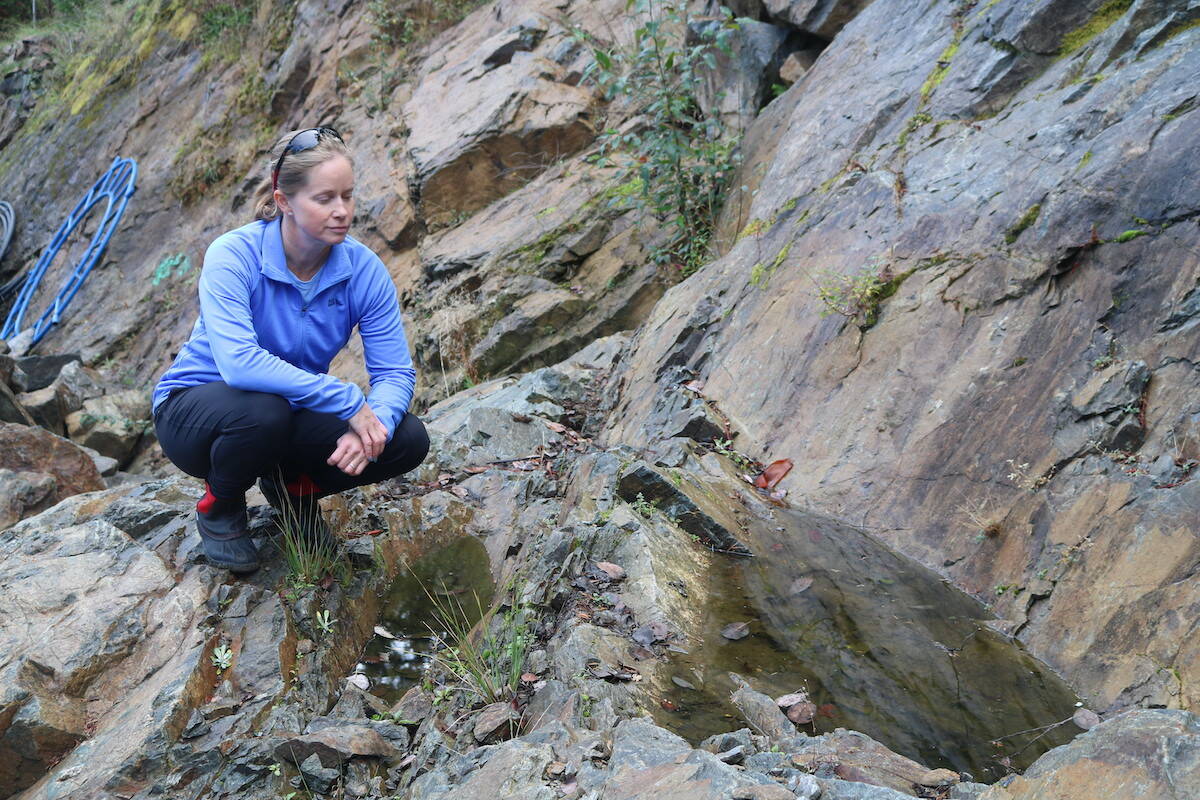
Those fears began in June 2023, when they noticed a “rainbow-coloured” liquid seeping through a fractured rock wall next to their house, in close proximity to their well.
Tests commissioned by the family found “high bacteria levels” in their well water, while the liquid seeping through the rock wall tested positive for fecal matter and E.coli, says Balogh.
The results prompted them to immediately stop using their well for domestic purposes.
A septic field uphill on their neighbour’s property, roughly 30 metres away from their well, quickly became the prime suspect as the source of the contamination. The system services a single-family home occupied since 2021, and a carriage house, which has been in use since 2018.
Balogh believes that until June 2023, her family had been unknowingly drinking contaminated water while the septic field was in use.
“You can’t taste it, you can’t see it, we were drinking it,” she says. “Our daughter was born in 2018 – she was raised on it – it’s heartbreaking.”
All four family members and their pet dog have experienced health problems consistent with waterborne infectious diseases they believe are connected to the contamination.
For her husband Chris and their 11-year-old son, the effects have been ongoing and severe, with symptoms that “present like arthritis,” says Balogh.
“We were in emergency yesterday because our son wasn’t able to walk for three days because of his joint pain in his ankles,” she says.
“My husband is on pretty heavy-duty cancer medication right now, because that’s how you have to treat this infection that’s throughout his body.”
Since first suspecting something might be wrong with their well water, Balogh says she and her husband tried repeatedly to raise their concerns with Island Health and the District of Highlands, but struggled to be heard.
In November last year, Island Health closed an investigation under the Drinking Water Protection Act, informing the family it found “no evidence of an identified threat” to their well from the neighbouring sewerage system.
Balogh says Island Health did not test their well water during the investigation, relying instead on surface observations, which she argues were flawed because they were conducted during a summer drought.
Island Health was invited to comment on the Baloghs’ complaints, but declined as the matter is the subject of active litigation.
“What’s been disheartening is nobody believing you,” said Balogh. “We’re living this nightmare, but for them it’s just a job, they don’t care – they get to go home, have a nice hot bath and sleep at night.”
As the family pushed for officials to take their concerns seriously, they also began work on installing a second well on their property. To allow access for drill trucks, trees were removed from the property and a temporary road built for access.
But that work has put them at odds with the District of Highlands and The Land Conservancy, as the site of the new well lies within a protected covenant area. Both The Land Conservancy and Highlands have since filed lawsuits against the family.
Although the new well has now been installed, Balogh says her family has been advised not to use it for domestic purposes as it is “next in line for contamination.”
But there could finally be some relief on the horizon.
A hydrogeological assessment concluded the neighbouring septic system posed an “immediate health hazard,” calling it “improperly installed and designed.”
Additional testing in November last year, conducted by environmental consultants hired by the family, confirmed a “direct hydraulic flow pathway” between the septic field’s absorption bed and the Baloghs’ well.
According to the report, it takes approximately seven days for effluent to travel from the septic system to the well.
Island Health has since taken action. Citing both reports, the health authority issued an order in October directing the neighbours to stop using the sewerage system immediately until it is either replaced or properly repaired. Once their tanks are full, the sewage must be pumped and transported to a facility legally authorized to accept it.
“I reasonably believe that the sewerage system located on the property is constructed in a manner that, in my opinion, presents a significant risk of not being capable of continuing or treating domestic sewage and may be creating a health hazard,” an Island Health environmental health officer wrote in a letter to the property owners, shared with Goldstream Gazette by Balogh.
An invitation to comment on Balogh’s allegations was sent to the property owners via their lawyers Carfra Lawton, but Goldstream Gazette was told: “No comment.”
In correspondence shared with Goldstream Gazette, Carfra Lawton stated in August that their clients continue to deny the allegations and are undertaking remediation work required by Island Health under the Public Health Act.
For Balogh, Island Health’s action feels like long-overdue validation.
“Everybody finally believes us,” she said. “Because it’s been a battle and I feel like a lot of people would have just rolled over … given up and walked away from their property.
“We couldn’t even sell, we can’t leave – we’re literally held hostage, so in our mind we had to fight.”
It also underscores the serious questions Balogh has raised over the last two years about how the septic system was permitted to operate in the first place.
According to information she obtained from Island Health and Highlands, the system operated without a Final Letter of Certification for six years – a period during which the district granted occupancy to both dwellings on the property.
A Final Letter of Certification is typically required within 30 days after installation. One was eventually filed with Island Health in the summer of 2023, shortly after the Baloghs raised concerns.
The family has since filed a lawsuit against the district, alleging it failed to ensure proper certification was in place before granting occupancy.
Highlands was asked to comment, but chief administrative officer Sarah Jones declined, citing ongoing litigation.
Additional lawsuits have also been filed against Island Health, the septic installer and the neighbouring property owners.
As Balogh prepares for the legal battles ahead, she says she’s finally beginning to feel hopeful about a fresh start for her family – and for their home.
“We’re hoping this is the start of good things,” she says. “Just to have the contamination stopped is a huge relief … and with all the rain coming through here, hopefully it will wash things out and make our property safe again.”