
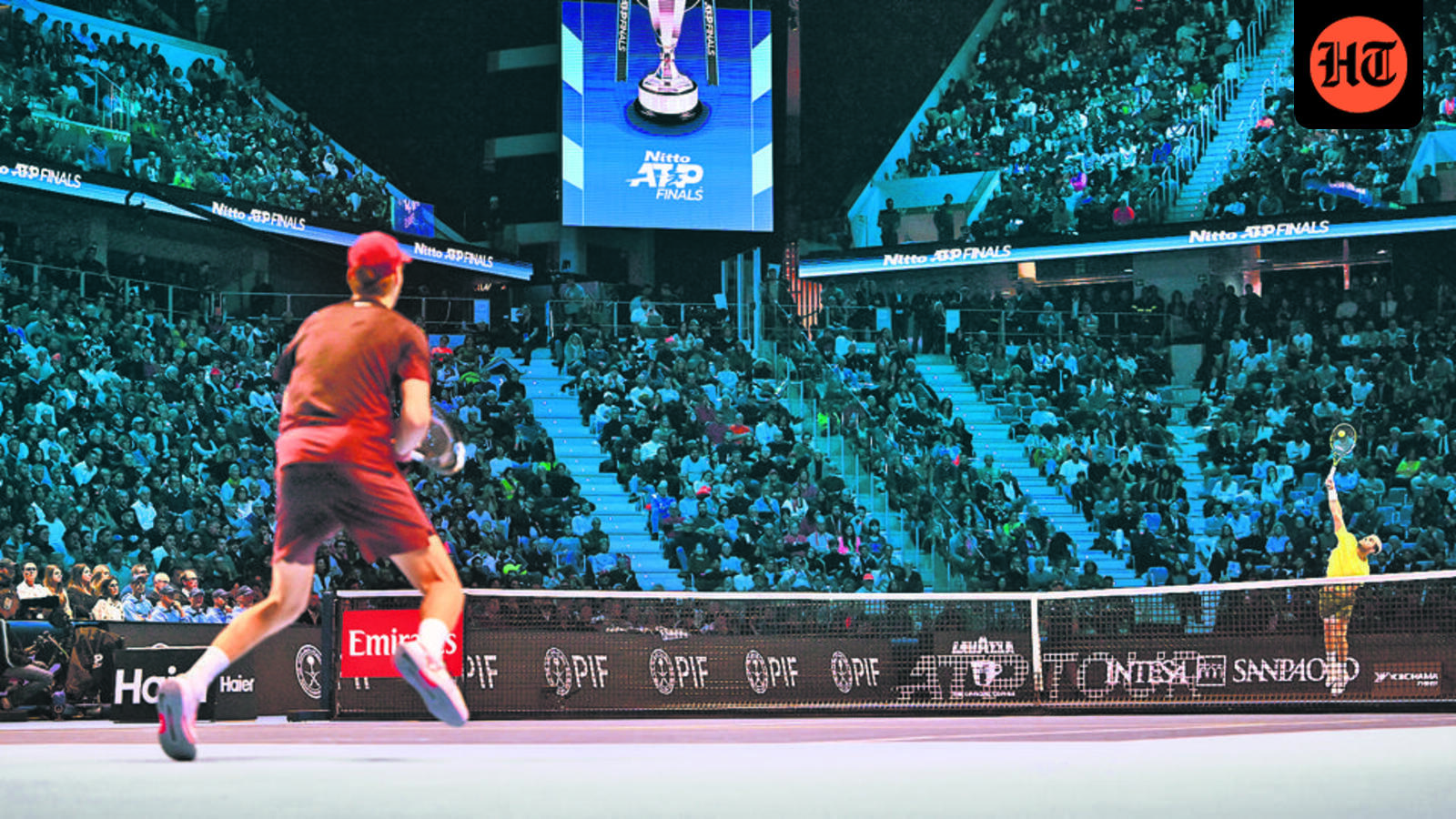
It is fitting that in the last major men’s tennis tournament of the season (the Davis Cup), it was Italy versus Spain, even if the two biggest players currently in men’s tennis were not there to lead their teams. Regardless, 2025 belonged to world No.1 Carlos Alcaraz and No.2 Jannik Sinner.
 The ball sitting up gives more time — especially to excellent movers like Alcaraz and Sinner — to reach even the most tightly angled shots. (Getty Images)
For the second season in a row, the duo split the four Grand Slams, and they were the only players who could truly get the better of each other on court — Sinner was the only player to beat Alcaraz twice this season, and Alcaraz the only player to beat Sinner more than once this year.
As this remarkable rivalry continues to develop, so does a growing trend, the further slowing down of tennis courts and balls, one that some experts, including current and former players, say favours Alcaraz and Sinner.
This year, two ATP 1000 Masters events known for their fast courts put up dramatically slower surfaces. The Shanghai Masters courts last year were measured at a pacy 40.8 on the court speed index, but this year dropped to a slow 32.8. Meanwhile the Paris Masters, held on indoor hard courts, dropped from a fast 45.5 to 35.1 this year. In comparison, clay courts — the slowest surface in the sport — tend to range within the late 20s.
The court pace index or court speed index is a complex metric measured by an algorithm that uses several factors including velocity of ball, temperature, and friction. A court speed index of 29 or lower means the court is slow; between 30 and 34, medium-slow; 35 and 39, medium; 40 and 44, medium-fast; and 45 and above, fast.
Tennis icon Roger Federer, who was the first man to reach the tally of 20 singles Grand Slam titles, and world No.3 Alexander Zverev believe that the conditions are being slowed down to favour Sinner and Alcaraz, and shine a light on their brand of attritional tennis.
A match between the top two players in the world is a big-ticket event in tennis today, prompting the allegations that courts are being slowed down to increase the chances of a Sinner-Alcaraz final. But there is also the argument that both Sinner and Alcaraz are simply a cut above the rest.
“The end of range is when you get out of the singles court and sort of into the doubles alley. With most guys, when they get into that area they start to lose shape,” said Neville Godwin, 2017 ATP coach of the year. “With (Sinner and Alcaraz), you have to go the extra metre on either side to get them into an uncomfortable position where they lose shape or strength of shot.”
In other words, an opponent has to hit in even more acute angles against the two. It is a credit to their movement, anticipation and game savvy, but is amplified by the slowing down of surfaces.
“Courts are getting more coarse, so the balls tend to grip more on the surface and sit up rather than zip off the surface,” added Godwin, who has previously trained former Wimbledon and US Open finalist Kevin Anderson and currently trains world No.54 Alexei Popyrin.
The ball sitting up gives more time — especially to excellent movers like Alcaraz and Sinner — to reach even the most tightly angled shots. However, what this is doing is making the sport one-dimensional as well.
“Because week to week there is not much change in the conditions, everyone ends up with similar game styles and nobody really needs to really adapt,” said Jamie Murray, former doubles world No.1, and elder brother of three-time major winner Andy Murray.
“So it becomes quite generic, which is not necessarily that exciting to have on tour.”
Even the difficult transition between the slow-and-high-bounce clay season to fast-and-low grass has become easier.
“In Wimbledon now, the ball bounces up to the hip or shoulder, just like if you’re playing on a hard court. But traditionally grass courts mean the ball should bounce up to your ankles, or knees at best,” Murray added.
Continuing with the trend, the balls in use are making matters worse. While courts have been slowing down since the early 2000s, in the past few years, the balls have started to become heavier and turn dead much earlier.
When a new ball comes in contact with the racquet or surface, the felt starts to fluff up making it slower as it travels through the air. What also does not help players is that each tournament has a specific contract with a ball manufacturer, and each plays differently.
“Players used to be able to adjust in maybe two or three sessions to a new situation,” Godwin explained. “Now it’s closer to four or five before you feel comfortable with the flight and bounce, and court speed. It just feels heavier. The catalogue of injuries, particularly on the shoulder and elbow for serving, have increased, and it cannot be by accident.”
Alcaraz and Sinner though have been the most successful at dealing with the changes and making something out of nothing.
“Those two guys have the ability to create a lot of power for themselves with a dead ball, with no help from the court or ball,” Murray added. “They can do that because of their racquet head-speed or timing. They can hit through those conditions while the others have struggled for various reasons.”
The most effective way to play in such conditions is to stick to the baseline rather than come up to volley.
According to statistics kept by Wimbledon and reported by ESPN, 60 % of the points played in men’s singles and 12% in women’s singles, in the 1997 edition, were serve-and-volley. This year’s competition saw 4% of men’s points being played as serve-and-volley, and the figure drops to one percent in women’s singles.
“All points are becoming very similar,” Murray added.
Coincidentally, each point looking like the other is what is said to have prompted organisers to reduce the speed of courts.
Rallies would not last long on the faster courts of the 1990s. The men’s singles final of 1994, in which Pete Sampras beat Goran Ivanisevic in straight-sets, saw a combined tally of 42 aces. The first set, which ended 7-2 in the tiebreak, lasted 49 minutes, but according to the BBC, had only five minutes of actual play.
Now we’ve reached the other end of the spectrum.
“You’d have to start considering drawing the line when you’re watching a tennis match and you feel like the skill level is diminished,” Godwin said.
“(Earlier, we’d say) they’re just serving and volleying and nobody can return. Now we have gone too much the other way, whereby nobody can volley, nobody can slice, nobody can chip… We’ve gone too much the other way. I’m not sure we’re all the way there yet, but I think we’re quite far in that direction.”
The sport, the sponsors and the fans, everyone stands to benefit from another Sinner vs. Alcaraz marathon finale. But where does it leave the rest of the players and the dynamic of the game? Where does one draw the line?