
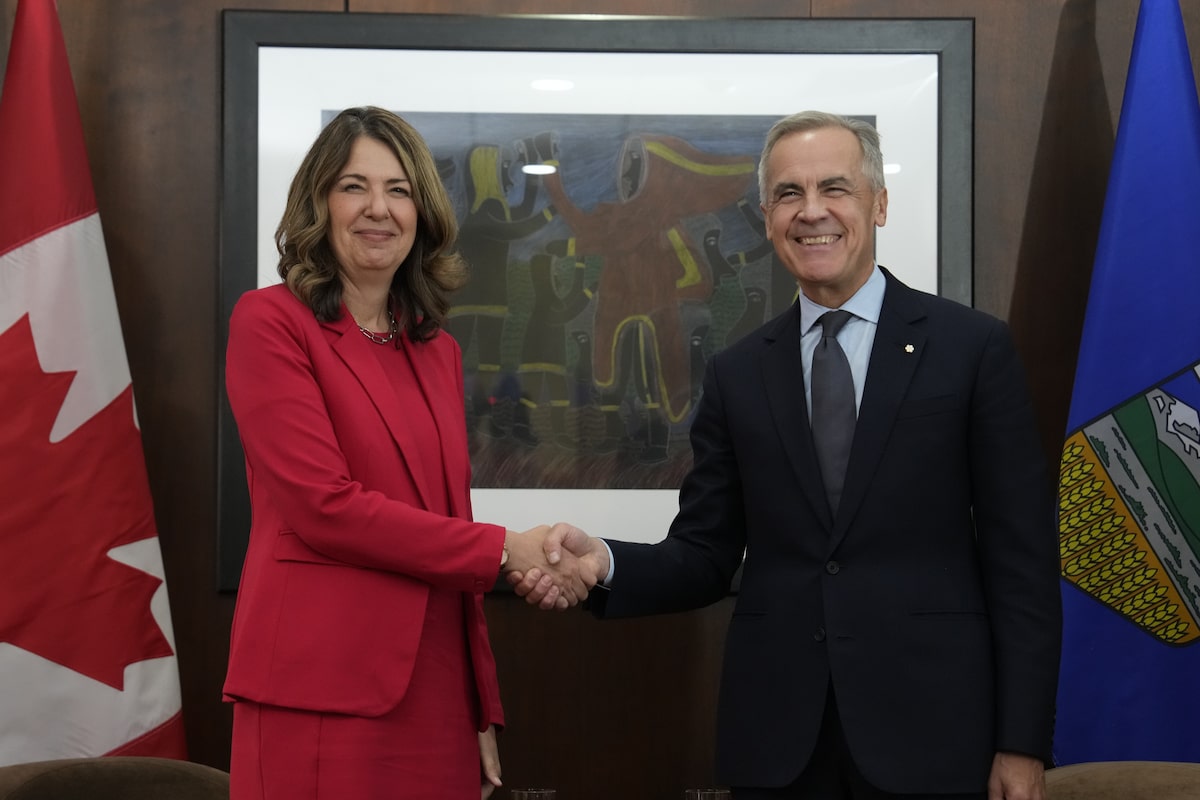
Prime Minister Mark Carney shakes hands with Alberta Premier Danielle Smith at the start of a meeting in Ottawa on Oct. 6.Adrian Wyld/The Canadian Press
Prime Minister Mark Carney and Alberta Premier Danielle Smith are set to announce a memorandum of understanding on energy in Calgary Thursday, over the objections of B.C. Premier David Eby.
Mr. Eby said he spoke privately with Mr. Carney Monday, laying out three specific concerns about a heavy oil pipeline running from Alberta to his province’s northwest coast, but received no commitment that Ottawa would heed his objections.
Mr. Eby was caught off guard last week when The Globe and Mail reported that Ottawa and Alberta were close to concluding a wide-ranging framework on energy development, including a limited exemption to the existing ban on oil tanker traffic off British Columbia’s northwest coast. That would set the stage for a new pipeline long sought by Ms. Smith.
A source told The Globe Monday that Mr. Carney and Ms. Smith are expected to sign an MOU to formalize the agreement at an event hosted by the Calgary Chamber of Commerce on Thursday.
Alberta pushes back on B.C.’s opposition to proposed pipeline
The Globe reported last week, citing two sources, that the MOU would also include a plan to move ahead with changes to industrial carbon pricing in support of scaling up carbon capture technology, and a lowering or removal of the industrial emissions cap.
The Globe and Mail is not naming the sources, who were not authorized to discuss negotiations with Alberta.
An energy deal with Alberta would be in keeping with Mr. Carney’s push to enhance Canada’s economic independence from the United States, but it has also stoked concern in B.C. over the potential consequences for the environment and relations with Indigenous groups.
Mr. Eby said B.C. had not been aware of the talks with Alberta, an issue he raised with the Prime Minister in a discussion the two held Monday.
“He has outlined to me that the agreement with Alberta is not finalized yet,” Mr. Eby told reporters. “And I took the opportunity of our conversation to outline British Columbia’s perspective.”
He told Mr. Carney that First Nations must have a say in a pipeline that goes through their traditional territory; the current tanker ban should not be lifted; and any multibillion-dollar federal subsidy to an Alberta pipeline must be matched with similar subsidy for a B.C. project.
But Mr. Eby also said there is little likelihood that any private-sector company would be willing to invest in an oil pipeline to the West Coast. “There is not a world in which [with] the current price of oil, a private company is going to step up and pay for this pipeline across the north,” he said.
A pipeline is estimated to cost $20-billion to $30-billion.
Of particular concern to B.C. is a partial lifting of the tanker ban on the West Coast because the northwest waters are wild and dangerous.
“It is an incredible precarious shipping route. It is the reason why the ban on oil tankers has existed for generations across multiple generations of different political stripes,” Mr. Eby said. “A heavy oil spill would decimate a $1.7-billion industry of fisheries and tourism and way of life in the northwest.”
Justin Trudeau’s Liberal government passed the Oil Tanker Moratorium Act in 2019, formalizing restrictions on oil-tanker traffic in northern B.C.
Mr. Eby said Mr. Carney “listened carefully but made no commitments on it” and he urged him to “at a minimum” include coastal First Nations at the bargaining table.
He also said he told Mr. Carney he found it unacceptable that B.C. was excluded from the talks. “This is not something that would happen to Quebec. This is not something that would happen to other provinces in the federation.”
Testifying before the House of Commons natural resources committee Monday, Natural Resources Minister Tim Hodgson was non-committal about the partial tanker ban.
He reiterated that Ottawa will work with any pipeline or critical-mining proponent provided they have the support of First Nations and provincial jurisdictions “and we will work with them to clear whatever barriers there are.”
But he did tell MPs that MOU negotiations are going very well with Alberta.
“That is a work in progress right now. We are getting close to a place and when that gets done, we will have more clarity,” Mr. Hodgson said.
Gary Mason: Approving a pipeline project is easy. Making it happen will be difficult and painful
An Alberta source said that MOU largely came together over the Grey Cup week through negotiations between Privy Council Clerk Michael Sabia and Larry Kaumeyer, the province’s deputy minister of energy and minerals.
The two would then brief and get input from Mr. Carney and Ms. Smith, said the source, whom The Globe isn’t identifying to get information on the talks.
In October, Ms. Smith had announced that Alberta would submit a pipeline proposal to the Major Projects Office by May of next year, though no company has said – so far – it would be willing to build it.
The MPO is a federal office that works to speed up natural resource developments and other infrastructure projects.
Asked by reporters Monday to respond to Mr. Eby’s concerns, Mr. Hodgson noted that several projects based in B.C. have recently been referred to the MPO.
“We will be talking with British Columbia in short order,” he said.