
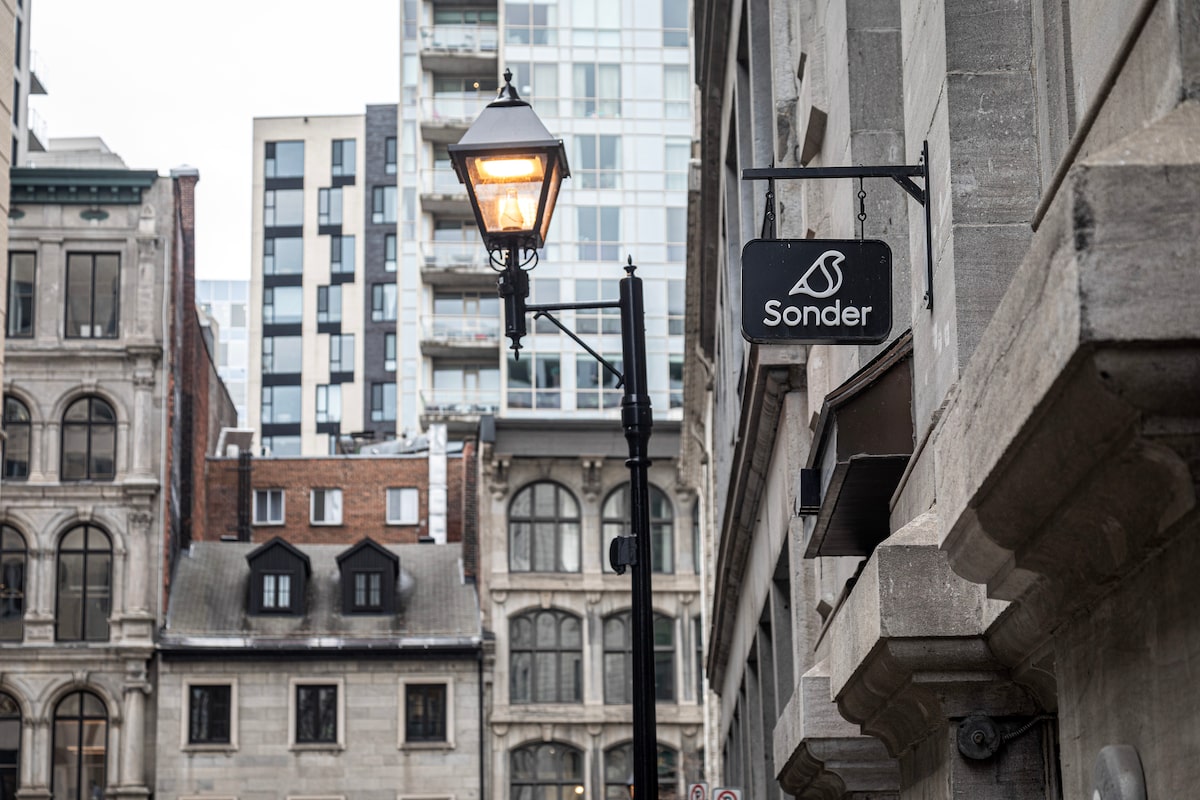
Sonder’s le Victoria location on Rue des Récollets in Montreal on Nov. 24. Sonder had hundreds of units across Vancouver, Toronto, Ottawa and Montreal, where it was founded.ROGER LEMOYNE/The Globe and Mail
After the abrupt collapse of short-term rental company Sonder, the race has begun to take over nearly 1,000 of its units in Canada and get former staff working again.
Once valued at nearly US$2-billion and seen as a rival to Airbnb Inc., Canadian-founded Sonder promised the comforts of an apartment with the consistency of a hotel suite.
It folded earlier this month shortly after Marriott International Inc. suddenly ended its licensing deal with the company. Sonder then filed for bankruptcy after more than a decade in business, with a trail of court filings that hinted at years of financial strain.
Two U.S.-based companies, Kasa, Inc. and Lark, told The Globe and Mail they’re each actively pursuing opportunities to take over the management of Sonder units in various cities across Canada. Collectively, the two companies have already taken over about a dozen such sites across North America, but it would be their first foray into the management of properties in the Canadian market.
Sonder’s abrupt shutdown leaves travellers stranded and neighbours relieved
Roman Pedan, founder and chief executive officer of Kasa, said he’s been in talks with former Sonder landlords in Toronto and Montreal. While he declined to comment on the status of any potential deals, Mr. Pedan said he could reopen the units in as little as two weeks once a deal is signed.
“They kind of fit like a glove,” said Mr. Pedan of the compatibility between Sonder and Kasa properties. His business spans 85 short-term rental and boutique hotel properties across the U.S. that closely resemble the defunct units in terms of style, setup and self-serve check-in.
The goal is to repurpose as much from the existing property as possible and re-employ many of the former staff, said Mr. Pedan. “They know the property really well. They really care.”
A sign on the door of Sonder’s Apollon location on Rue St-Sacrement in Old Montreal says the property is closed.ROGER LEMOYNE/The Globe and Mail
Sharing Sonder’s digital-first operations and suite setup – lock systems, WiFi, room layout – helps Kasa speed up the transition process. But that’s where the similarities largely end.
Before its shutdown, Sonder employed a lease arbitrage model, which involved signing long-term rental agreements with owners before renovating and renting out the space. Kasa operates through management agreements, taking over day-to-day operations rather than leasing the properties themselves.
“It avoids the mismatch of fixed obligations and volatile demands,” said Mr. Pedan. As he sees it, the lease arbitrage model is “a weapon of financial destruction for companies.”
Selina and WeWork are just two examples of businesses that employed the model and filed for bankruptcy in the last five years.
WeWork CEO David Tolley to step down as company exits bankruptcy
Robert Blood, founder and chair at hospitality company Lark, said he is currently pursuing negotiations for Sonder units in the Vancouver area and has reached out to some property owners in Toronto and Montreal.
Similarly to Kasa, Lark offers third-party hotel management with independently branded properties. It operates about 75 properties across North America.
Mr. Blood’s team is also looking to re-employ former Sonder staff.
Lark has already transitioned one Sonder property in Cambridge, Mass., since the company’s collapse, and had earlier done so with a property in Mexico City.
But locating and connecting with owners amid bankruptcy proceedings has been a challenge, said Mr. Blood.
A man peers into the entrance of Sonder Apollon in Montreal.ROGER LEMOYNE/The Globe and Mail
And not everyone is thrilled about the possibility of any new hospitality tenants taking over Sonder properties.
“Ideally, we would want these units to become part of non-market rentals, which would help the over 92,000 people on the waitlist for affordable, social housing in the City of Toronto,” said Yaroslava Montenegro, executive director of the Federation of Metro Tenants’ Associations.
With the fall of Sonder, “all levels of government should have jumped at the opportunity to acquire these rental units,” she said.
Mr. Pedan said he understands why people raise concerns around housing. But, he said, short-term rentals have “become a convenient scapegoat for a problem they simply don’t cause.”
Furnished and flexible rentals house travelling nurses, workers on corporate rotations and “thousands of others who don’t fit the traditional 12-month-lease mould,” said Mr. Pedan, adding that the stays generate taxes and fund city services.
While he is eager to launch his business in Canada, he said Kasa will only do so under the right circumstances.
Reopening a Sonder property involves securing new licences and clearing regulatory hurdles and, in Canada, there are additional language and legal requirements as well as currency considerations. But Mr. Pedan said these were “minor blockers.”