

GW
Gowling WLG
More

Gowling WLG is an international law firm built on the belief that the best way to serve clients is to be in tune with their world, aligned with their opportunity and ambitious for their success. Our 1,400+ legal professionals and support teams apply in-depth sector expertise to understand and support our clients’ businesses.
In 2022, it was estimated that 8 million Canadians have one or more disabilities that limited them in their daily activities.
Canada
Privacy
To print this article, all you need is to be registered or login on Mondaq.com.
Article Insights
Antoine Guilmain’s articles from Gowling WLG are most popular:
with Senior Company Executives and HR
in Canada
with readers working within the Oil & Gas industries
Introduction
In 2022, it was estimated that 8 million Canadians have one or
more disabilities that limited them in their daily activities. Over
the past two decades, in an effort to reduce the persistent
challenges faced by this significant portion of the population, the
federal government—and many provincial governments—
have introduced accessibility legislation aimed at preventing and
removing barriers.
Accessibility refers to the design and delivery of environments,
services, products, and information in ways that allow people of
all abilities to participate fully in society. While accessibility
legislation in Canada covers a broad range of areas, this article
focuses specifically on laws that govern digital accessibility in
the private sector. It does not address employment-related
obligations or broader human rights protections. Instead, it
highlights the standards most relevant to digital platforms and
services.
Digital Accessibility
As digital platforms become increasingly central to how
Canadians live, work, and connect, governments across Canada have
enacted legislation to ensure these platforms are accessible to
everyone.
Known as digital accessibility, this concept is evolving from
best practice into a legal requirement. It refers to the inclusive
design and development of digital technologies—such as
websites, mobile apps, and electronic documents— so they can
be used by all individuals, regardless of ability.
For organizations operating in the digital space, understanding
and complying with these requirements is essential— not only
to meet legal obligations, but to promote inclusive service
delivery. In this guide, we break down the Canadian legal
obligations and applicable accessibility standards.
The Canadian legal landscape
Federal level: Accessible Canada Act
Canada’s federal digital accessibility regime is governed by
the Accessible Canada Act (“ACA”), which came into force
in 2019. The ACA aims to make Canada barrier-free by January 1,
2040, and applies to federally regulated entities, including
government departments, Crown corporations, and private-sector
organizations such as banks, telecommunications providers, and
transportation companies.
Under the ACA, organizations must:
Develop and publish Accessibility Plans every three years.
Establish a process for receiving and responding to feedback on
the Accessibility Plan.
Report annually on progress made, in consultation with persons
with disabilities.
To support these requirements, Accessibility Standards Canada
formally adopted the European Harmonized Standard EN 301 549
(v.3.2.1) as a National Standard of Canada in May 2024 (discussed
in greater detail below).
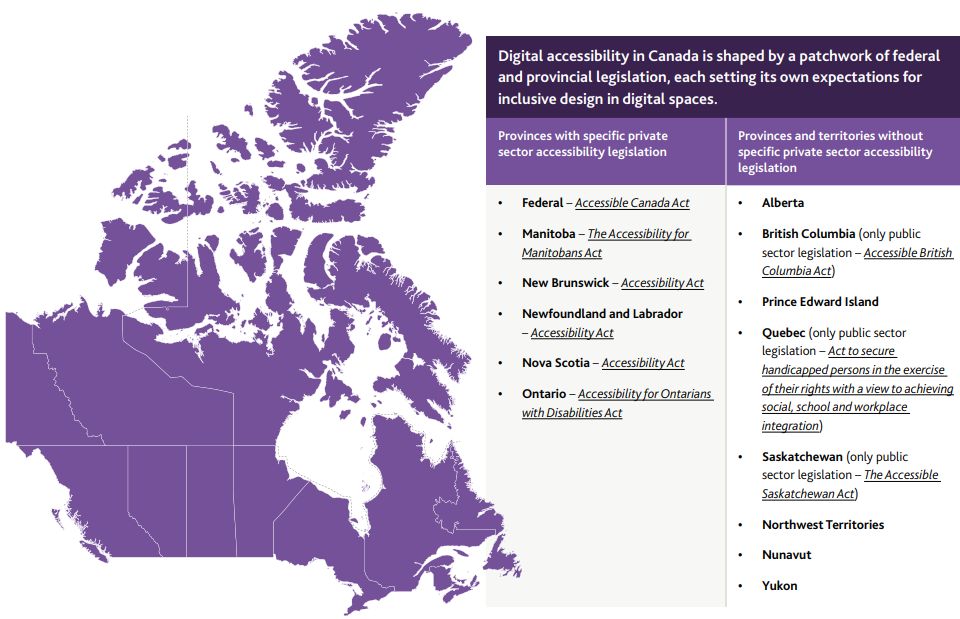
Provincial level
Several provinces have introduced their own accessibility
legislation. While some have implemented laws covering both the
public and private sectors, others focus solely on the public
sector. A few provinces currently have no specific digital
accessibility legislation in place, as outlined in the table
above.
A review of the different legislation shows a priority to tackle
accessibility in areas such as goods and services, employment, the
built environment, accommodations, public transportation and
education. However, for the purposes of this article we’ll be
focusing on legislation which tackles accessibility in the
Information and Communication Technology (“ICT”)
sector.
Currently, Ontario, Manitoba, Nova Scotia, Newfoundland and
Labrador, New Brunswick, British Columbia and Saskatchewan all
include ICT as a thematic priority for accessibility. Alberta,
Prince Edward Island, Northwest Territories, Nunavut and Yukon
currently do not have specific accessibility legislation.
Quebec’s legislation does not refer to ICT.
To view the full article click here.
Read the original article on GowlingWLG.com