
With the trade war with the U.S. continuing to affect workers in key provincial industries, the Legault government is leaning in on a series of measures in hopes of putting money back into Quebecers’ pockets.
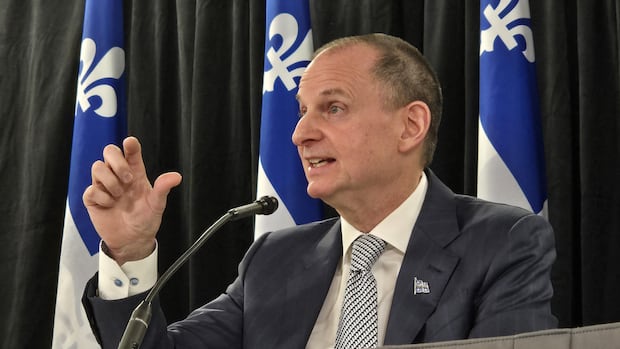
Finance Minister Eric Girard unveiled an economic update that includes tax breaks for workers, using the Green Fund surplus to tackle the province’s debt and provide support to companies hit hard by U.S. President Donald Trump’s tariffs.
According to Tuesday’s economic update, Quebec’s economic growth in 2025 and 2026 will be more pronounced than projected in the last budget.
The deficit for 2025-26, as defined by the Balanced Budget Act, is $12.4 billion, which is smaller than the $13.6 billion total that was projected last year.
The forecast is based on the assumption that the effective tariffs on Quebec imposed by the Trump administration will be under 10 per cent, but that they could persist.
The province’s real GDP is expected to increase by 0.9 per cent in 2025, 1.1 per cent in 2026, after a gain of 1.7 per cent in 2024.
Still, Girard plans to help workers save $1.8 billion over five years through a reduction of contribution rates to the Quebec Pension Plan (QPP) and Quebec Parental Insurance Plan (QPIP).
Starting Jan. 1, 2026, employees in Quebec will stand to save up to $137, according to the province’s economic update. That number jumps to $259 for self-employed workers.
“Today in the current context of economic uncertainty, we are not only making the responsible choice to protect Quebecers’ purchasing power, who must cope on a daily basis with the rising cost of living, but also to protect businesses that are affected by tariffs and changes transforming our economy,” Girard said.
Use of Green Fund surplus
Girard announced he will be using the $1.8 billion surplus from the province’s Green Fund — money meant to tackle climate change — to help pay off the province’s debt.
In his update on the province’s economy, Girard explained that the surplus will instead go toward Quebec’s Generations Fund in 2026-27, which he says will contribute to generational fairness and give Quebecers “flexibility in the long term.”
Most of the fund’s surplus stems from the previous government.
“If we use the surplus, we will increase government spending, and when we have a deficit, the last thing we want to do is increase spending,” Girard told reporters. “So for seven years, we didn’t use this surplus to avoid an increase in spending.”
In order to redirect the entirety of the Green Fund surplus to pay off the province’s debt, the government is relying on the adoption of Bill 7, an omnibus bill sponsored by Treasury Board President France-Élaine Duranceau.
Liberal critic for finance, Frédéric Beauchemin, said Girard’s final economic update helps the government appear as though it is managing public funds well, although the savings promised to Quebecers have “nothing to do” with the government’s ability to manage debt.
He pointed to the Green Fund surplus being used for the Generations Fund as an example.
“They’re taking away from your left pocket to put into your right pocket,” Beauchemin said.
Québec Solidaire finance critic Alejandra Zaga Mendez said her party was “not impressed at all” with the economic update due to Girard presenting few initiatives to lower the cost of living for Quebecers and the government redirecting the Green Fund surplus.
“If you want to be fair with future generations, it’s to stop climate change right now. It’s to invest in green initiatives. That was more fair and that was the deal with the carbon exchange system,” Mendez said.
WATCH | Legault’s economic vision unveiled earlier this month: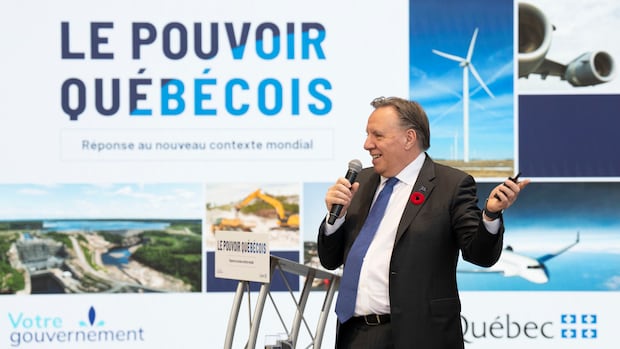
Energy development at centre of Legault’s new economic vision to deal with U.S. tariffs
Premier François Legault’s strategy, called Quebec power, includes accelerating major infrastructure projects, boosting hydro production and ensuring the province’s businesses get their fair share of federal defence contracts. He says the idea is to replace jobs that will be lost due to the trade war caused by Donald Trump’s tariffs.
Quebec’s net debt burden will stand at 39 per cent of the province’s GDP as of March 31, 2026.
The government is continuing to aim to balance the budget by 2029-30. It hopes to bring down the debt burden to 32.5 per cent of GDP by 2037-38.
Aid for citizens
In line with the federal government, the Legault government is cancelling the increase in the capital gains inclusion rate, which represents a gain of more than $2 billion for Quebec citizens, Girard said.
The Quebec government also plans to implement a 2.05 per cent indexation of the parameters of personal income tax system and social assistance benefits, starting Jan. 1, 2026.
To support vulnerable people, the Quebec government will ensure that funding will be available for the Residential Adaptation Assistance Program and the RénoRégion programs — initiatives aimed at improving housing conditions.
It will also increase the special benefit for the purchase of infant formula from $22.50 to $45 starting on April 1, 2026, which will help low-income parents whose children rely on the product.
Relief for tariff-stricken industries
The province is also putting in place measures to allow businesses to write off certain types of investments more quickly and to allow businesses in the manufacturing sector to save on taxes when investing in their factories and therefore to see an immediate increase in their cashflow.
The government will be providing a two-year payroll tax holiday for businesses in the fishing, agriculture and forestry industries, which have been especially affected by Trump’s tariffs.
In 2026 and 2027, the contribution rate to the Health Services Fund will fall to 0 per cent for the following industries:
Agricultural crops, livestock and aquaculture. Logging, sawmills and pulp and paper mills. Fisheries.
This measure corresponds to savings of over $43,000 for the forestry sector, nearly $6,000 for the agricultural sector and nearly $2,500 for the fishing sector.
Similar to the federal government, immediate expensing will apply to investments in buildings used for manufacturing or processing activities to support manufacturing businesses investment.
The initiative applies to property acquired on or after Nov. 4, 2025 and will be ”phased out over a four-year period from 2030 to 2033,” the update says.