
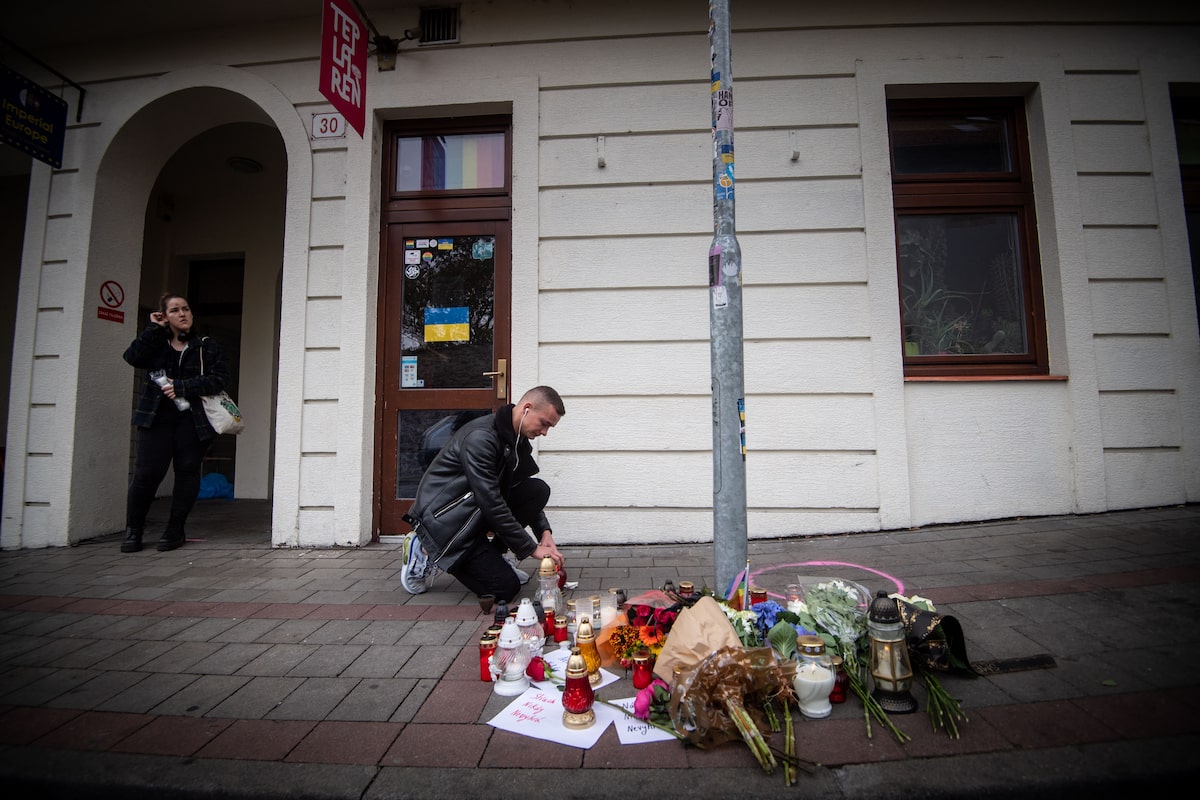
A man places a candle on the pavement at Zamocka Street in Bratislava on October 13, 2022 after a teenager shot dead two men at the Teplaren bar, a gay bar. Manifestos circulated on Terrorgram have played a role in inspiring deadly attacks, including this one, according to U.S., British and Australian authorities.VLADIMIR SIMICEK/Getty Images
A white-supremacist group known as the Terrorgram Collective, whose online manifestos glorifying Nazis are aimed at youth, has been blamed for inspiring a deadly shooting at a gay bar in Slovakia in 2022 and a mass stabbing at a mosque in Turkey in 2024.
The group’s online reach has become apparent in Ontario, where judges in Ottawa and Toronto have recently convicted two men of terrorism charges for spreading Terrorgram’s propaganda.
Governments in Britain, the U.S. and Australia have designated Terrorgram as a terrorist group. But Canada has not.
Federal cabinet ministers are responsible for designating terrorist groups. The list currently comprises nearly 90 groups, including Mexico’s Sinaloa Cartel and India’s Bishnoi Gang, transnational crime groups added for the first time by the government this year.
Created in the wake of the Sept. 11, 2001 attacks, the list primarily included Islamist extremist groups such as al-Qaeda when it started, but more recently, several violent white-supremacist groups have been added.
Ontario man, member of now-defunct neo-Nazi group, pleads guilty to terrorism charges
Designating a group as a terrorist organization is significant. It can prompt law-enforcement agencies to launch investigations or redirect resources. Such listings also give banks the power to seize assets and may also lead border guards to step up scrutiny of suspected members.
“It has teeth,” says Stephanie Carvin, a national-security professor at Carleton University. “If it’s believed that you are a member of one of those organizations, then good luck having a bank account − and good luck existing in the 21st century.”
The Canadian government should consider listing Terrorgram and related groups, Evan Balgord, executive director of the Canadian Anti-Hate Network, said in an interview.
Mr. Balgord pointed out that the group’s two convicted Ontario operatives have been described in court as men who started neo-Nazi fighting clubs that were allegedly recruiting young men to spread hate.
“That’s the most serious threat on our doorstep right now,” Mr. Balgord said. “So I’d like the question to be asked: Should we designate them? And why aren’t we?”
In response to questions from The Globe and Mail for this story, Canadian government officials explained the government’s process for designating a terrorist organization but declined to say whether it has plans to designate the Terrorgram Collective.
Tim Warmington, a spokesman for Public Safety Canada said, “an entity may be added if there are reasonable grounds to believe that it has knowingly carried out, attempted to carry out, participated in, or facilitated a terrorist activity.”
The Terrorgram Collective rose during the pandemic, when neo-Nazis around the world gathered in online encrypted chat groups to discuss their shared aim of overthrowing governments, according to an expert witness who gave evidence in Ontario’s Superior Court this year in connection with the two recent convictions.
The terrorism expert, Matthew Kriner of the U.S. Middlebury Institute for International Studies, wrote in a court-filed report that the postpandemic period is “defined by the rise of the Terrorgram Collective and its dominance.”
Manifestos circulated on Terrorgram have played a role in inspiring deadly attacks, according to the U.S., British and Australian governments. The shooting in Slovakia killed two people; five were injured in the mass stabbing in Turkey.
Britain’s Home Office placed the Terrorgram Collective on its terrorist entities list in April, 2024. In that Parliament, politicians applauded the measure and denounced the group’s “fascist” world views including “vile antisemitism.”
In early January, 2025, the United States followed suit.
“The group promotes violent white supremacism, solicits attacks on perceived adversaries, and provides guidance,” the U.S. State Department said in a statement designating the Terrorgram Collective.
Ottawa man sentenced to 10 years over neo-Nazi terrorist propaganda
While designating a group as a terrorist entity can highlight threats and assist law-enforcement probes, such measures are not necessarily needed to lay criminal terrorism charges.
Months before the American designation, U.S. authorities charged several citizens with being Terrorgram operatives. In one case, California attorney Phillip Talbert alleged two Americans had sought to harm minority groups and had also “doxed and solicited the murder of federal officials.”
This past June, Australia also designated the group after laying individual criminal charges. “By listing Terrorgram, the Australian Government is acting to keep Australians safe from terrorism and violent extremism,” said Tony Burke, Minister for Home Affairs in a statement.
Officials there allege that last year a 19-year-old local man attempted to livestream his terrorist attack targeting a politician in New South Wales. He faces life in prison for his thwarted attack, which led Terrorgram members to post advice on how others could carry out more successful strikes.
The Terrorgram Collective’s Canadian activities were exposed in Ontario courts this fall, in the cases where two men were convicted of terrorism offences.
Both had started out in the Atomwaffen Division − a neo-Nazi terrorist group that Canada has listed. But as that group splintered, they became influential members of Terrorgram.
In September, Ottawa’s Patrick Gordon MacDonald was sentenced to 10 years in prison for terrorism – in part, for his role in videos he produced, which the judge described as “supporting violent extremism.”
“The videos and the offender’s graphic designs glorifying senior Nazis created a heightened level of propaganda on the Internet. The videos also helped to radicalize individuals, especially in the 10-to-20-year age group,” Ontario Superior Court Justice Robert Smith wrote in his sentencing ruling in September.
Mr. MacDonald had pleaded not guilty to terrorism.
Matthew Althorpe is to be sentenced this winter in a Toronto court. In October, he pleaded guilty to terrorism offences that included co-writing and spreading key Terrorgram manifestos.
Prosecutors are seeking a 20-year prison sentence, while his defence lawyer is seeking 14 years.
Court heard these manuals that were instrumental in indoctrinating attackers who hatched the deadly plots in Slovakia, Turkey and other countries.