
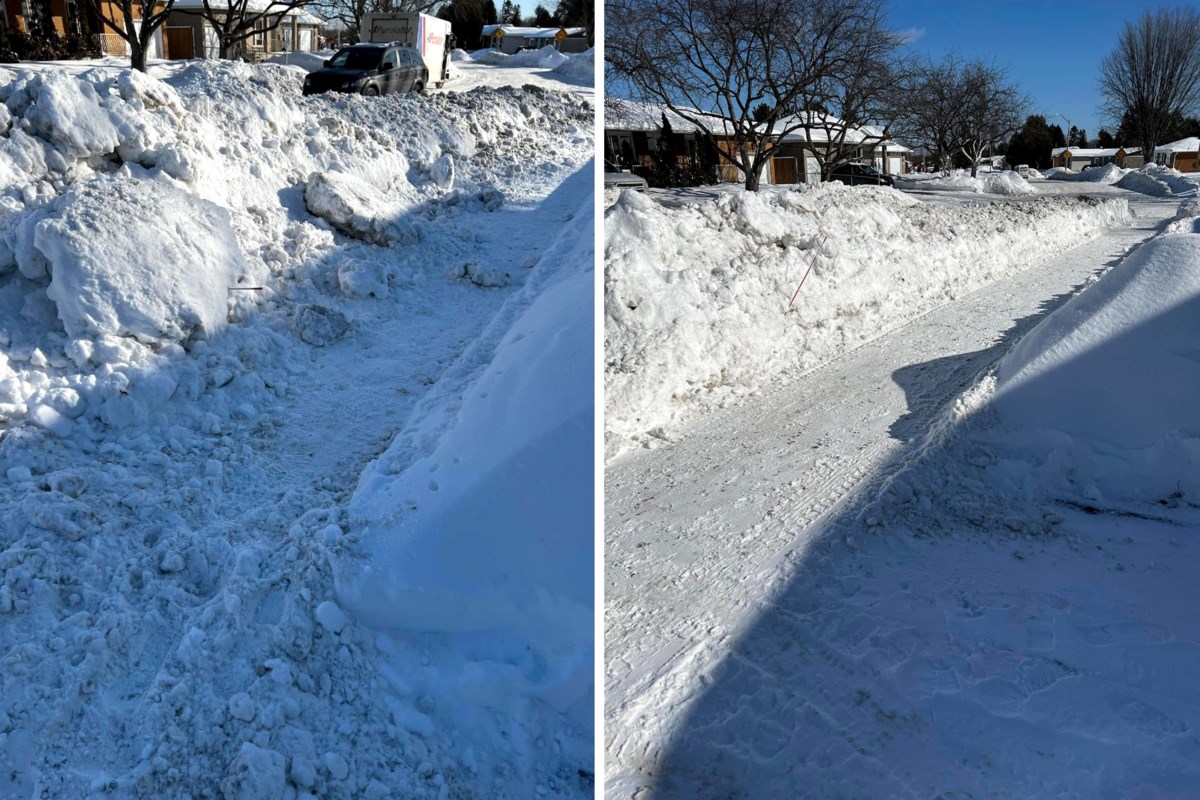
The group Greater Sudbury Safer Sidewalks says surveys it has conducted during the past two years of a pilot project exploring enhanced winter sidewalk maintenance clearly show the public wants the project to become permanent
You may have noticed that it has been easier to get around on the sidewalks the past two winters. That is because of a pilot project improving winter sidewalk maintenance.
During budget deliberations coming up Dec. 2-4, city council is expected to vote on whether to make the pilot a permanent improvement. Doing so would support better mobility, health, safety and quality of life for all of us. It would benefit everyone, and it would especially benefit seniors, young families and those with mobility challenges.
It is the right decision for our city and for the wellbeing of residents.
Whether you are getting to your destination on foot, with a mobility device, by bus or in your vehicle, you depend on clear sidewalks to get around. When sidewalks are clear you can get to work, to school, to medical appointments, to groceries, to family — in short, to the destinations necessary for daily life, and for the daily functioning of our community and economy. When sidewalks are clear, you can go for a walk, meet your neighbours, follow your doctor’s advice to keep active (i.e. you can maintain your physical, mental, and social health).
Mobility is a basic right in every season, and clear winter sidewalks are essential transportation infrastructure.
Through my work with Coalition for a Liveable Sudbury, every winter I heard from residents who were housebound, isolated, injured or missing work because of poor sidewalk conditions. In 2020, residents came together to form Greater Sudbury Safer Sidewalks (GSSS) to advocate for better winter sidewalk conditions.
After successfully advocating for a review of winter sidewalk maintenance standards (in February 2021), GSSS carefully documented the impact of current sidewalk maintenance standards on residents in a report shared in May 2021, based on a survey of 428 residents from every ward.
The results starkly demonstrated the toll of poor winter sidewalk conditions:
49 per cent of respondents had fallen and injured themselves on icy sidewalks;
45 per cent often or always had to stay at home during the winter because they could not get around on the sidewalks;
68 per cent went on the street because sidewalks were impassable, even though they felt unsafe in traffic;
68 per cent felt unsafe using sidewalks to get to essential destinations.
Residents reported being unable to get to where they needed to go, being fearful of walking, and suffering negative impacts to their physical health.
“My older parents and I cannot leave our house because we are afraid of falling” one respondent said, while another shared,“This winter, poorly plowed sidewalks have meant I don’t go out to exercise very much. That’s bad for my mental health, my physical health and my sleep.” And yet another said, “Sidewalks limit my ability to get groceries and medications.”
In June 2023, GSSS brought these voices (and this data) to Tom Davies Square, in a presentation to the city’s Operations Committee, and in September of 2023, that committee voted in favour of a pilot project for improved winter sidewalk maintenance. The pilot project ensured that every sidewalk was plowed once per week whatever the weather, and also gave more capacity to clear sidewalks after storms.
It was carried out in the 2023-2024 and 2024-2025 winter seasons, and during both winters, GSSS evaluated the results by calling on residents to share their experiences and crunching the data.
Both the residents and the numbers spoke clearly: the pilot project made a positive difference for sidewalk conditions and residents’ lives. You can read the 2023-2024 report here and read the 2024-2025 report here.
Winter sidewalk conditions affect residents deeply, and this is reflected in the high levels of engagement and dedication shown in documenting the pilot results. Ninety-six residents the first winter, and 90 the second, from every part of Greater Sudbury, took time to report on sidewalk conditions, many of them on a weekly basis.
Many people commented that they felt the pilot project made a positive difference for sidewalk conditions, and for their mobility and experiences using sidewalks. In fact, last winter, this was the second most common type of open comment shared.
Let’s take a closer look at the numbers from the 2024 2025 winter season. Unsurprisingly, sidewalk conditions were more often good or acceptable on days when residents reported that the sidewalk plow had passed, demonstrating the value of more frequent plowing.
Among residents reporting their sidewalk conditions weekly, walkers reported good or acceptable conditions a high percentage of the time (median 69 per cent) and unsafe or impassable conditions a smaller percentage of the time (median 31.5 per cent). However, residents with mobility challenges (using a mobility device or stroller), found sidewalk conditions unsafe or impassable more than half of the time (median 55 per cent), and reported sidewalk conditions to be good or acceptable less than half of the time (median 45 per cent). The year before, during a milder winter, walkers reported good or acceptable conditions a median of 86 per cent of the time, and those using a mobility device 67 per cent.
These results show that the pilot project was an important improvement over status-quo service levels, but that more improvements are needed during poor weather, especially for residents with mobility challenges.
Sidewalk conditions were not consistently clear 24 hours after a storm (as required by the current service standard). However, from the data, and comments from residents, it appeared that sidewalk conditions could be acceptable after a storm if a sidewalk plow was available to clear the sidewalk soon after the snowstorm, and again after the road plow had passed and filled the sidewalk (which sometimes happened multiple times, especially on busy roads). This indicates the importance of frequent or continuous plowing for all routes, especially after storm events, rain on snow, or freeze-thaw events.
In all years, whether looking at all survey responses for sidewalk and intersection conditions, responses from weekly monitors, responses during or after significant weather events, or qualitative comments, the most frequent challenges remain icy conditions, sidewalks or intersections blocked with snow, deep snow, and slush. All of these challenges are addressed by more frequent plowing and sanding.
The experiences shared by residents provide a strong basis for the need to continue the pilot project and to further enhance winter sidewalk maintenance.
On Sept. 15, the city’s Operations Committee voted to continue the pilot project this winter (2025-2026), and requested a business case to make it a permanent service level change. This business case is expected to be voted on by the Finance Committee on Dec. 2-4.
During budget deliberations, council has the opportunity to make an important step forward for residents’ quality of life and basic mobility, by making the pilot project a permanent improvement. If they vote yes, our community will be better for it.
Naomi Grant is a member of Greater Sudbury Safer Sidewalks.