
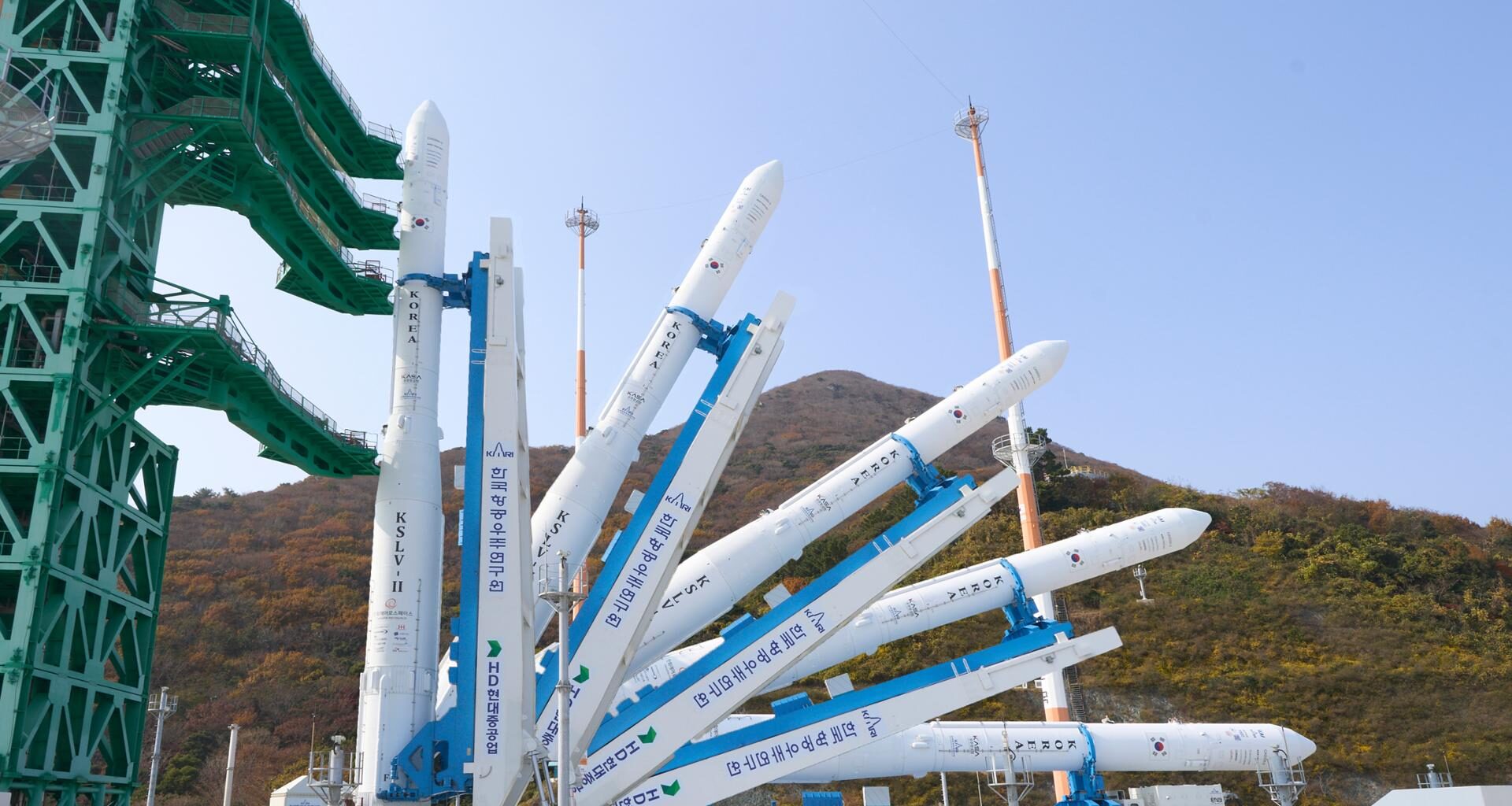
Final preparations for the fourth launch of Korea’s homegrown space rocket Nuri were under way Wednesday, according to the country’s space agency, as the country seeks to place 13 satellites into orbit through the mission set to take place shortly after midnight.
The 200-ton Nuri is set to blast off from Naro Space Center in the country’s southern coastal village of Goheung, South Jeolla Province, at around 1 a.m. Thursday, according to the Korea Aerospace Research Institute (KARI).
The positioning of the rocket on the launchpad, which began Tuesday, was completed at around 11 a.m. The exact liftoff time is expected to be announced at around 8 p.m.
The launch is expected to proceed without major weather-related disruptions, according to the Korea Meteorological Administration.
It will mark the fourth launch of the homegrown space rocket, with Hanwha Aerospace having overseen the entire assembly process for the first time as part of the government’s long-term plan to hand over space technologies to the private sector.
Korea first launched the Nuri rocket in October 2021, which failed to enter orbit while carrying a 1.5-ton dummy satellite.
In June 2022, Korea made the second attempt, which successfully put a Performance Verification Satellite (PVSAT) and a 1.3-ton dummy satellite into orbit.
The third launch was held in May 2023 with Korea successfully putting a next-generation small satellite and seven cube satellites into orbit.
In the latest launch, Nuri will aim to reach an altitude of 600 km, compared with the 550 km achieved during the third round.
The rocket is loaded with one next-generation medium-sized satellite, the CAS500-3, along with 12 cube satellites developed by local universities and companies.
The CAS500-3, developed by Korea Aerospace Industries and weighing 512 kilograms, will be tasked to conduct space science research, including measurement of space magnetic fields and plasma along with observation of auroras.
When the rocket reaches the target altitude, the medium-sized satellite will be separated first, followed by two cube satellites at intervals of 20 seconds.
The combined weight of satellites and equipment loaded on the rocket is around 960 kg, heavier than the third launch’s 500 kg.
After deploying all satellites, Nuri will operate a collision-avoidance maneuver and dump the remaining fuel to complete its estimated flight of 21 minutes and 24 seconds.