
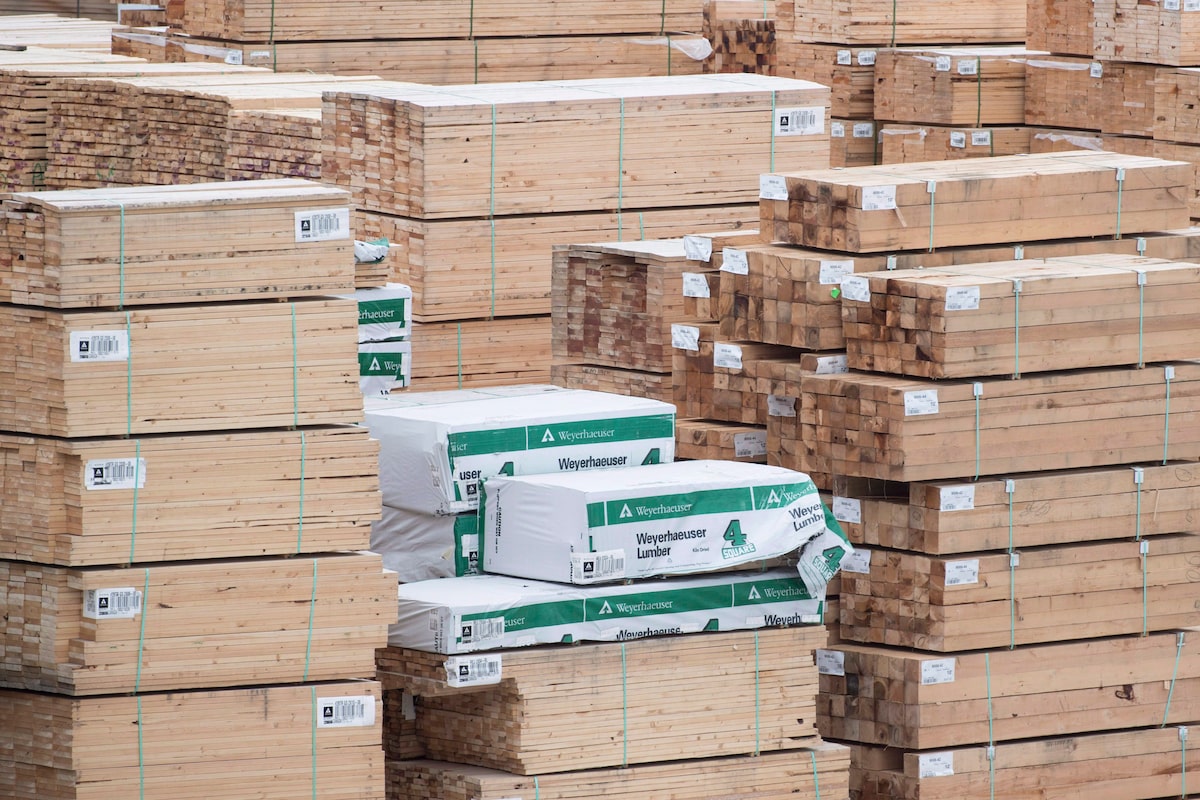
The Business Development Bank of Canada rolled out the government’s loan package for the softwood lumber industry in October.JONATHAN HAYWARD/The Canadian Press
Canada’s banks have told Natural Resources Minister Tim Hodgson that loans for struggling softwood lumber companies will roll out in the coming weeks, but cautioned that gaps in Ottawa’s support program could leave some out of the running for tariff assistance.
Mr. Hodgson met with senior banking executives on Monday evening in a push to accelerate the federal government’s $700-million loan package for the softwood lumber companies, according to two sources. The softwood lumber industry has warned that, without faster financial support in the face of an intensifying U.S. trade war, businesses could start closing.
Prime Minister Mark Carney pledged support for the industry in early August, including programs to diversify and expand trade of Canadian wood products abroad. In mid-October, after several weeks of discussions with industry groups and banks, the Business Development Bank of Canada rolled out the loan package and lenders started accepting applications.
Legault warns 30,000 Quebec forestry jobs could be lost as trade war continues
The BDC guarantees the loans and the banks assess and administer them.
But the industry is sounding alarm bells that businesses have yet to receive the loans. The concerns prompted the minister to speak with lenders about the urgent need to distribute loans, two of the sources said.
The Globe and Mail is not identifying the sources because they are not authorized to speak publicly about the matter.
Various groups have said they are disappointed by the rollout of BDC’s financial supports, which they say has been too slow.
The BC Lumber Trade Council, the Forest Products Association of Canada, the Canadian Lumber Trade Alliance and the Independent Wood Processors Association of British Columbia are among the groups concerned about the fate of sawmills that are operating at below break-even levels.
“Given the acute financial pressures facing parts of the sector, frustration is growing over the pace of program implementation and the absence of firm timelines for when credit will actually flow,” Kurt Niquidet, president of the BC Lumber Trade Council, said in a statement on Tuesday.
Minister of Energy and Natural Resources Tim Hodgson speaks during Question Period on Nov. 20.Adrian Wyld/The Canadian Press
At the meeting, Mr. Hodgson impressed on the banks that there are deepening challenges in the softwood lumber sector and the government wants to help address any barriers to issuing loans quickly.
In August and September, the BDC consulted with several industry, Indigenous and financial-services groups to build the program and negotiate the terms of the loan package. The federal Crown corporation aims to help small and medium-sized forestry operations by backstopping financial terms with existing lenders.
Since the BDC launched the program a month ago, the applications have been cycling through complex due-diligence and credit-risk procedures at the banks. This typically takes multiple weeks of discussions with the businesses and reviewing financial documents.
The process is further complicated given the precarious state of the softwood lumber industry, made up of companies with a range of balance-sheet and risk issues. When banks lend money, they weigh the health of the company and the amount of risk the lenders can accommodate in their portfolios.
U.S. alleges Canada is subsidizing softwood industry with $1.2-billion in funding
While companies will start receiving loans over the next few weeks, some senior bank leaders cautioned that particularly distressed companies may be unable to participate in the federal government’s program, according to two sources.
Some of the businesses are already carrying too much debt and cannot take on more loans. Others have prohibitively low credit ratings and – even with the BDC backing the loans – may not be eligible for financing, according to two of the sources.
When negotiating the terms of the loan agreements with the banks, the BDC set certain standards, including credit ratings, as low as possible to ensure a wide range of companies could receive support.
For those companies that do not immediately meet the banks’ lending criteria, the BDC is reviewing applications on a case-by-case basis, BDC chief community banking and impact officer Miguel Barrieras said in an interview.
The BDC recently addressed an application from a business that narrowly missed the banks’ lending criteria. The BDC validated the business – a process that substantiates a company’s application through a different set of standards than a traditional lender – so the banks can authorize the loan.
“There’s a sense of urgency given the state of the working capital position and liquidity. All participant association banks and the BDC are trying to work as fast as we can and we’re being as responsive as we can,” Mr. Barrieras said.
The process “naturally takes several weeks, even when done fast. We’re all trying to reassure the businesses it’s on its way.”
Ottawa is planning on announcing further assistance for the softwood lumber sector by the end of the week, one of the sources said. The package is not yet finalized, but the government has considered a variety of recommendations from lenders and businesses.
Lumber industry warns of crisis as B.C. and Ottawa prepare for softwood summit
B.C. Premier David Eby and provincial Forests Minister Ravi Parmar have said that British Columbia’s softwood industry faces enormous challenges, warning of widespread effects to communities and employees.
Currently, U.S. import taxes on softwood lumber total 45.16 per cent on most Canadian producers.
The U.S. Department of Commerce levies anti-dumping and countervailing duties totalling 35.16 per cent against most Canadian producers. The department raised the duty rates in the summer, up sharply from the previous 14.4 per cent.
In September, President Donald Trump announced new 10-per-cent tariffs on softwood against Canada and other countries, citing Section 232 of the U.S. Trade Expansion Act, which allows him to invoke national-security concerns to impose such levies. Those tariffs took effect on Oct. 14.
“We need Ottawa to move quickly, not months from now to deliver targeted relief to workers, contractors and communities,” Mr. Parmar said in an Oct. 10 letter to Mr. Hodgson.