
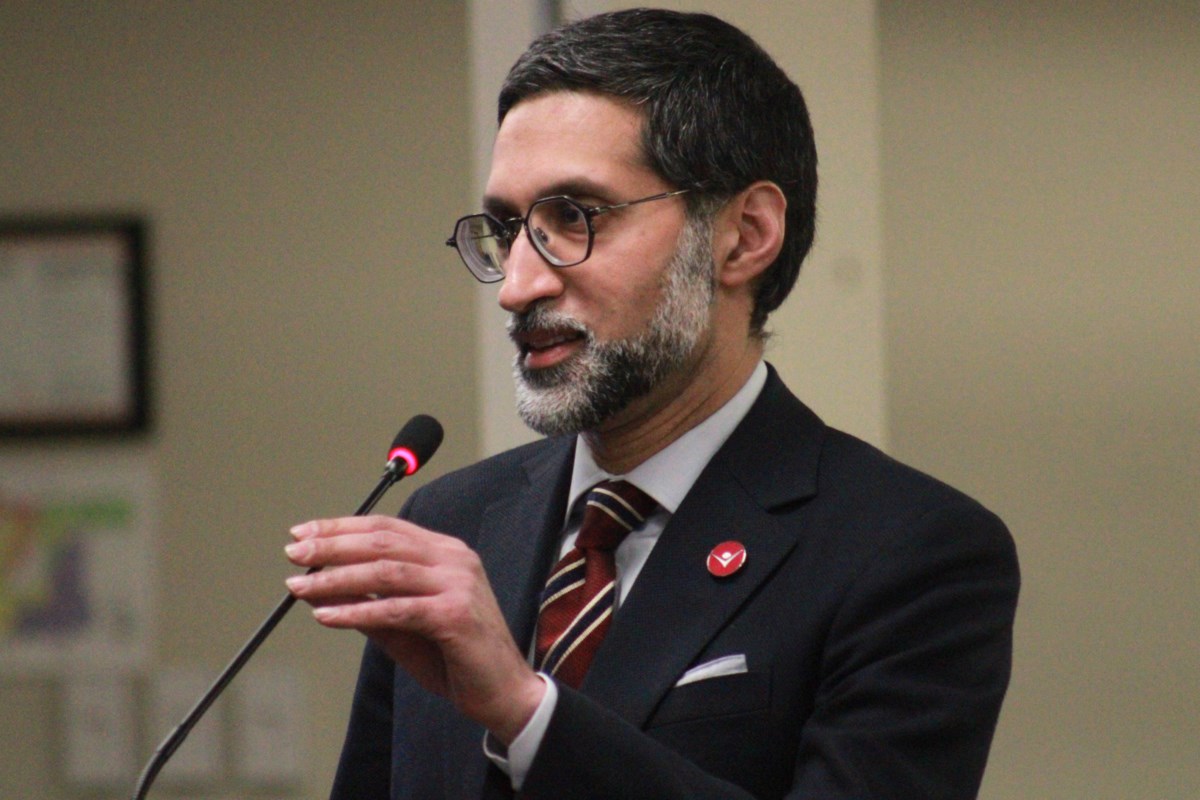
A unanimous Greater Sudbury city council voted to send a letter to various provincial officials, including Premier Doug Ford, asking them to restore 75 per cent funding to Public Health
Within these “precarious times,” the provincial government “isn’t really living up to their obligations” in funding Public Health Sudbury and Districts.
So described Public Health Sudbury and Districts acting Medical Officer of Health and CEO Dr. Mustafa Hirji during a 2026 budget presentation to city council members on Tuesday.
These comments kicked off a presentation which delved into budgetary constraints, service and projected staff cuts in future years.
This, within a climate of worsening health outcomes, including the rising prevalence of preventable diseases due to such things as vaccine hesitancy.
As such, Hirji said Public Health’s role, particularly in prevention, remains of great importance.
(On this front, despite a jump in vaccine-prevented measles and whooping cough cases, Public Health Sudbury and Districts cut a proposed scale-up of proactive education to combat misinformation in an effort to keep their 2026 budget low.)
With municipal budget deliberations slated to begin next week, the financial request was the topic of the day, with Public Health Sudbury and Districts tabling a $32-million budget last week.
With various scalebacks and a $2.4-million draw from reserves (“Now is a rainy day,” Hirji said), they managed to pare their ask of 19 area municipalities down to a 2026 increase of $614,154.
Greater Sudbury accounts for roughly 85 per cent of the Health District population, so their lion’s share of the municipal contribution includes a 2026 increase of $525,301 (a 0.14 per cent impact on the tax levy).
The province has announced a $187,238 increase in 2026, meaning they aren’t holding true to their pledge to fund 75 per cent of the organization.
In 2026, the province’s total share of the Public Health Sudbury and Districts budget is 61.6 per cent, leaving a $3.8-million provincial shortfall to be covered by municipalities, of which Greater Sudbury is funding $3.2 million.
During Tuesday’s meeting, city council voted to support a motion which asks the city to send a letter to provincial officials, including Premier Doug Ford, requesting the province to fill this gap.
The motion was tabled by Ward 1 Coun. Mark Signoretti, who also serves as health board chair, and it received unanimous support.
The letter will also be sent to the local board of directors, the Association of Municipalities of Ontario and the Association of Local Public Agencies.
Public Health Sudbury and Districts’ 2026 budget was described by Hirji as status quo, following various service cuts budgetary constraints forced them to make last year.
After $2.4 million is pulled from reserves to balance the books next year, he said the organization will be left with approximately $6 million in reserves, which is enough to fund 8.2 weeks of operations.
The provincial guidelines require they retain 7.5 weeks of operational dollars in reserves, so, he said, “we’re getting close to that line.”
With their 2026 reserve-fund pull not something they can repeat, Hirji cautioned that their ability to retain current staffing levels, as they did with their 2026 budget, could not continue into future years without a budget boost. Future layoffs would mean further service-level reductions.
Adding a bit more context to Public Health Sudbury and Districts’ budgetary constraints, Hirji noted that although their budget has increased since 2015, when adjusted for inflation, it has actually been cut by 18 per cent.
Other 2026-27 budget highlights
In addition to Public Health Sudbury and Districts, six City of Greater Sudbury departments shared context regarding their operations and 2026-27 budget deliberations.
During a series of wide-ranging discussions, some highlights included:
Landfill site tipping fees are slated to jump as part of a full cost recovery effort in response to a 34-per-cent cost increase as a result of retendering of a pre-COVID landfill operating contract. City Environmental Services director Renee Brownlee said costs have been driven by inflation, supply chain issues, escalating labour costs and regulatory delays. Currently $106 per tonne, tipping fees are slated to jump to $135 per tonne in 2026 and $150 per tonne in 2027. “This is similar to many other municipalities,” Brownlee said. The $5 gate fee is not proposed to change.
The City of Greater Sudbury needs to advocate for expanded producer responsibilities when it comes to landfill waste, Brownlee said, noting that the province has “stagnated” when it comes to a past pledge to shift the burden from taxpayers onto producers for the landfilling of such things as textiles, furniture, drywall and flooring.
GOVA Transit numbers are down, with approximately 5.8 million rides projected to take place this year, a drop from last year’s record-setting 6.2 million. This, city Transit Services director Brendan Adair said, is due a drop in international students at local post-secondary institutions.
In his first presentation to city council, newly hired Greater Sudbury Fire Services Chief Rob Grimwood made a brief push for a business case requesting four additional firefighters. It’s not to increase the complement of firefighters or affect service levels, he said, but to reduce the number of overtime hours currently being filled. Staff clarified that $2.5 million has been spent on firefighter overtime so far this year, to Oct. 31, which the new hires should help pare down. Greater Sudbury Fire Services had requested eight additional full-time firefighters in the 2024 budget to help lessen the overtime burden, but city council approved four at the time. The current request would fulfill this full initial request. Grimwood also advocated for the hiring of two mechanical officers, who “really are a jack of many trades,” taking care of respiratory protection programs, flow testing, minor repairs and other equipment. Among other things, these new staff will help fulfill Ministry of Labour orders, he said.
Greater Sudbury Paramedic Services currently have 33 staff off work, including 23 with occupational stress injuries, which Chief Aaron Archibald said aligns with provincial numbers. Their current supervisor to staff ratio is 1:43, and approximately half of their staff have been with the organization for five years or less. Approximately 20 per cent have been with Greater Sudbury Paramedic Services for less than one year.
Greater Sudbury budget deliberations will continue at 9:30 a.m. on Dec. 2, when city council members will begin debating business cases which propose service level changes. Meetings will continue during subsequent days as needed.
These business cases are not baked into the city’s base budget, which currently proposes a tax levy increase of 5.2 per cent. A one-per-cent tax levy change is equal to $3.7 million.
Upcoming budget meetings can be viewed in-person at the Lionel E. Lalonde Centre in Azilda or livestreamed by clicking here. The city’s full proposed budget document and other material can be found on the city’s website by clicking here.
Tyler Clarke covers city hall and political affairs for Sudbury.com.