
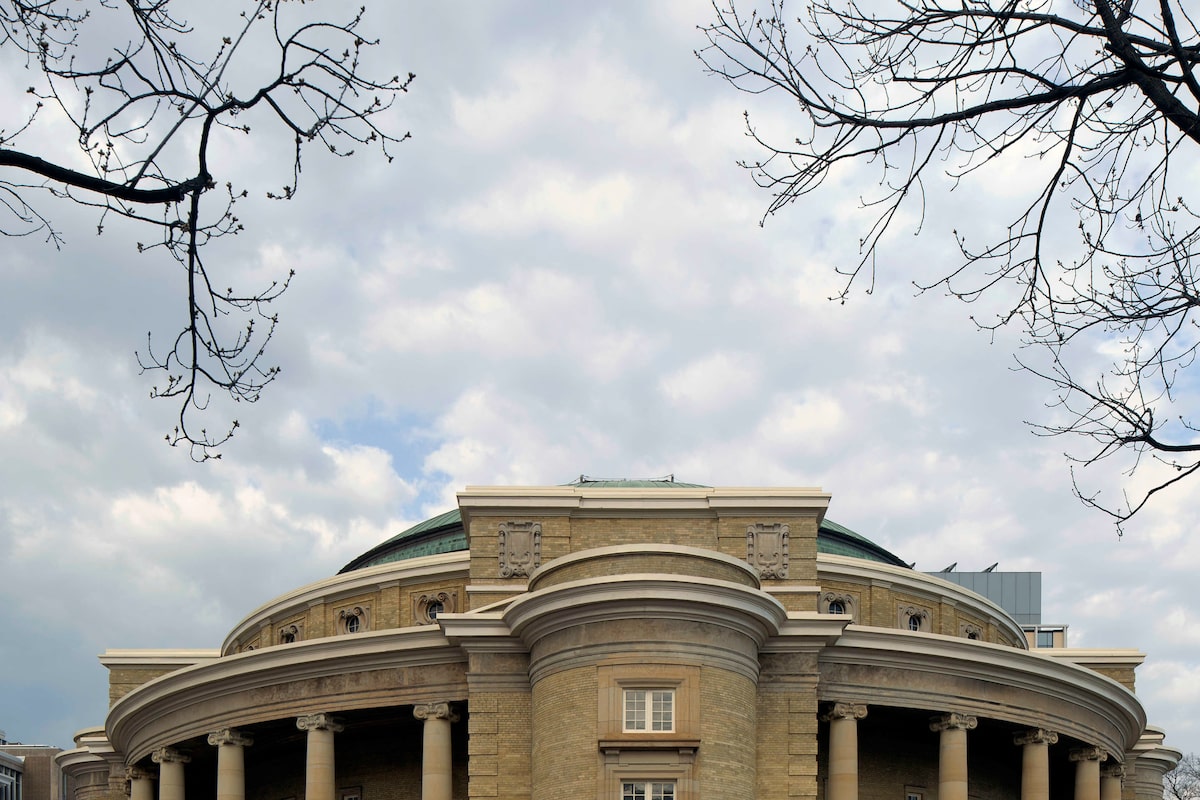
The Convocation Hall at University of Toronto, one of the many works of Scarborough-born architect Frank Darling.A-Frame/A-Frame
If he hasn’t already, Oscar-winning director Guillermo del Toro – his love of Toronto and shooting creepy movies here has been well documented – should scout the grounds of the University of Toronto’s St. George campus, and specifically the work of Scarborough-born architect Frank Darling (1850-1923).
The buildings were designed during the Edwardian era (1901-1910), a brief and distinctive architectural period that followed the excesses of the Victorian age (1837-1901) and preceded the First World War. It was also a time that Canada did some critical nation-building, says architect and author David Winterton.
“An incredible, incredible number of buildings were built,” he says as we stroll south on Philosopher’s Walk, the path that cuts south from Bloor Street West, and admire the first portion of the Royal Ontario Museum (1910-11) designed by Mr. Darling and partner John Andrew Pearson. “It was the height of the empire; the Canadian identity was about being within this supernational state [but] it wasn’t so much about Red Coats oppressing people, it was more about a cultural identity, and that’s what I’m trying to uncover.”
While Toronto Edwardian: Architect of Canada’s Imperial Age (McGill-Queens University Press) won’t be released until February, 2026, I asked Mr. Winterton, a principal at ERA Architects, for a small taste of what readers can expect. The book covers Mr. Darling’s entire career; Darling and Pearson were a powerhouse firm that saw hundreds of designs erected across the country. But the University of Toronto’s main downtown campus is a neat microcosm we can cover in a few hours. Some of it, I find, is bizarre enough to bring to mind the directors of horror movies.
Architect and author David Winterton.Dave LeBlanc/The Globe and Mail
As we stand on the thick, semi-opaque glass floor tiles of the 1909, five-storey Library Bookstack Addition (to David Dick’s Romanesque Revival University Library, now part of the Gerstein Science Information Centre), I can’t help but think of bloody fingers from the floor below poking through the metal-edged gaps, or that amphibian-humanoid creature from The Shape of Water swimming up to press its face against the soles of my shoes.
“This would have been cutting edge, this would have been the Apple Store of its day,” says Mr. Winterton in a hushed voice. Maybe, but in 2025 I can’t shake the retro-futuristic H.G. Wellsian vibe.
Compare that, however, to the domed pomposity of Convocation Hall, also by Mr. Darling (1905), where thoughts of inspiring movies such as Dead Poets Society come to mind. This incredible building, writes Mr. Winterton in the book, is “one of, if not the most, memorable designs the firm would produce.” As we walk toward it on a mild mid-November day, there is student activity and open doors, so we duck inside to admire the curved hallways and their quirky little doors, and the amazing ceiling of eight ribs that connect to a triumphant circular laylight.
Inside the Convocation Hall.Dave LeBlanc/The Globe and Mail
“When I worked at [Robert A.M.] Stern’s office [in New York], the design process was very much about precedent,” Mr. Winterton says thoughtfully. “When a project came in, there’d be a certain number of precedents that Bob would accept as being appropriate. I think Darling was one of those architects who was able to synthesize form, because there’s no precedent for this; there are round buildings for sure, but nothing quite like this.”
And while there would be plenty of precedent for the kinds of houses Toronto’s well-heeled wanted built for them during the firm’s active years, it’s convenient that “Holwood,” the residence Mr. Darling designed for Sir Joseph and Lady Flavelle (1901), is now part of the university’s Faculty of Law. It was, writes Mr. Winterton, “the consummate transposed British country house and the most richly appointed of Mr. Darling’s city houses,” with “mostly intact interiors” that have been lovingly preserved by the faculty.
The Flavelle Mansion.Dave LeBlanc/The Globe and Mail
Once I can pry my eyes away from the intense beauty of the “Jacobian-inspired” carved oak and sandstone fireplace, Mr. Winterton suggests I look up at the ceiling by German-Canadian art nouveau painter Gustav Hahn. It’s breathtaking. We peek into the former music room and then study some of the simpler woodwork in the hallway, which sports Mr. Darling-specific motifs. “This is a period of architecture where every space was considered,” says Mr. Winterton. “This form, with the little legs, this kind of keystone form, was used a lot by the Edwardian architects, but for Darling in particular, this is his signature.”
Vaulted ceiling decoration by German-Canadian artist Gustav Hahn in the hall of Holwood.Sean Galbraith/Sean Galbraith
Despite architectural signatures, Frank Darling, the man, remains something of an enigma. His offices were “engulfed in flames and all the records destroyed three times,” and, because he was a lifelong bachelor, there was no direct family to keep (and donate) his papers: “I was hoping that during the research that someone would pop up and say, ‘Oh I’ve got this box of uncle Frank’s diaries’ or something,” Mr. Winterton says with a laugh.
The Thermodynamics Building, University of Toronto.A-Frame/A-Frame
As we penetrate further into the campus to study Mr. Darling’s “delightful” yet “overlooked” Physics Laboratory (1906), I ask Mr. Winterton a tough (and possibly silly) question I’ve tried on other aficionados. If, for some strange reason, all buildings by Frank Darling had to be demolished and only one could be spared, which would it be? For Mr. Winterton, it’s an early work, the 1885 Bank of Montreal building (now the Hockey Hall of Fame).
“That changed everything in Canadian architecture,” he says. “It was the most significant building and most sophisticated building in Toronto for decades: the interiors, the exterior, sculptural program, the conception of the banking hall, [and] it was bigger than anything in Montreal at the time.”
Luckily, there are so many Frank Darling buildings–banks, hospitals, and even early skyscrapers – the next few generations of Canadians will be able to enjoy them, use them, and, thanks to Mr. Winterton, understand them.
“If my writing of this book helps people read this period of architecture better, or read Toronto better, I think that’s a great thing.”