
Government calls $340-million project “gold standard” while critics say it’s a “toxic” foreign subsidy.
Canada’s AI minister says Nokia’s Ottawa expansion is “what sovereign AI looks like.” Industry critics, however, say the federal government’s support of a Finnish multinational actually might hurt the Canadian economy.
“This is what sovereign AI … looks like in practice. It means employing Canadians, building tech right here, [and] deploying the tech throughout the world.”
AI minister Evan Solomon
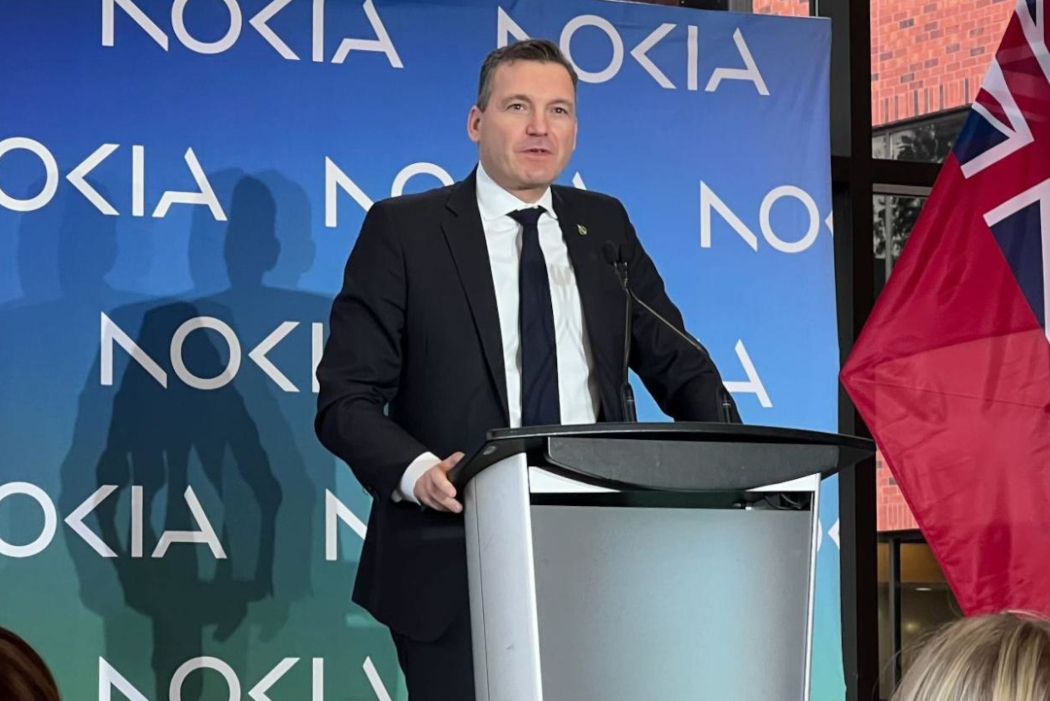
Minister Evan Solomon spoke at the groundbreaking of Nokia’s Ottawa campus expansion on Tuesday morning, where he invoked the catchphrase “sovereignty is not solitude” twice. The expansion is supported by $72 million in government funding, more than half of which comes from the federal government, committed under Prime Minister Justin Trudeau.
The $340-million project seeks to refresh Nokia’s branch plant at 600 March Rd, once the home of Ottawa-founded telecommunications company Newbridge Networks, which ended up in Nokia’s hands after a series of acquisitions.
“This is what sovereign AI … looks like in practice,” Solomon said. “It means employing Canadians, building tech right here, [and] deploying the tech throughout the world.”
Solomon’s comments follow Canadian government commitments to buy Canadian and support sovereign innovation, with Solomon previously calling digital sovereignty “the most pressing policy and democratic issue of our time.”
Shopify CEO Tobi Lütke took to X to voice his displeasure at the government’s decision to support the Finnish firm. He called the government’s involvement in the project “toxic,” and argued the subsidies make labour cheaper and accrue wealth for the foreign company instead of Canada.
It’s “not good for our economy that American and [overseas] branch offices can employ Canadians at half the cost to all the [C]anadian companies around them due to these subsidies,” Lütke said.
 Policymakers and stakeholders break ground on Nokia’s Ottawa campus expansion.
Nokia’s Ottawa campus is where its fibre optic, artificial intelligence (AI), and quantum-safe networking tech is developed in Canada to be deployed globally, all of which is “absolutely critical,” Solomon said.
“Sovereign AI means supporting Canadian innovation, working with allies, ensuring resilience, ensuring security, and building our digital infrastructure,” Solomon added, expanding the definition further. “Nokia delivers on every single point.”
Lumping in Nokia as a Canadian innovation, despite its headquarters existing on the other side of the planet, has been an ongoing concern of The Council of Canadian Innovators (CCI), a technology-sector lobby group.
On the BetaKit Podcast, following the 2025 budget, CCI president Ben Bergen explained that any company incorporated in Canada is considered a Canadian company, even subsidiaries of multinational companies. Much like Lütke, Bergen warned that spending money on those doesn’t truly benefit domestic firms.
Following Solomon’s remarks at Nokia, Bergen told BetaKit via text that “The Council of Canadian Innovators will continue to work with Minister Solomon and the federal government to make it clear that cutting a cheque to a foreign multinational is not an innovation strategy, nor does it build sovereignty for Canada.”
Solomon has on multiple occasions acknowledged the importance of making sure Canada has a strong domestic innovation of its own, and isn’t made up of foreign subsidiaries.
“We cannot be branch-plant nation, we gotta be AI-headquarter nation, so keeping people and our IP and our ideas here,” Solomon said at the ALL IN conference in Montreal in September.
But while the Canadian government has committed to supporting a sovereign cloud, which Solomon has said means Canadian control over data that is “free from coercion,” he also didn’t rule out American partners as part of the project.
RELATED: Nokia opens new Toronto office as part of broader Ontario-wide expansion
When asked at the groundbreaking event how Nokia’s expansion fit into Canada’s digital sovereignty, Solomon pointed to the 340 jobs set to be created and called it “an investment in one of the great tech hubs in the country.”
“This is literally the very definition of what it means to be a strong, sovereign nation,” Solomon said. “You want partners that have been here for a long time, that are growing here, and that will be here, and there’s more to come.”
“This is literally the gold standard of what we want to see,” he added.
In another X post, Lütke said partnering with foreign multinationals is a valid strategy for factory and manufacturing jobs, or even bootstrapping industrial strategies around energy and datacenters, but “it’s just a total braindead idea to do this with knowledge jobs.”
Still, Nokia’s expansion was touted by policymakers as a boon for Ottawa. Kanata North MP Jenna Sudds called the new centre a “vote of confidence” in Canada’s innovation economy, while Mayor Mark Sutcliffe said “we think of Nokia as a local company” because of its strong presence. Minister of International Trade Maninder Sidhu asserted that “this is what trade diversification looks like.”
Nokia Canada president Jeffrey Maddox told reporters after the event that the government has been a “fantastic partner.”
“I will tell you that, as the head of a corporate multinational in Canada, Canada is moving faster than we’ve ever seen a government move on a lot of these [technology] topics,” Maddox said.
The new research-and-development hub is slated to open in late 2028 or early 2029, Maddox said. It will span nearly 750,000 square feet in the heart of the Kanata North Tech Park, providing a home to over 1,900 of Nokia’s Ottawa employees.
Disclosure: BetaKit majority owner Good Future is the family office of two former Shopify leaders, Arati Sharma and Satish Kanwar.
All images courtesy Alex Riehl for BetaKit.