
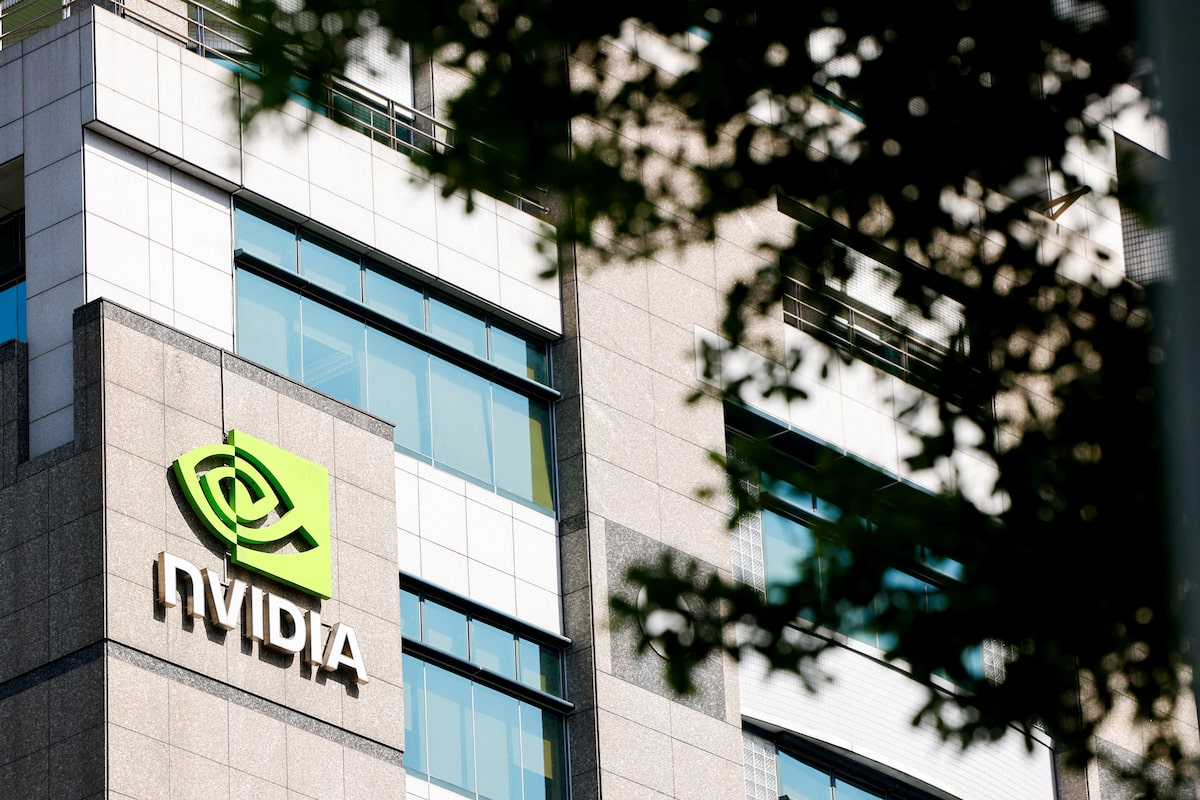
Mr. Burry has said AI stocks such as Nvidia are overvalued as companies spend massively to build data centres while the financial returns remain unclear.Ann Wang/Reuters
Michael Burry, the contrarian investor immortalized in The Big Short for his bet against the U.S. housing market, is in a war of words with the most valuable company in the world over whether there is another financial bubble in artificial intelligence.
Mr. Burry has taken aim at Nvidia Corp. NVDA-Q, the dominant maker of graphics processing units (GPUs) that are used to build and run AI models, and highlighted what he believes are questionable accounting practices in the industry. Nvidia reportedly passed around a memo to Wall Street analysts this week rebutting some of his claims.
Writing on his Substack Tuesday, Mr. Burry accused Nvidia of making “straw man” arguments and posted a copy of the memo. “This is the most valuable company in the world,” he wrote. “I can hardly believe it came from Nvidia, but all signs are it did.”
Nvidia did not immediately reply to a request for comment.
Mr. Burry recently closed his fund, Scion Asset Management, to outside investors and launched a Substack called Cassandra Unchained this month for the annual subscription price of $535. He disclosed in his recent post that he is betting against Nvidia through put options.
Mr. Burry has said AI stocks are overvalued as big tech companies spend massively to build data centres while the financial returns remain unclear. The hype around AI, along with a number of so-called circular financing deals among AI companies, has drawn comparisons to the dotcom bubble more than two decades ago.
AI-related stocks have taken a hit in the past month as concerns have grown. Nvidia shares are down roughly 14 per cent from a high in late October.
The seven-page memo cites Mr. Burry’s account on X as one source of the claims being rebutted, and cycles through many of the arguments that purport to show the AI ecosystem is on shaky ground, including circular financing.
To take one example, Nvidia said in September it will invest up to US$100-billion into OpenAI in increments as the company builds out data-centre capacity. OpenAI, which is losing money, is a huge user of Nvidia chips, making the deal appear to be vendor-financing to a cash-strapped customer. Nvidia struck a similar arrangement with Anthropic more recently.
The memo said that these “strategic investments” amount to a small share of Nvidia’s revenue. In the last quarter, Nvidia invested US$3.7-billion into private companies, which equates to 7 per cent of its revenue from the same period. Portfolio companies mainly raise capital from other sources, according to the memo, and not from Nvidia. These companies are also generating revenue rapidly, indicating a path to profitability.
Ottawa urged to regulate AI chatbots in forthcoming online safety bill
The fact that AI developers such as OpenAI and cloud providers such as CoreWeave Inc. CRWV-Q are losing money is not unusual, the memo states, because these are emerging companies. “Investors may rationally assign high valuations to unprofitable AI startups if the total addressable market is perceived as sufficiently large,” the memo states. “Many investors expect AI to dramatically reorganize nearly every sector of global GDP.”
One of Mr. Burry’s chief criticisms has to do with the economic lifespan of GPUs, which large tech companies such as Microsoft Corp. MSFT-Q and Amazon.com Inc. AMZN-Q generally put at four to six years. Mr. Burry argues the useful life is shorter, perhaps 2.5 to 3.5 years, in part because Nvidia is releasing new chips every year or so.
The difference is crucial from an accounting perspective because a longer lifespan allows companies to boost income and the value of their assets. Because the lifespan is shorter than reported, he argued, tech companies are facing big writedowns in the years ahead.
The memo said that “some companies have increased useful life estimates to reflect the fact that GPUs remain useful and profitable for longer than originally anticipated,” in some cases for more than six years.
Mr. Burry remained unconvinced. “Just because a widget is used does not mean the widget is profitable,” he wrote, comparing GPUs to an old iPhone. “I can continue to use it if I make myself happy with the poor performance, even if nobody else would want it.” Older, less efficient chips will be costly to operate, while newer models have different cooling and power requirements when installed in data centres.
He also pointed to a recent podcast interview with Satya Nadella in which the Microsoft chief executive officer said he did not want to risk overbuilding data-centre capacity for one generation of chip. “One of the biggest learnings we had even with Nvidia is their pace increased,” Mr. Nadella said on the podcast. “I didn’t want to go get stuck for four years, five years of depreciation on one generation.”
Microsoft is still reporting a six-year lifespan for chips, which Mr. Burry argued does not jibe with Mr. Nadella’s comments.
Microsoft did not immediately return a request for comment.
Nvidia reported stellar third-quarter earnings last week, with CEO Jensen Huang dismissing concerns of a bubble. Still, the results did little to quell jittery markets.
Benjamin Butler, an analyst at Veritas Investment Research in Toronto, wrote in a report Tuesday that Nvidia appears to be increasing support for cash-strapped customers. The company disclosed a new support mechanism by guaranteeing a partner’s data centre lease obligations for up to US$860-million. While the arrangement is not material for Nvidia, it is notable because it shows the company has moved beyond equity investments to support demand, according to Mr. Butler.
“The ‘off-balance sheet type’ arrangement allows the partner to access a data-centre facility it might not have been able to secure on its own,” he wrote. “More importantly, it suggests to us that external funding sources to the AI ecosystem may be tightening.”
Nvidia is facing growing competition, too. Alphabet Inc. GOOGL-Q has long used its own AI chips and is now in talks with Meta Platforms Inc. about using the hardware, The Information reported.
In a statement on X Tuesday, Nvidia said it is “a generation ahead of the industry.”