
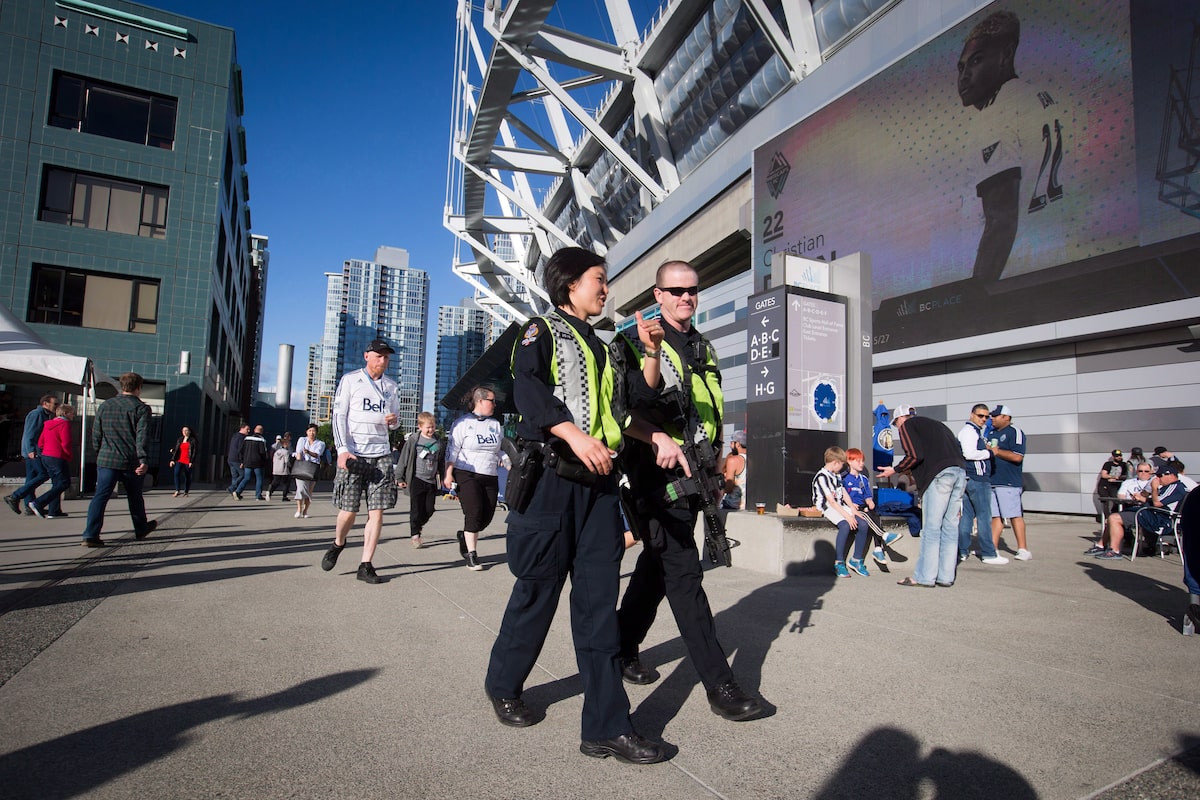
Vancouver Police officers patrol the plaza outside B.C. Place stadium before a Canadian Championship game, May, 2017. The stadium, where seven World Cup games will be held, will be at the centre of a two-kilometre controlled zone with temporary bylaw changes for security and branding.DARRYL DYCK/The Canadian Press
With less than 200 days before the first World Cup soccer game in Vancouver on June 13, 2026, the city is seeking to temporarily change some of its bylaws to meet FIFA’s rigorous requirements for security and “brand protection.”
The city’s move is the latest among many preparations and surprise changes as it braces for the impact of the games. Those have ranged from soaring costs associated with some World Cup activities to the displacement of the BC Lions to calls from Airbnb to loosen up the licensing system and create more spaces for tourists.
Vancouver councillors heard Wednesday about what won’t be allowed in the two-kilometre controlled area around BC Place stadium, where the seven FIFA games will be held.
That “beautification zone,” as it’s also called, will cover much of the downtown peninsula, part of the Downtown Eastside and the south shore of False Creek, including Granville Island. It is an area where the city plans to aggressively take down any graffiti and clamp down on unauthorized advertising related to the games.
“We need to have these rules in place to make sure we don’t have that graffiti on the worldwide stage with billions of people literally watching,” deputy city manager Karen Levitt told councillors.
Carney confirms he will attend FIFA draw in Washington alongside Trump
Several councillors said they are hearing concerns that small businesses may be penalized, such as clubs being prohibited from postering music events or shops being forced to spend money on cleaning graffiti within the new 24-hour time limit. Others are worried vulnerable people in the downtown area will be pushed outside the boundary.
Ms. Levitt promised there would be no effort to remove people who are experiencing homelessness, and that any enforcement of advertising and signage rules would be focused on egregious examples of people trying to make money from unauthorized FIFA merchandise.
“Our enforcement measures are really around brand protection,” said Gurv Brar, the city’s director of departmental corporate services in the development and licensing department.
In the most recent version of the legal agreement between the City of Vancouver and FIFA, the 239-page document devotes a major section to ensuring that commercial use of the FIFA brand is well-guarded against “ambush marketing activities.”
FIFA’s revenue during World Cup years soars as it sells television, marketing and licensing rights, among other things. In 2022, its revenue was almost $5.8-billion, according to its financial statement for that year. During the same period, its revenue from marketing rights was $1.4-billion, while licensing rights brought in $270-million.
Canada men get first look at what could await them at draw for 2026 FIFA World Cup
Vancouver’s most recent version of the agreement has redacted information about how much FIFA will be paying for the use of BC Place and its affiliated services.
Other changes approved by Vancouver include traffic restrictions that could shut down or limit use of major commuter streets around game-time, permissions for noise beyond the usual hours at event sites, and no-go zones in certain city areas.
Many of the changes are similar to the rules that were in place for the 2010 Winter Olympic Games in the city, where people were encouraged to use transit because of the many traffic restrictions.
Immigration Minister lifts work-permit requirement for foreign employees at World Cup
The city’s report comes a few days after the news that the cost of a restored outdoor amphitheatre at the Pacific National Exhibition grounds, which will be used for official FIFA Fan Festival activities, has risen to $183-million after an original estimate of $65-million from four years ago.
The BC Lions recently announced that two of the team’s season games will be relocated to Kelowna because their home stadium of BC Place won’t be available because of the World Cup.
The city’s much-loved Concord Pacific Dragon Boat Festival is being cancelled next summer because of the exclusion period for activities around BC Place, which is near False Creek, where the event is usually held. The exclusion period will last for a two full months from the beginning of June to the end of July, extending beyond the weeks during which the games will take place.