

Last Updated On 27 November 2025, 1:50 PM EST (Toronto Time)
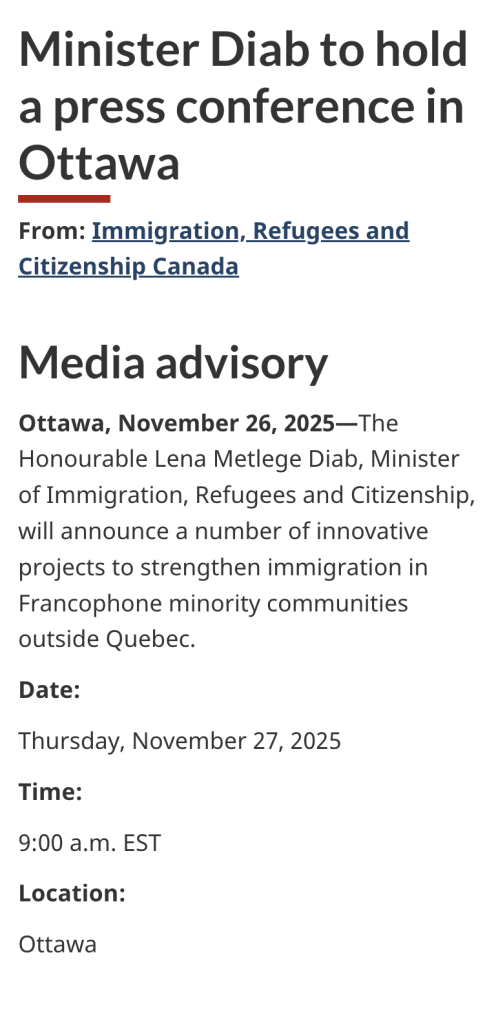
The Honourable Lena Metlege Diab, Minister of Immigration, Refugees and Citizenship, announced a number of innovative projects to strengthen immigration in Francophone minority communities outside Quebec on November 27, 2025.
The highly anticipated press conference unveiled 4 groundbreaking projects, designed to further strengthen francophone immigration.
📅 Event Details
Date: Thursday, November 27, 2025
Time: 9:00 a.m. EST
Location: Ottawa, Ontario
The Honourable Lena Metlege Diab, Minister of Immigration, Refugees and Citizenship, announced an investment of approximately $3.6 million to support four new projects funded by the Francophone Immigration Support Program (FISP).
Several of these initiatives aim to facilitate the immigration of Francophone and bilingual candidates to support the growth of Francophone minority communities.
They meet the labour market’s needs (especially in health care, education and early childhood) through overseas support, promotion and recruitment activities.
These activities align with the Government of Canada’s priorities announced in Budget 2025:
increase Francophone immigration outside Quebec to a target of 10.5% admission rate for French-speaking permanent residents outside Quebec in 2028, making progress on the commitment to have 12% in 2029
work with employers, provinces and territories to attract top global talent and grow our economy
meet regional economic needs and, support key sectors in need of labour
enhance the vitality of official language minority communities
You may also like: Expect More French Express Entry Draws To Increase Francophone PRs To 12%
Official Media Advisory
🎯 What to Expect
Minister Diab will reveal innovative projects and initiatives aimed at bolstering francophone minority communities across Canada.
This announcement comes at a pivotal moment as Canada accelerates its commitment to French-speaking immigrants outside Quebec.
Why This Matters?
Historic Targets: Canada is increasing francophone immigration from 9% in 2026 to 10.5% by 2028 and 12% by 2029
Record Investment: $137.2 million allocated through the Official Languages Action Plan 2023-2028
Growing Opportunities: French-speaking candidates now receive priority pathways to permanent residency
Community Revitalization: Strengthening francophone communities from coast to coast
📊 Context: Canada’s Francophone Immigration Surge
Under Canada’s newly released Immigration Levels Plan for 2026-2028, francophone has emerged as a cornerstone priority despite overall target stabilization:
Permanent Resident Targets:
2026-2028: 380,000 permanent residents annually (stabilized)
Economic Immigration: 64% of total admissions by 2027-2028 (highest in decades)
Francophone Immigration Targets Outside Quebec:
2025: 8.5% of admissions
2026: 9% of admissions
2027: 10% of admissions
2028: 10.5% of admissions
2029 Goal: 12% of admissions
This represents a strategic commitment to reversing the demographic decline of francophone minority communities across Canada.
Express Entry: French Language Category Dominates
The Express Entry system has become the primary gateway for French-speaking skilled workers:
2024 Performance:
Total French Category ITAs: 36,000 invitations (23% of all ITAs)
Average CRS Cut-off: 409 points (lowest among all categories)
Priority Status: Second-highest ITA issuances across all categories
2025 Acceleration (as of November):
Total French Category ITAs: 36,000+ invitations issued
Leading Category: Now the highest ITA-issuing category in Express Entry
Lowest CRS Scores: Some draws as low as 379 points (March 2025)
Strategic Draws: Multiple large-volume draws, including 7,500 ITAs in a single draw on March 21, 2025.
🌟 Strategic Importance
Why Canada is Prioritizing Francophone Immigrants:
Demographic Urgency: Francophone communities outside Quebec have experienced population decline
Bilingualism Commitment: Strengthening Canada’s identity as a bilingual nation
Economic Benefits: French-speaking immigrants fill critical labour shortages
Regional Development: Supporting francophone communities in all provinces and territories
Global Positioning: Attracting talent from francophone countries worldwide
Additional Pathways:
Provincial Nominee Programs (PNP):
24% of French-speaking admissions came through PNPs in 2023 (4,775 permanent residents)
Leading provinces: New Brunswick (70%), Manitoba (65%), Nova Scotia (62%)
Francophone Mobility Program:
LMIA-exempt pathway for employers hiring French-speaking workers
Streamlined processing for bilingual professionals
Rural and Francophone Community Immigration Pilot:
Targeted pathway for French-speaking candidates in rural communities
Addresses labour shortages while supporting francophone demographic weight
💡 What French-Speaking Candidates Need To Know
Eligibility Requirements:
Minimum NCLC 7 (or TEF equivalent) in all four language abilities: reading, writing, speaking, listening
Express Entry profile in Federal Skilled Worker, Canadian Experience Class, or Federal Skilled Trades programs
Additional CRS points: Up to 56 bonus points for French proficiency
Current Advantages:
✅ Lower CRS cut-off scores than general draws
✅ More frequent category-based draws
✅ Increased ITA allocations year-over-year
✅ Priority processing pathways
✅ Enhanced settlement support services
We are also expecting a francophone category-based Express Entry draw tomorrow so let’s wait and
Media Advisory Contact: Laura Blondeau
Director of Communications
Minister’s Office
343-550-4808
Lauralee.Blondeau@cic.gc.ca
Media Relations
People and Communications Sector
613-952-1650
media@cic.gc.ca
About Immigration, Refugees and Citizenship Canada: Immigration, Refugees and Citizenship Canada (IRCC) is responsible for selecting foreign nationals as permanent and temporary residents, providing protection to refugees, and granting citizenship. IRCC works to enhance Canada’s economic, social and cultural prosperity while maintaining the integrity of Canada’s immigration and citizenship programs.

Satinder brings expertise, knowledge, and experience related to internal work flows at IRCC. She worked at Canadian Consulate in Chandigarh before moving to Canada.
Her articles on “Chinook – An internal IRCC tool used to bulk process temporary applications” was one of the notable work on our news website

by Satinder Bains
25 November 2025, 5:09 PM EST25 November 2025, 5:32 PM EST

Load More Post
Something went wrong. Please refresh the page and/or try again.
You may also like: Statistics Canada Jobs Hiring Now For 77 Locations In Ontario
Canada’s Top 10 Universities For 2026 | New World Rankings
Top 20 Occupations In Canada With Highest Growth Until 2035
New Canada Citizenship Law To Make It Easier For Children Born Abroad