
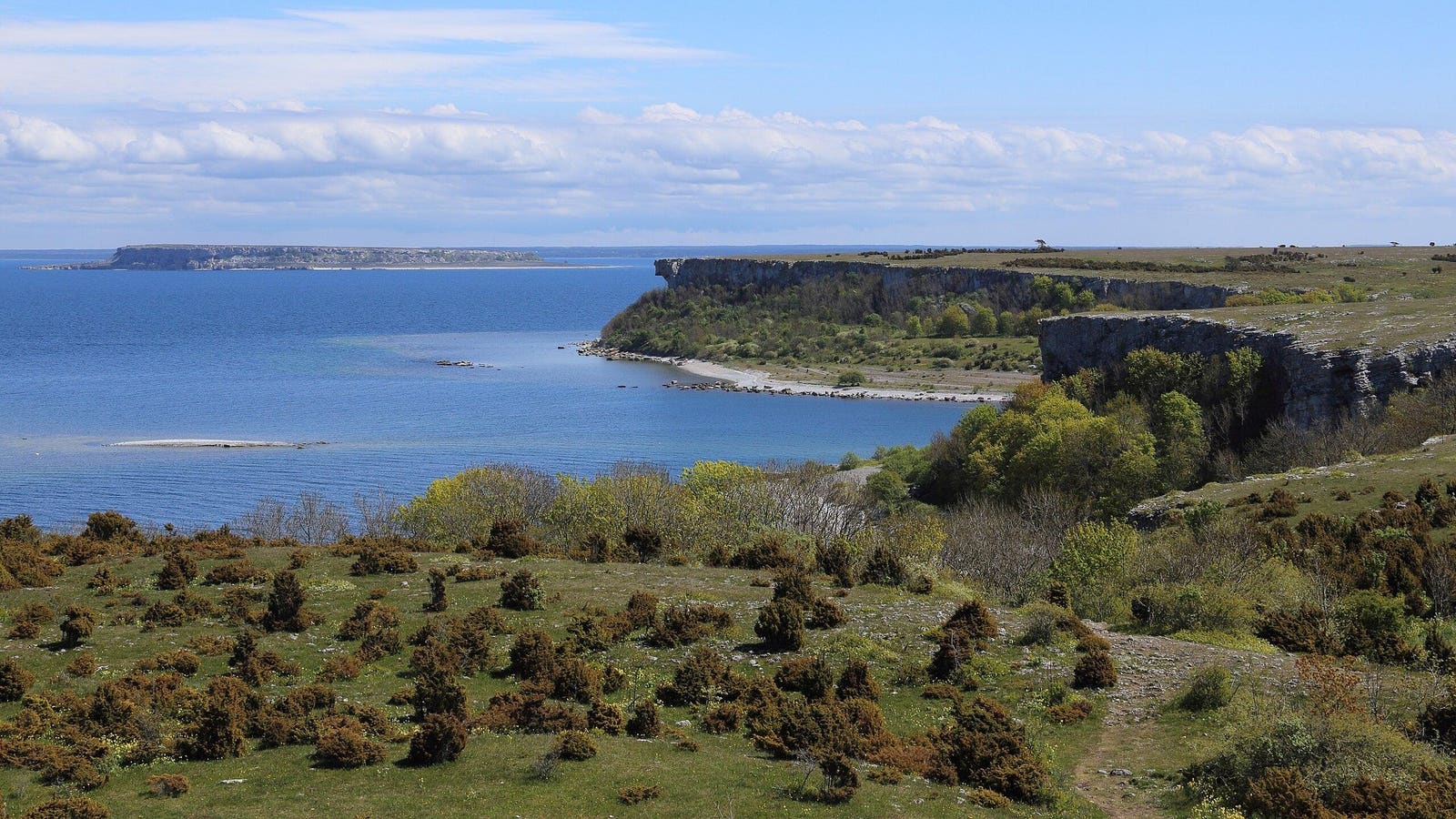
Wolf bones unearthed on a tiny island in the Baltic Sea were found to be thousands of years old, and bore multiple signs of living alongside ancient humans.
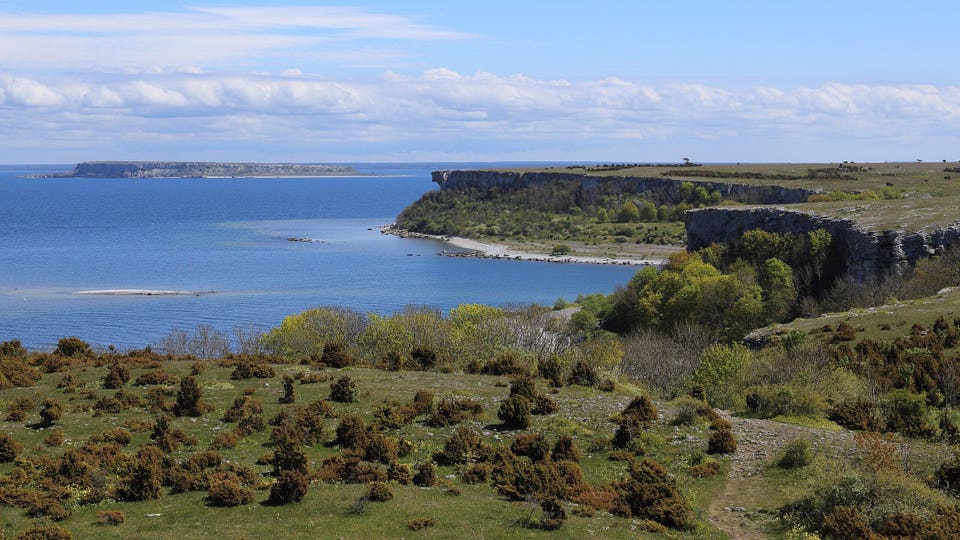
The small, remote Baltic island of Stora Karlsö, with Lilla Karlsö and Gotland in the distance. (Credit: Paul Bischoff / CC BY-SA 3.0)
Paul Bischoff via a Creative Commons license
The Swedish island of Stora Karlsö, a site known for its intensive use by seal hunters and fishers during the Neolithic and Bronze Ages, is an ancient coral reef that is more than 400 million years old. It is very small, with a total area of just 2.4 km², and remote, situated 6 km off the southwest coast of Gotland, which is another, somewhat larger, island in the Baltic Sea. And yet, despite its small size, Stora Karlsö is a popular destination for birders, wildlife and nature photographers and enthusiasts, and has been so for roughly 100 years. It also is an important research site where pioneering conservation methods are developed and tested.
Stora Karlsö also is home to a number of intriguing mysteries. Like its island neighbor, Gotland, Stora Karlsö is not home to any endemic populations of terrestrial mammals – it’s too remote and small – which means that the only way that these animals could reach this island and survive would be through human assistance. So it’s quite surprising to discover that this far-flung speck of an island (arrow, Figure 1A, inset) was home to grey wolves. How did they get there? What did they eat?
“Because this island is located so far out into the sea, it’s very difficult to imagine that wolves could have gotten here themselves,” observed one of the study’s co-lead authors, evolutionary biologist Anders Bergström, a Lecturer at the University of East Anglia, where his research focuses on deciphering and understanding the evolutionary histories of animals.
F I G U R E 1 | (A) Map showing the location of Gotland, Stora Karlsö and Öland in the Baltic Sea. The gray area shows the reconstructed shoreline approximately 9,000 cal BP. (B) A range plot of humeral greatest distal breadth (Bd) in modern and ancient dogs and wolves, including a wolf-dog hybrid from the comparative dataset used by Pira. (C) δ13C and δ15N stable isotope values of a representative sample of dogs, humans, and fauna from approximately contemporaneous archaeological sites on Gotland, Stora Karlsö and Öland, and Mesolithic dogs from mainland Sweden and Denmark. PWC=Pitted Ware Culture, TRB=Trichterbecherkultur or Funnel Beaker Culture (Early to Middle Neolithic), MN = Middle Neolithic, LN = Late Neolithic, BA = Bronze Age.
doi:10.1073/pnas.2421759122
These wolf bones were found to be quite old. Dr Bergström and collaborators radiocarbon dated them as being between three and five thousand years old. Considering their extreme age, were these ancient wolves somehow connected to the development of dogs?
“The background to this is that [we] set out to learn more about dog history, and more or less stumbled over this discovery,” Dr Bergström explained in email. “When analysing the DNA of these couple of individuals, we realised that they were actually wolves, which was very surprising.”
Were these ancient bones unearthed recently?
“The bones had been discovered by archaeologists already back in the 1920’s, and they had suggested that these particular bones were a little bit unusual for dog bones and could potentially be from wolves, but without DNA analysis it was not possible to be sure,” Dr Bergström told me in email.
Dr Bergström and collaborators used genomic analysis to confirm that two of the canid bones were indeed wolves, not dogs, and carried no genetic evidence of dog ancestry. Perhaps not surprisingly, these study wolves did have several traits that are typically associated with life alongside humans.
“There is also evidence of a marine diet in these wolves from stable isotope analysis, which is very unusual in wolves, and suggests that they were being fed by the humans on the island who relied heavily on fishing and seal hunting,” Dr Bergström explained in email.
Were these wolves pets? Companions? Guardians? And what was the process whereby wolves came to willingly live alongside humans? Did wild wolves gradually come to accept the presence (and benefits) of living alongside humans, or did humans intentionally control them?
Detail of one of the upper arm bones from one of the wolves included in the study. (Credit: Jan Storå / Stockholm University)
Jan Storå / Stockholm University
“The discovery of these wolves on a remote island is completely unexpected,” said another of the study’s co-lead authors, palaeogeneticist Linus Girdland Flink, a Lecturer in Ancient Biomolecules at the University of Aberdeen, where he specialises in extracting and analysing DNA from ancient bones, teeth, soils and sediments.
“Not only did they have ancestry indistinguishable from other Eurasian wolves, but they seemed to be living alongside humans, eating their food, and in a place they could have only have reached by boat,” Dr Girdland Flink explained. “This paints a complex picture of the relationship between humans and wolves in the past.”
In fact, everything about these wolves looks like if they were domestic dogs under human management – except their DNA, which shows they were actually wolves, making this a rare and striking finding.
The DNA data further revealed that the study wolves had extremely low genetic diversity. Was this due to natural causes or was it the result of living alongside humans, and under their control in isolation or under controlled breeding conditions for generations?
“The genetic data is fascinating. We found that the wolf with the most complete genome had low genetic diversity, lower than any other ancient wolf we’ve seen,” Dr Bergström explained. “This is similar to what you see in isolated or bottlenecked populations – or in domesticated organisms.”
F I G U R E 2 | Genetic identities of the Stora Förvar wolves. (A) ADMIXTURE clustering of a dataset containing dogs, wolves, and the G.11 and G.7 wolves. (B) qpWave/ qpAdm results for the Stora Förvar wolves. The best-fitting models are single-source models using a 5.1k y-old Swedish wolf as the source, to the exclusion of dogs. (C) Heterozygosity estimates for the Stora Förvar wolves, in the context of Late Pleistocene, Holocene, and present-day wolves, as well as Holocene and present-day dogs. Error bars correspond to ±2 SE.
doi:10.1073/pnas.2421759122
In addition to the low genetic diversity identified in one of the study wolves, the morphological data revealed these individuals were physically smaller than typical mainland wolves – yet another piece of evidence that these wolves may have been tamed, kept in captivity, or managed by humans in some other way.
Yet another surprise was that one of the study wolf specimens, which was radiocarbon dated to the Bronze Age, showed advanced pathology in a limb bone, which would have limited its mobility. This suggests this particular wolf may have been cared for by humans or was somehow able to survive in an environment where it did not need to hunt large prey.
Taken together, this study’s findings provide evidence that, in certain environments, wolves and humans lived alongside each other in human settlements, and found mutual benefits in doing so. This study’s findings additionally suggest that human-wolf interactions in prehistory were more diverse (and harmonious) than previously thought, extending beyond simple hunting or avoidance to include complex social relationships and interactions that may point to new aspects of wolf domestication that did not lead to the creation of the dogs we know and love today.
Source:
Linus Girdland-Flink, Anders Bergström, Jan Storå, Erik Ersmark, Jan Apel, Maja Krzewińska, Love Dalén, Anders Götherström and Pontus Skoglund (2025). Gray wolves in an anthropogenic context on a small island in prehistoric Scandinavia, Proceedings of the National Academy of Sciences 122(48):e2421759122 | doi:10.1073/pnas.2421759122
© Copyright by GrrlScientist | hosted by Forbes | LinkTr.ee
Socials: Bluesky | CounterSocial | LinkedIn | Mastodon Science | Medium | MeWe | Spoutible | SubStack | Threads | Twitter