
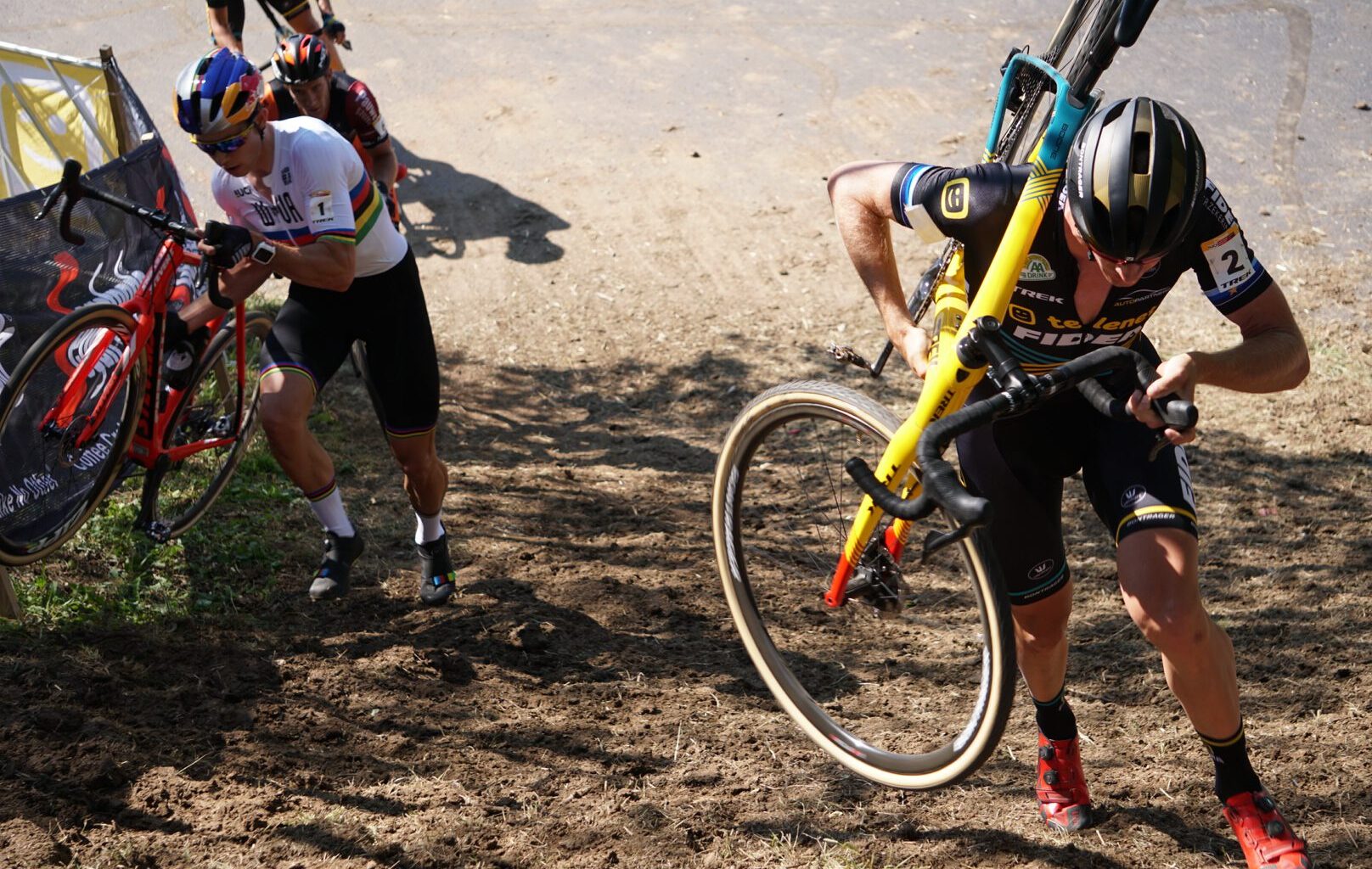
Fresh off his emotional European cyclocross title, Toon Aerts is being pretty…open about the four-year cloud that hung over him. In an interview with Humo, the 32-year-old lays bare the toll of the case that halted his career, the searching that nearly consumed him, and the uneasy peace he’s found in returning to the top.
The Middelkerke win, he says, wasn’t a simple comeback. It was a release. “A great injustice was done to me,” he said. “Two strong years of my career were taken away. This title doesn’t erase that.” Even so, it provided something he desperately needed: evidence to himself that he could still be the rider he once was. “For a long time it was a huge question mark, but I can now say that I’m back at my level.”
Watch Toon Aerts’s emotional post-race Euro champs interview
The questions that linger aren’t athletic, but scientific. Aerts tested positive for traces of letrozole after Flamanville in 2022, a result he has always maintained came from contamination. He threw himself into trying to understand the finding — and admits he didn’t cope well with that obsession. “Until six months ago I was still working on it every day,” he said. He dove into academic papers, agriculture reports, anything that might explain why a hormone-blocking substance “mostly used in livestock farming” appeared in his system. “It wasn’t making me happy. It’s a needle in a haystack I’ll never find.”
He still believes an outside source is the only plausible explanation. He points to the supplements he used and to the setting of the race itself — a year after his test, fellow Belgian Shari Bossuyt also returned a positive from Flamanville. His much-mocked “Normandy milk” theory, he says, was simply an attempt to make sense of something senseless.
Aerts stresses that even cycling’s governing body recognised he had no intent to cheat. “The UCI wrote in its report that it involved unintentional use,” he told Humo. “They know I did nothing wrong.” His suspension was cut from four years to two, though he’s blunt about how hollow that concession felt. Riders, he says, are left to prove a negative — an almost impossible task. “I had to investigate myself how something I never wanted in my body ended up there.”
By the time the UCI issued its final decision, appealing no longer made sense. The money was gone, the energy even more so. What he has now is a title, a measure of closure, and the hope that the sport has learned something from his case — even if he’s still searching for answers he may never find.
Speaking of Flamanville, the 2025-2026 UCI Cyclocross World Cup continues in France this weekend. You can watch the elite men’s and women’s races on Flobikes.com starting at 7:30 ET.
Canadian Cycling Magazine will have a full report as well. Unlike Tabor, where Canada had three entrants, France will see just one–Sidney McGill. But fear not — as Christmas approaches, you’ll see a big wave of Canadian riders heading to Europe for the rest of the ‘cross season.”