
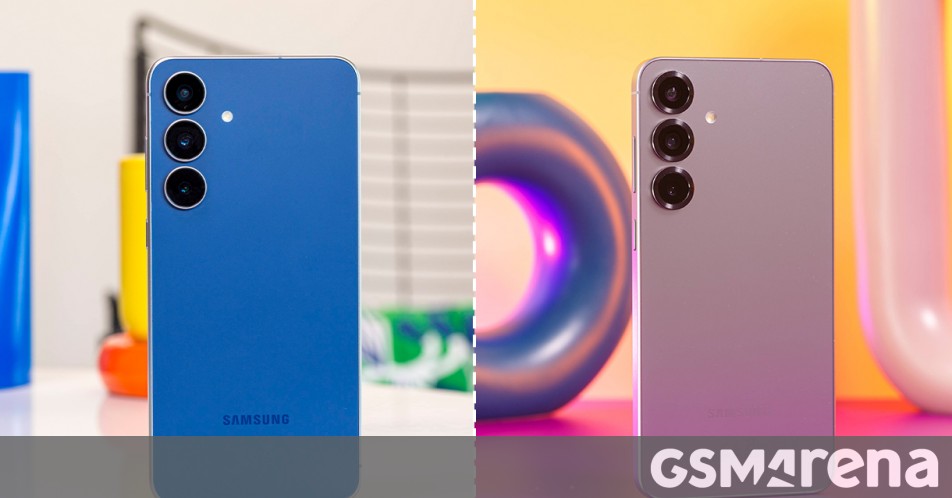
With this year’s Samsung Galaxy S25 FE, Samsung brings the model much closer to the S25 Series. Size- and design-wise, it’s identical to the Galaxy S25+, while it shares the full-fledged Exynos 2400 SoC with last year’s Galaxy S24+.
Compared to the S25+, the Galaxy S25 FE is around 30% cheaper in Europe and almost 50% cheaper in the US (when you account for storage and you shop from third-party retailers). Based on pricing and the specs sheet alone, the Galaxy S25 FE is the go-to option between the two if you are on a budget, and if that’s the case, well, it’s already settled.
But if the Plus model is really good enough to deserve its price premium, that’s what we intend to find out by comparing our review findings for these two models. We try to look beyond the specs sheet and see how the two phones compare in the real world.
For starters, you can compare the complete specs sheets here or directly continue with our editor’s assessment in the following video or in the text below.
Size comparison
The Galaxy S25 FE and the S25+ have roughly the same footprint, and they have an identical screen diagonal. However, physically, the more expensive S25+ is a couple of millimeters narrower and shorter than its sibling.
There’s a difference in build materials, too. The S25+ is protected by Gorilla Glass Victus 2 sheets on the front and back and features an Armor aluminum 2 frame, marketed as more rigid than the Enhanced Armor aluminum on the S25 FE. The latter also settles for the previous-gen Victus+ glass panels.
However, the two handsets feel very similar in hand. The slight deviations in dimensions and materials are virtually undetectable. And both devices boast IP68 ingress protection.
Display comparison
The displays on these two Samsungs are pretty similar. According to Samsung’s official specs sheet, the S25+ features a more premium LTPO display, whereas the S25 FE settles for a standard OLED screen. However, during our review process, we discovered that the S25 FE supports a variable refresh rate that can range as low as 1Hz, which is similar to what the S25+ achieves with its LTPO screen.
Of course, this is not to say there are no differences between the two panels at all. The S25+ features a higher-resolution screen. This display also has thinner bezels, which is easily perceived as being more premium.
The S25+ screen is also rated to produce higher max brightness, and in our standardized testing, it reached 1,449 nits, while the S25 FE could not exceed 1,247 nits. In practice, this is not a huge difference, as the boost in perceived brightness is not as linear as the numbers suggest. Both panels provide excellent sunlight legibility.
Battery life
Initially, we were expecting similar battery life from the two devices, but the Qualcomm chipset proved to be more efficient than the Exynos. The S25+ takes the lead with a significantly higher Active Use Score, outperforming the Fan Edition across every battery test. We saw the biggest gap in the call and gaming runtimes.
Charging speed
In theory, the Galaxy S25 FE and the S25+ should post similar charging times, since they share the same rated 45W charging power and the same battery – 4,900 mAh.
The S25+, however, significantly outpaced the S25 FE at the 15- and 30-minute marks. A full charge takes about the same time. The S25+ is merely 10 minutes faster to the finish line.
Speaker test
To our surprise, the Galaxy S25 FE offers better sound quality over the S25+. The former has more pronounced bass and warmer-sounding speakers overall, while the S25+ sounds straight-up flat in comparison.
When it comes to loudness, however, both perform similarly.
Performance
The Galaxy S25 FE runs on last year’s Samsung flagship SoC, the Exynos 2400, while the Plus model employs the Snapdragon 8 Elite for Galaxy, which is a slightly overclocked version of the standard SD 8 Elite.
In addition to the raw horsepower, the Galaxy S25+’s memory configurations are also better equipped. The Plus’ entry-level config is 12GB/256GB, while the S25 FE starts at 8GB/128GB (which uses UFS 3.1 storage until you jump to 256GB). Additionally, the S25 FE is only offered with 8GB memory in all of its variants, while the Plus is always offered with 12GB RAM.
Benchmark performance
Unsurprisingly, the Galaxy S25 Plus outperforms the S25 FE by a significant margin. The S25+ scored almost 40% higher in the multi-core CPU test and about 14% better in the combined AnTuTu 10 test. The GPU performance difference was most significant as the S25+ outperformed the FE by about 54% in the 3DMark Wild Life Extreme.
Camera comparison
On paper, the Galaxy S25+ has a better camera system than the S25 FE. The telephoto camera on the Plus features a larger sensor with higher resolution, and the ultrawide shooter also utilizes a slightly larger sensor.
The main and front-facing cameras, on the other hand, are pretty much identical, so we don’t expect any meaningful difference.
Image quality
As far as the ultrawide goes, both phones upscale their photos to 12 megapixels and there is hardly a clear winner. The S25+’s shots come out more detailed but it’s not in every scene and you have to really pixel peep to see the difference.
Then, as expected, the main camera difference is rather negligible. Both phones deliver comparable stills with similar quality.












S25 FE (0.6x) • S25 Plus (0.6x) • S25 FE (1x) • S25 Plus (1x)
As for the 2x crop zoom from the main camera, the image quality is give or take the same.












S25 FE (2x) • S25 Plus (2x) • S25 FE (3x) • S25 Plus (3x)
The difference in the zoom cameras is not as clear-cut as, once again, both phones upscale their photos to 12 megapixels. And while technically, the S25 FE has a smaller sensor, it also has a longer focal length so objects appear larger. The level of detail is not the same, though, and the S25 Plus still has more resolved detail.












S25 FE (0.6x) • S25 Plus (0.6x) • S25 FE (1x) • S25 Plus (1x)
Nighttime photography is equally decent with both phones’ main cameras, but if you are into pixel peeping, you might find the S25 FE’s photos slightly cleaner and with better definition – that’s still by a really small margin though.
That holds true for the ultrawide and the 2x zoom photos as well.
The difference we saw during the day from the two zoom cameras applies to the nighttime results as well, but it requires even more pixel peeping to notice it.












S25 FE (2x) • S25 Plus (2x) • S25 FE (3x) • S25 Plus (3x)
Video quality
Below we have a few framegrabs from the videos taken by the two phones at each focal length, so it’s easier to compare them to one another.
When comparing 4K videos taken with both of these Galaxy phones, we were surprised to find that the S25 FE actually captures sharper videos with better contrast during the day. The S25 Plus rendering is much more laid back.
Neither phone is great when it comes to telephoto zoom clips, but we prefer the less processed footage by the S25 Plus.








4K screengrabs: S25 FE (0.6x) • S25 Plus (0.6x) • S25 FE (1x) • S25 Plus (1x) • S25 FE (2x) • S25 Plus (2x) • S25 FE (3x) • S25 Plus (3x)
And at night, the trend continues – the S25 FE’s low light videos from the main and telephoto cameras are slightly more contrasty and less noisy. The S25 Plus’ ultrawide footage is better, though.








4K screengrabs: S25 FE (0.6x) • S25 Plus (0.6x) • S25 FE (1x) • S25 Plus (1x) • S25 FE (2x) • S25 Plus (2x) • S25 FE (3x) • S25 Plus (3x)
Verdict
As we noted earlier in the article, the S25+ is the better-equipped phone with higher-tier build materials, longer battery life, faster charging and the considerably more powerful SoC.
The S25 FE, on the other hand, is already substantially cheaper in most countries, while offering largely the same user experience. It also boasts better-sounding speakers and can hold its own in the camera department, too.
So if you are looking to save some money, grab the S25 FE. Otherwise, the S25 Plus is a more well-rounded phone that delivers an upper-tier screen, better performance, faster charging, and longer battery life, plus a few more niche features such as Ultra-wideband (UWB).
Get the Samsung Galaxy S25 FE for:
Largely the same user experience and camera quality.
The better speakers.
The lower price tag.

Get the Samsung Galaxy S25 Plus for:
The longer battery life.
The faster charging.
The more powerful chipset.
The higher base storage and more RAM.
Ultra-wideband (UWB) support.