
Swimmers and fish move through the water following much the same
principle of “action-reaction” (for every action, an equal and opposite
action applies). By the coordinated movement of their limbs, they
displace the water and, in reaction, their bodies move forward despite
the resistance of the water. But if they tried to swim in molasses,
they’d never make it, as the resistance of the molasses would absorb all
their energy and they’d never make it forward. The Scallop Theorem
clearly demonstrates what happens in such fluids with high Reynolds
coefficients. Newton’s third law applies.
Yet, on another scale,
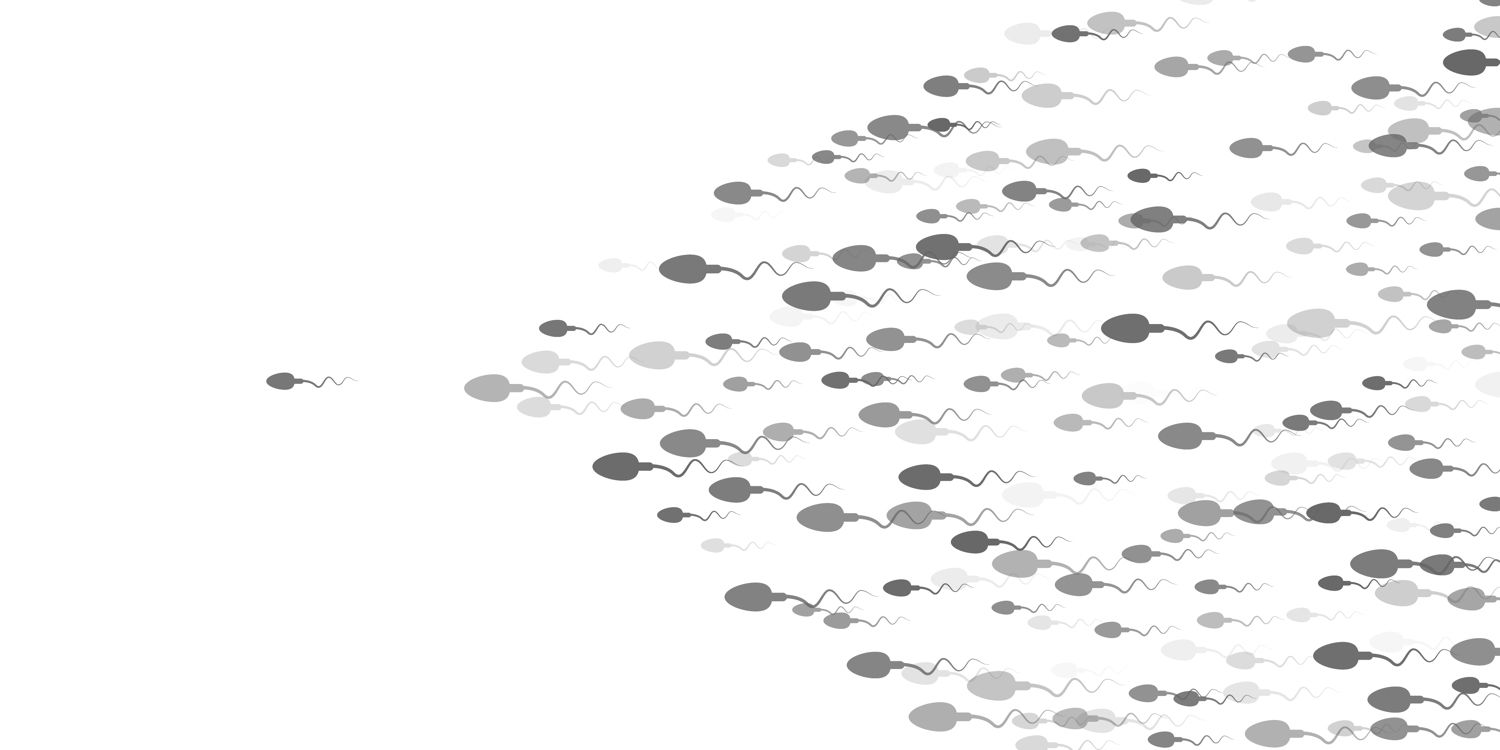
single-celled algae and spermatozoa manage to advance rapidly and with
ease in highly viscous fluids and over very large distances in
proportion to their size. How do they get around Newton’s implacable
third law?
Symmetries and reciprocity
Mathematician Kenta
Ishimoto’s team set out to understand how these single-celled creatures
snake their way through environments that, in principle, should paralyze
their movement. When the third law applies, it does so symmetrically
and reciprocally in environments in equilibrium; the solution to the
problem posed lies in what are called “non-reciprocal and
non-symmetrical interactions”, which characterize chaotic systems and
whose elements participate dynamically in the system, like birds in a
murmuration or pedestrians on a sidewalk. By establishing relationships
with their environment, they alter the conditions of equilibrium.
In
the case of unicellular algae and spermatozoa, researchers have modeled
the movement of cells and their flagella. In principle, a viscous fluid
would dissipate the flagella’s energy, preventing them from moving and
exhausting them within minutes. And yet, somehow, the flagella manage to
propel these cells without provoking any reaction from their
environment.
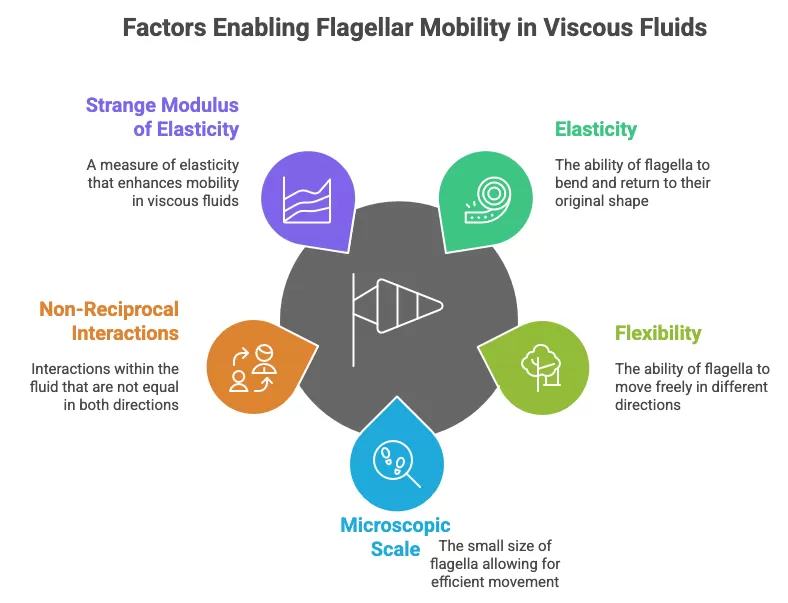
The researchers discovered that flagella have
developed an elasticity and flexibility on a microscopic scale that
enables them to move without losing much energy in the surrounding
colloid-like fluid, which are complex plasmas where interactions are
non-reciprocal. As quantum physics researchers have named stealth
particles with names like “charming” or “strange”, the researchers
called this property “strange elasticity”.
“Using
simple, solutionable models and biological flagellar waveforms for
chlamydomonas algae and spermatozoa, we studied the strange flexural
modulus to decipher non-local and non-reciprocal internal interactions
within the material.”
But this strange elasticity
property does not fully explain the propulsion generated by the
undulatory motion of the flagella. The researchers have therefore also
derived a strange modulus of elasticity to describe the internal
mechanics of flagella. Their investigations include “transverse
responses”, modified dislocation dynamics and topological waves. What is
certain is that the greater the strange modulus of elasticity, the
better the mobility in such fluids.
While
these results may eventually help in the design of small micro-robots
mimicking living materials, modeling methods can already be used to
better understand the underlying principles of collective behavior.
To see the research – Odd Elastohydrodynamics: Non-Reciprocal Living Material in a Viscous Fluid – Kenta Ishimoto, Clément Moreau, Kento Yasuda – Physical Review Journal
Illustration – 610820594
References
Scallop Theorem – https://en.wikipedia.org/wiki/Scallop_theorem
Reynolds number – https://en.wikipedia.org/wiki/Reynolds_number
Murmuration – Dossier Thot Cursus – https://cursus.edu/en/files/13523/murmuration
Kenta Ishimoto – Professor of Applied Mathematics – Department of Mathematics, Kyoto University
https://www.math.kyoto-u.ac.jp/~kenta.ishimoto/
Odd Elastohydrodynamics: Non-Reciprocal Living Material in a Viscous Fluid – Physical Review Journal
https://journals.aps.org/prxlife/abstract/10.1103/PRXLife.1.023002
Odd Viscosity and Odd Elasticity
https://www.annualreviews.org/content/journals/10.1146/annurev-conmatphys-040821-125506
Experimental study of the nonreciprocal effective interactions between microparticles in anisotropic plasma
https://www.nature.com/articles/s41598-020-70441-z
A New Theory for Systems That Defy Newton’s Third Law
https://www.quantamagazine.org/a-new-theory-for-systems-that-defy-newtons-third-law-20211111/