
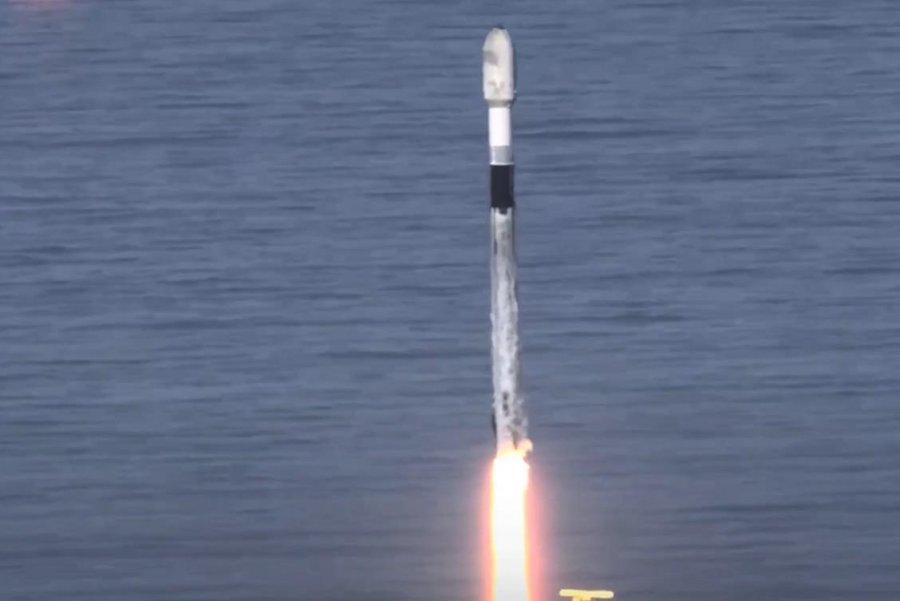
Nov. 28 (UPI) — SpaceX on Friday launched 140 payloads, the 19th mission of the Smallsat Rideshare program from California.
The Falcon 9, with cubesats, microsats, hosted payloads and orbital transfer vehicles, lifted off from Vandenberg Space Force Base’s Pad 4E at 10:44 a.m. PST. The Transport-15 mission was scrubbed on Wednesday as the oxygen load was supposed to start on the rocket’s upper stage.
Clients included 36 SuperDove satellites for Planet Labs’ Earth-observation network and satellites for clients like Exolaunch, D-Orbit and NASA.
Mexico’s Alvaro Obregón Borough sent the first locally assembled microsatellite into orbit.
About 8 1/2 minutes after liftoff, the first-stage booster landed on the drone ship, Of Course I Still Love You, in the Pacific Ocean. This was a record 30th mission for the booster with past ones including five missions for the National Reconnaissance Office, four previous rideshare flights and NASA’s Surface Water and Ocean Topography.
It was the 165th landing on the vessel and the 540th booster landing for Space, including in Florida.
The last ride-share flight was on June 23.
So far, Falcon 9 has launched 30-plus missions with rideshare payloads, sending more than 1,400 payloads to orbit.
SpaceX, in an information sheet, said the cost is as low as $325,000 for up to 120 pounds.
“If your payload is delayed, apply 100% of monies paid toward the cost of rebooking on a future mission, subject to a 5-10% rebooking fee,” SpaceX said.
Missions are planned every four months.
SpaceX’s next Florida flights
SpaceX plans to resume Falcon 9 missions from Florida with flights with 29 Starlink satellites each scheduled for Monday and Tuesday after a 10-day pause during the Thanksgiving holiday week.
The last launch was Nov. 22 when a Falcon 9 rocket carried 29 Starlink satellites into low-Earth orbit from Canaveral Space Force Station’s Pad 40 at 2:53 a.m. EST. It was the record 101st mission from Florida’s Space Coast this year.
From Florida, the four-hour window for the next flight is from midnight to 4 a.m. from Pad 39A at Kennedy’s Space Center.
Then Tuesday from 3:16 to 7:16 p.m., a Falcon 9 is scheduled from Launch Complex 40 at Cape Canaveral Space Force Station.
Another Starlink missions are scheduled the following week: Dec. 7.
On Dec. 9, SpaceX also is planning the third national security launch this year for the Space Force’s Space Systems Command and the National Reconnaissance Office.
There have been 67 Starlink missions this year from Florida, carrying 1,724 satellites. In all there have been 150 Falcon 9 launches this year, including from California.
From Florida’s Cape Canaveral and Kennedy Space Center there were a record 93 this year, after 74 missions in 2023. Aside from SpaceX, Blue Origin and United Launch Alliance also launch missions from Florida’s space coast.
Mission to the International Space Station
SpaceX also sends astronauts to the International Space Center for NASA aboard Dragon. The last mission was Crew-11 on Aug 1 and docking the next day.
On Thursday, Russia launched two cosmonauts, Sergei Kud-Sverchkov and Sergei Mikaev, and American astronaut Christopher Williams from the Baikonur Cosmodrome in Kazakhstan. It lifted off at 4:27 a.m. local time.
One day later, the Soyuz MS-28 spacecraft successfully docked with the space station, Roscosmos said. Their mission is scheduled to last eight months.
A launch inspection discovered “damage to several elements of the launch pad,” according to a statement from Roscosmos.
“An assessment of the condition of the launch complex is currently underway.
The launch pad includes support systems for the rocket and a structure for occupants to access their capsule atop a Soyuz rocket.
“In the worst case this could seriously affect the rotation of crewed missions and cargo flights to the ISS,” analyst and blogger Georgy Trishkin wrote on Telegram.
With the docking, there is a 10-member crew. Three are scheduled to return to Earth by Dec. 8, according to NASA.