
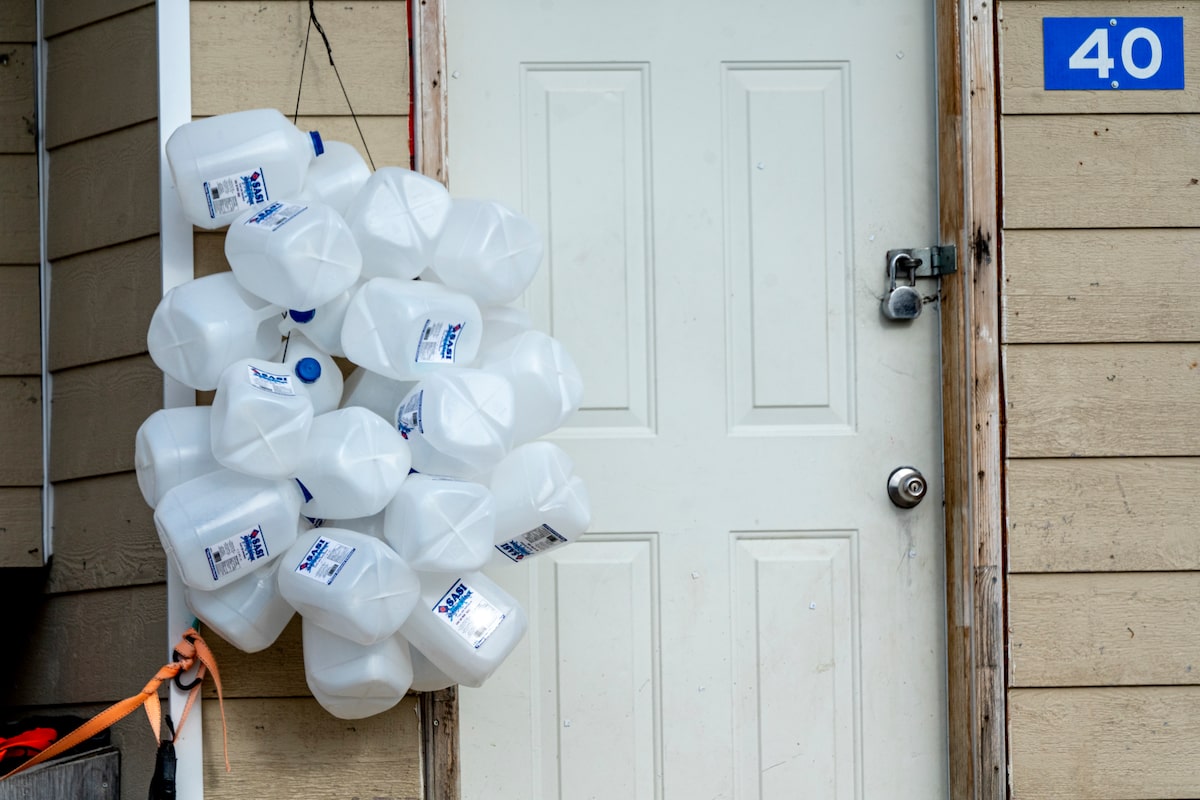
Empty water jugs hang outside a locked door on Oct. 26, 2020, in Neskantaga First Nation after the community was evacuated because of a water crisis.DAVID JACKSON/The Globe and Mail
First Nations are pressing the Carney government to obey a four-year-old court settlement and pass long-promised drinking water legislation before year’s end or risk more legal action.
Bill C-61, the First Nations Clean Water Act, died on the order paper with the spring election call. Introduced in 2023, the proposed legislation would have set minimum standards for drinking water on reserves, acknowledged First Nations’ jurisdiction over water on their lands and recognized safe drinking water as a human right.
The Chiefs of Ontario (COO), a group representing the leaders of 133 First Nations in the province, passed a resolution calling on the government to retable Bill C-61 immediately.
And the Siksika Nation in Alberta has accused Ottawa of violating a legal commitment to pass the bill and fund First Nations water upgrades.
Under the terms of a 2021 class-action lawsuit settlement, Ottawa agreed to spend at least $6-billion upgrading water and wastewater infrastructure and pass a law to ensure reserves have safe water.
In July, Indigenous Services Minister Mandy Gull-Masty’s office said the government intended to reintroduce the legislation during the fall session.
With that session ending Dec. 12, several chiefs have lost faith that C-61 will reappear by year’s end and say litigation is their sole recourse.
“The only option that we have, it would seem, is to go back to court,” said R. Donald Maracle, Chief of the Mohawks of the Bay of Quinte. “And that’s not what the drinking water settlement was supposed to do. It’s supposed to ensure that First Nations have safe drinking water.”
The Siksika Nation said much the same in a letter to Ms. Gull-Masty earlier this year, vowing that it would resort to legal action if Canada failed to reintroduce the legislation by the end of 2025.
So far, the letter – and several like it from other nations – has gone unanswered, said lawyer Clayton Leonard, who represents Siksika and other First Nations on drinking water issues.
“They turtled on C-61 completely – we’re not hearing anything from them,” he said. “I think the conclusion a lot of nations are reaching is litigate or go home.”
First Nations leaders had hoped the fall budget would mention drinking water legislation. Instead, the sole commitment on First Nations water was a continuation of existing funding of roughly $777-million a year.
“The budget tells me that there is going to be no legislation introduced, or that the legislation is going to be weakened,” said Linda Debassige, Grand Chief of the Anishinabek Nation, a political organization comprising 39 First Nations across Ontario.
First Nations voice concerns over lower drinking water funding in federal budget
In an e-mailed statement, Ms. Gull-Masty said the government is “working carefully to make sure the new legislation is strong, effective, and truly reflects the needs and priorities of First Nations communities.”
“I take this issue very seriously and hope to have more to say very soon,” she added.
Since 2015, successive Liberal governments have spent more than $5-billion on water infrastructure projects on First Nations and lifted 149 long-term drinking water advisories. But 38 advisories remain in place. A recent Auditor-General’s report found that nine have lasted a decade or longer.
Neskantaga First Nations Chief Chris Moonias looks into the water reservoir tank on Oct. 26, 2020.DAVID JACKSON/The Globe and Mail
It’s unclear what’s holding up the bill. In June, the environment ministers of Alberta and Ontario asked their federal counterpart to scrap all policies and legislation that undermine economic growth, including C-61. Ontario’s Todd McCarthy later apologized.
Chiefs are also concerned that another piece of the 2021 settlement – the $6-billion obligation for water infrastructure – has disappeared.
Several chiefs attending a COO assembly last week said federal officials told them the $6-billion is already gone, despite the many water projects in their communities that remain unfunded.
Ms. Gull-Masty’s statement did not directly address a question about the sum.
“Where did the $6-billion go?” Mr. Maracle said. “Some class-action members didn’t get any money at all.”