
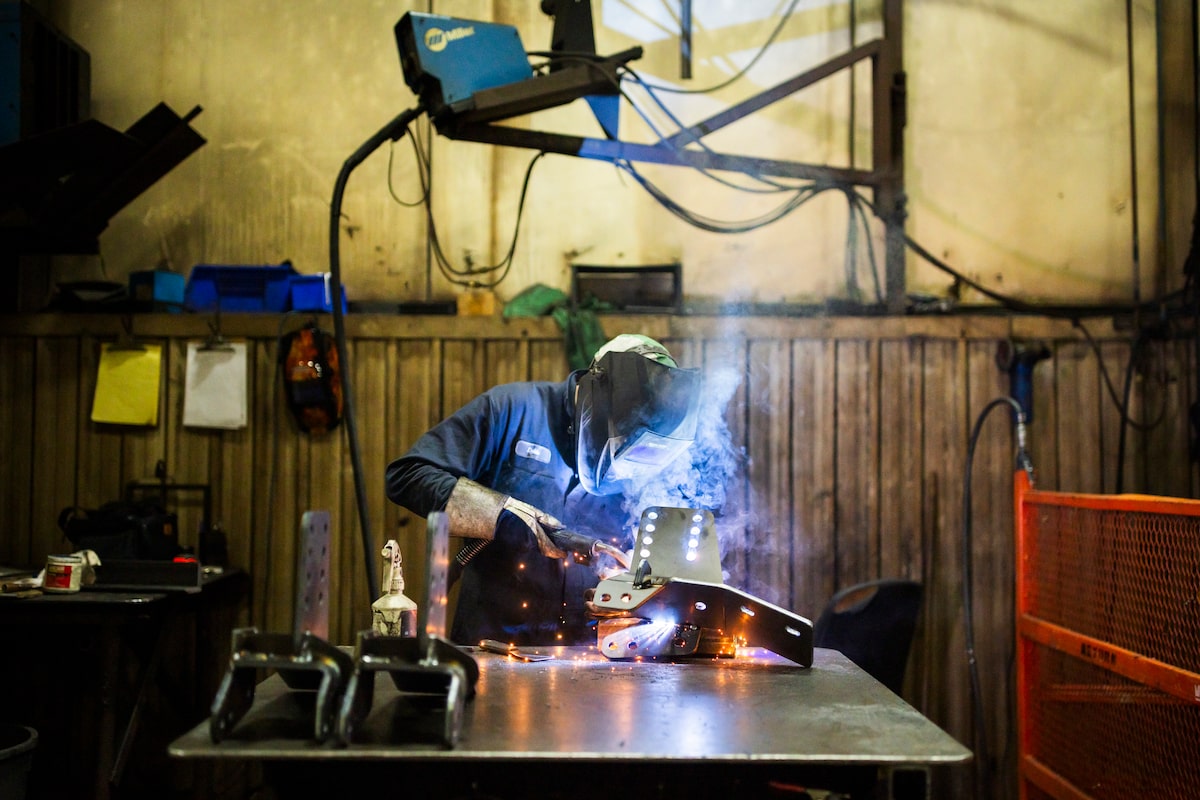
Months into the trade war, Canadian manufacturers are struggling.
They’re losing sales in the crucial U.S. market. They’re laying off staff to keep afloat. And they’re snowed under by reams of paperwork as they try to navigate the complex – and frequently changing – tariff policies of the White House.
Broadly speaking, the Canadian economy has avoided the worst-case scenario from U.S. President Donald Trump’s assault on free trade. Most Canadian goods exports are still entering the U.S. duty-free, thanks to a carve-out tied to the North American trade deal.
But the United States has also targeted several industries – including steel, aluminum, automobiles and lumber – with punishing tariffs as high as 50 per cent, and that spells trouble for Canadian communities that rely on heavy industry and U.S. demand to power growth, notably those in Southern Ontario.
If anything, this is just the latest tough chapter for Canadian manufacturing.
At the turn of this century, the industry accounted for roughly 16 per cent of overall gross domestic product; that’s now down to less than 9 per cent.
“What’s especially notable in recent years is that factory output was drifting lower even before this year’s trade trauma (which has just piled on the pain),” Bank of Montreal chief economist Doug Porter said in a research note this week. “That was not obviously the case in the U.S. economy, where manufacturing output has been rising and still accounts for just over 10 per cent of GDP.”
When Mr. Trump ramped up his tariff threats last year, The Globe and Mail spoke with several manufacturers about their plans for potential duties. With tariffs in place, we’ve asked them again for an inside look at their operations – and the details aren’t pretty.
Their operations have generally become leaner as they cope with weaker sales, and because they’re geared to selling in the U.S. market, it’s tough – if not impossible – to simply ship their goods overseas.
But crucially, they are still in business. They may be down, but they’re certainly not out.
Arctic Snowplows
When Arctic Snowplows ships a $10,000 plow to the U.S., it now comes with an added cost of $500.
That’s because the London, Ont.-based company, which makes heavy-duty plows for snow clearance, is getting hit with a 50-per-cent duty on the steel content in its finished product. Jim Estill, owner of the nearly six-decade-old company, said U.S. sales are down 40 per cent as a result of Mr. Trump’s protectionist policies.
“It’s a huge number for us,” he said.
American tariffs on steel and aluminum are not only higher now than during Mr. Trump’s first term in the White House, they encompass a broader range of products. That means many Canadian manufacturers that use steel or aluminum as inputs are getting hit by tariffs to varying degrees.
A year ago, Mr. Estill was unequivocal that Canadian policy makers needed to retaliate against U.S. tariffs. That’s not exactly how things have panned out. Prime Minister Mark Carney has rolled back many of Canada’s countertariffs on the U.S. in a bid to revive trade talks, including charges on American snowplows.
As a result, Arctic Snowplows faces tariffs when selling to American customers, but its U.S. competitors face no such duties when selling into Canada.
As a result of Mr. Trump’s protectionist policies, Arctic Snowplows’ U.S. sales are down 40 per cent.
Nick Iwanyshyn/The Globe and Mail
“We have no advantage in Canada, and we have a disadvantage in the United States,” Mr. Estill said. “I’d like to think that that’s because there’s a bigger picture that I don’t see, and that they’re actually negotiating something. If they’re not, then Trump has won.”
Arctic is spending less on marketing in the U.S. and focusing its efforts on Canada. That said, Mr. Estill said it’s tough to make up for the loss of U.S. revenue with domestic sales. And despite the push to “buy Canadian,” nationalistic fervour only runs so deep.
“Wouldn’t you think municipal bids would buy Canadian? Yeah, they buy Canadian – unless you’re $1 higher,“ he said.
A bigger plan for the Canadian economy is to diversify its trade partners. The Carney government has set a goal of doubling non-U.S. exports to $600-billion annually in a decade, and it’s making billion-dollar investments to enhance trade infrastructure.
But Mr. Estill said the realities are complicated. There are several hurdles – language barriers, shipping costs and local regulations – that make it difficult to simply pivot to other markets.
“My cost to sell in Germany is extremely high,” he said. “My cost to sell in Buffalo – I can have someone there in an hour and a half.”
Ultra-Form Manufacturing
The Trump tariffs are bad for Kacee Vasudeva’s business.
The 80-year-old entrepreneur owns Ultra-Form Manufacturing, a maker of metal fittings for car components. Mr. Vasudeva was negotiating a US$2-million contract with a U.S. parts maker when Mr. Trump, then on the campaign trail, began threatening to impose tariffs on imported cars and other goods last fall.
That deal never happened. Mr. Vasudeva then watched Ultra-Form’s sales fall by 40 per cent as Mr. Trump came into office and began imposing tariffs on trade partners, spurning the North American free trade agreement that had fostered an efficient supply chain that crosses two borders.
Ultra-Form makes couplings used in a car’s cooling, brake and other systems that use fluids. From a factory in northwest Toronto, Ultra-Form’s machinists turn 12-foot bars of steel and aluminum into polished fittings purchased by larger parts makers that sell to carmakers.
Although auto parts that comply with rules of origin in the United States-Mexico-Canada Agreement are exempt from tariffs, some of Ultra-Form’s parts are subject to 50-per-cent duties based on their steel and aluminum content. Other parts are hit with tariffs in haphazard fashion, because the rules are complex and the duties are tough to calculate, resulting in errors.
“It’s hit and miss,” Mr. Vasudeva says. “Once in a while, they put a duty on it and then we have to fight it. It’s a difficult time now.”
Ultra-Form’s sales fell as Mr. Trump came into office and began imposing tariffs on their trade partners, disrupting the once-efficient supply chain that crossed two borders.Christopher Katsarov/The Globe and Mail
The slump forced the company to lay off about half of its 40 employees last spring. Mr. Vasudeva also used a federal work-sharing program that averted further job cuts. “We are bringing them back slowly,” he says, as sales have recovered a bit and are about 18 per cent less than at this time last year.
Mr. Vasudeva came to Canada from India in 1972 at age 25 with $25 in his pocket. He fixed up an old lathe to make metal sliders and sold them to furniture makers from the trunk of his car. By 1977, he was in the car parts business, turning out large volumes of metal fittings for Detroit’s Big Three automakers. He went on to start several ventures that employed hundreds of people making hand tools, mosquito repellent and bed-bug traps.
His name is on more than 80 Canadian patents, some of which are licensed to global manufacturers.
“Some of them made me a lot of money,” Mr. Vasudeva says of his innovations, seated in a boardroom at his factory. However, “Ultra-Form has been a challenge for me.”
To limit his tariff exposure on exports, Mr. Vasudeva buys metal from U.S. suppliers for parts he exports. He sticks with Canadian steel and aluminum for domestic and Mexican products. This is uncomfortable for the devout “Buy Canadian” believer.
“What choice do we have?” he says.
A softwood lumber yard in the Monteregie region, Que., in October, 2025. Lumber is one of several industries that the U.S. has targeted with punishing tariffs as high as 50 per cent.Christinne Muschi/The Canadian Press
Brink Group of Companies
About a year ago, John Brink predicted Mr. Trump’s tariffs would result in a worst-case scenario for his 50-year-old company.
That prediction came true, and then some.
Mr. Brink founded his lumber company in 1975 and has since expanded it to become the Brink Group of Companies, which also focuses on real estate, warehousing and media.
Like most other Canadian softwood producers, the company is currently facing American import taxes of 45.16 per cent as Mr. Trump tries to boost the U.S. industry. This is up from 14.4 per cent this time last year.
The company used to employ about 400 people at its secondary manufacturing plants in Prince George, Vanderhoof and Houston, all in British Columbia. Now, that number is less than 75, Mr. Brink said. “It has been devastating for us as a company.”
Since 2017, Mr. Brink estimates his company, which relies on the U.S. as its primary export market, has paid more than $80-million in duties.
To say he’s concerned about the future would be an understatement. Mr. Brink is frustrated that the U.S. has turned up the heat on Canadian softwood lumber producers, who make up the bulk of American imports. In 2024, Canadian softwood lumber exports to the U.S. totalled US$5.1-billion, or about 74 per cent of the total value of imports, according to the National Association of Home Builders.
But in adding new barriers, the U.S. is making it costlier to build homes and more expensive for buyers, Mr. Brink said.
“They do not have enough lumber or timber to supply mills, to supply the needs for housing that is desperately needed in that market. And if they do, prices will go to all-time highs. That’s how it works. At the end of the day, the buyers of the product will pay for it,” he said.
After downsizing, Mr. Brink said his company’s rate of production has dropped by 75 per cent. He’s worked with his partners in the U.S. for 50 years; pivoting the business to rely upon another market isn’t an option. It would take hundreds of millions of dollars in capital expenditures for new infrastructure, training and equipment, which he simply doesn’t have.
But Mr. Brink doesn’t give up easily. He’s optimistic about incoming support from the federal government.
In August, Ottawa announced a $1.2-billion financial aid package for Canadian lumber producers, including $700-million in loan guarantees to help with operations and $500-million in grants and contributions to diversify markets and reduce dependence on the U.S. On Wednesday, Ottawa topped up its loan guarantees promise with an additional $500-million.
The support program, run by the Business Development Bank of Canada, began distributing loans through the commercial banking system in October. But companies, including Brink, have lamented its lethargic rollout. On Wednesday, Ottawa responded, saying it would create a “single window” for applications in order to streamline the process.
Support like this from the federal government is critical and must remain consistent, Mr. Brink said. Because one day, he added, all of this will pass. “And then we have to rebuild an industry.”
Commercial trucks cross the Ambassador Bridge, a key trade artery between Canada and the U.S. While most Canadian goods exports are still entering the U.S. duty-free, the U.S. has targeted several industries with its tariffs, including steel, aluminum, automobiles and lumber.JEFF KOWALSKY/AFP/Getty Images
AceTronic Industrial Controls
At AceTronic Industrial Controls Inc., the Trump tariffs are starting to bite. U.S. customers of the Mississauga-based company, which makes machinery and parts for manufacturers of plastic goods, are balking at the added cost, paperwork and hassles of accounting for and paying the duties.
The chaotic way in which Mr. Trump imposed the tariffs has saddled companies with a series of tough questions. How much copper is in a cable? What does it weigh? Is it subject to other tariffs? What about compliance with the North American free trade agreement?
These are the kinds of questions AceTronic’s staff, U.S. buyers and customs brokers are asked by U.S. government officials. Sometimes they guess; sometimes they get it wrong.
A recent AceTronic shipment of a cable assembly for a plastics mould-making machine was hit with a 200-per-cent tariff for reasons the company cannot fathom. The correct amount should have been 35 per cent, says Kim Thiara, owner of AceTronic.
The costs and hassles of paying and reporting the tariffs are mounting, she says, and starting to crimp U.S. sales.
“It’s just starting to rear its ugly head now,” Ms. Thiara says. “We just had a call last week with a customer … saying, ‘You know, Kim, we know you’re a family-owned business and we love the work that you’ve been doing with us, but our hands are getting kind of shackled.’”
The tariffs, ranging from 25 per cent for the non-USMCA compliant components of auto parts to 50 per cent for copper and steel content, come on top of freight and related charges.
“The tariffs are just putting it to a point where it’s not justifiable for them to continue doing business with us,” says Ms. Thiara, whose customers make food packaging, medical equipment and other products.
Her automotive business – selling to customers that supply carmakers in Ontario and the U.S. – has seen the biggest sales drop of her segments, says Ms. Thiara. Once a Trump supporter, she told The Globe a year ago that she doubted the incoming president would use tariffs to set fire to the long-standing trading relationship between the two countries in his push to bring home manufacturing.
“I’m a very optimistic person,” she says. “I don’t think anybody thought it would be like this.”