
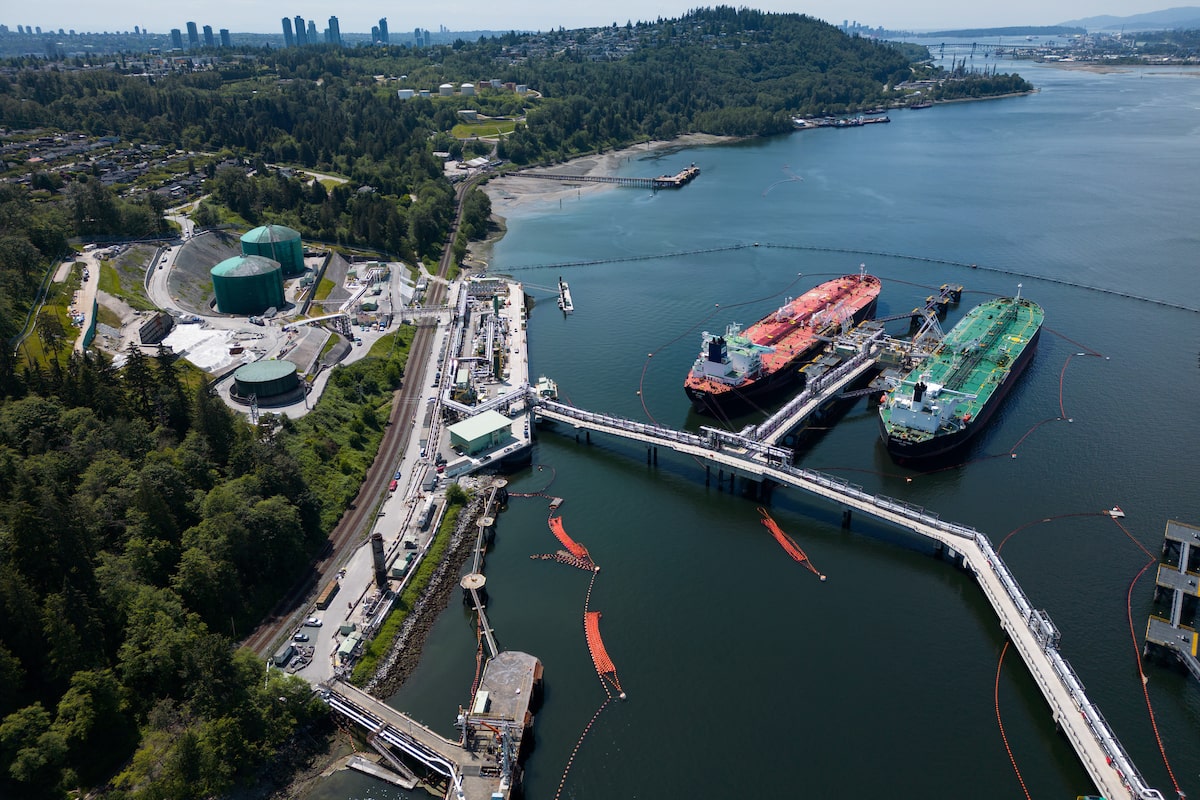
Crude oil tankers are seen docked at the Trans Mountain Westridge Marine Terminal, where crude oil from the expanded Trans Mountain pipeline is loaded onto tankers, in Burnaby, B.C., June, 2024.DARRYL DYCK/The Canadian Press
Trans Mountain Corp. is on track to return $1.7-billion to the federal government this year, owing to higher-than-expected volumes on the pipeline system and less capital spending than it had predicted.
The government-owned pipeline company reported adjusted earnings before interest, taxes, depreciation and amortization of $591-million in the third quarter, compared with $512-million in the same period of 2024. It returned $314-million to the federal government, consisting of $151-million in interest payments and $163-million in cash dividends.
“It was a long, tortured process” to get the Trans Mountain expansion completed, but it’s now doing what it is supposed to do – returning money to Canada’s coffers, chief executive officer Mark Maki told The Globe Friday.
Since the expansion came on line in 2024, it has reined in the differential between Canadian and higher U.S. oil prices, thereby increasing revenues to Canada. It has also boosted access to Asian markets, Mr. Maki said.
Morneau asked future CEOs to weigh in on Trans Mountain pipeline purchase. Here’s how it went
An average of 777,000 barrels per day flowed through the pipeline system in the third quarter, up from 692,000 bpd over the same period last year. Utilization for the quarter was 87 per cent, bringing it to 84 per cent year-to-date.
Increased use of the line was a result of market forces and Trans Mountain’s concerted effort to ensure the system can perform at its maximum 890,000 bpd capacity when it needs to, Mr. Maki said.
The Crown corporation is looking to increase the capacity of the pipeline system even further through various projects to boost capacity by a collective 360,000 bpd, or roughly 40 per cent.
Trans Mountain wants to introduce drag-reducing agents into the pipeline system to reduce friction between the oil and the line itself, for example, which has the potential to increase capacity by up to 10 per cent, or 90,000 bpd.
Mr. Maki expects a final investment decision on that work next year.
The company is also eyeing a larger optimization project for the line, which would include adding 30 kilometres of new, 36-inch diameter pipe adjacent to the existing main line and 11 new pump stations along the route. It would also increase power to the line to make pump stations more effective.
Opinion: As pipeline politics begin anew, Ottawa must fast-track the courts
A final decision on that project will likely be made in late 2026 or early 2027, Mr. Maki said.
British Columbia has said it backs the proposal to boost capacity on the line − a sharp reversal from a government that once fiercely opposed the initial Trans Mountain expansion, arguing when it was proposed that increased shipping traffic would put B.C.’s marine environment at risk.
The province has also given a green light to the Vancouver Fraser Port Authority to dredge the Second Narrows waterway to allow tankers to load more oil at the Trans Mountain marine terminal in Burnaby.
Boosting capacity on the line will ensure that Canadian commodities aren’t stranded or sold into a market where there’s a heavy discount, Mr. Maki said, and the B.C. government has been “incredibly supportive” ever since the U.S. began a trade war by imposing tariffs on Canadian goods.
Opinion: A blockbuster not-yet-agreement with the devil in the politics
Still, the planned expansion won’t meet the growing needs of the sector, he said – particularly if Alberta meets its goal of doubling production.
“You need something else, somewhere else, and so that’s the process that the country’s got to work through,” Mr. Maki said.
That’s where the energy accord signed Thursday by Prime Minister Mark Carney and Alberta Premier Danielle Smith comes in. It aims to boosts Alberta’s energy sector and diversify export markets in the face of U.S. President Donald Trump’s trade war, laying the conditions for construction of a new oil pipeline to the West Coast.
Mr. Maki called the agreement “a positive step for the country” that will help meet Mr. Carney’s ambition to make Canada into an energy superpower.