
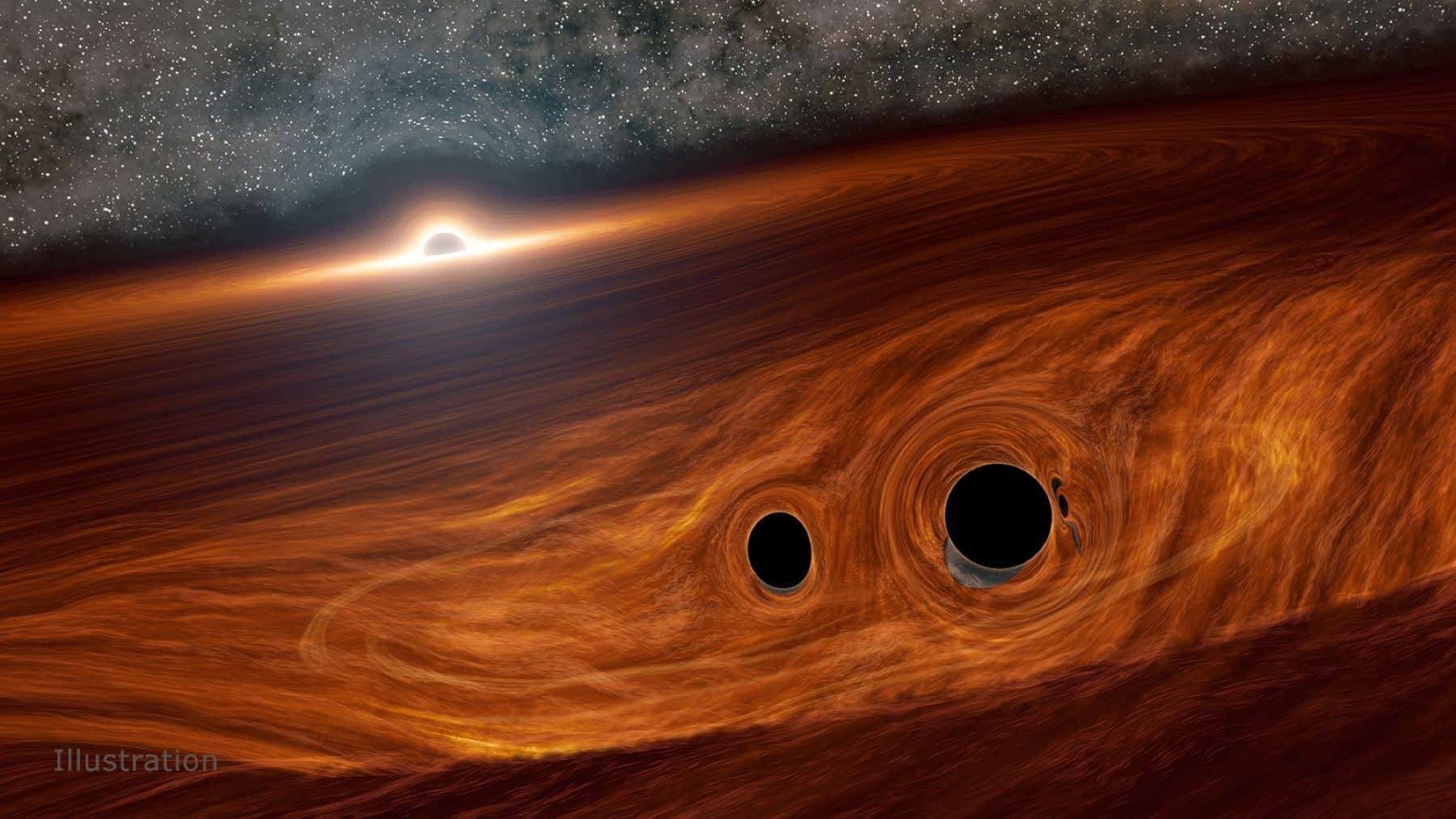
There is only one thing more incredible than quiet space: the unpredictable nature of the universe. One moment, it is calm and dark, like a black hole; the next, scientists are dealing with an unexpected pool of force. It is in one of the latter events that researchers from NASA uncover the loud arrival of one familiar space nemesis.
Uncommon collision millions of years in the making
For years, scientists believed they had mastered the universe and its behavior: a silent, dark, and mathematically dynamic realm. However, during a recent space exploration, scientists have encountered something strange lurking in the darkness. This strange phenomenon wasn’t something uncommon. But the turn it took may have caused a shift in the universe.
Somewhere in deep space, scientists find two titanic objects between galaxies. Through advanced telescopes, they discovered that these two objects had spiraled towards one another and caused an enormous collision so severe. The aftermath of this event has sent ripples through the silent fabric of the universe.
The two objects are black holes that happen to have collided into each other in what scientists believe was 740 million years ago. The team of scientists who made their discovery was led by Professor Roberto Maiolino, an astrophysicist at the University of Cambridge. He and his team captured their aftermath using NASA’s James Webb Space Telescope.
Scientists explain how this event shakes the universe
Black holes are one of the most peculiar objects in deep space. They can be found at the center of every galaxy and are formed when a giant star explodes or dies within that galaxy. As their name suggests, black holes are dark, almost invisible entities that have heavy densities and a powerful gravitational pull.
Throughout their lifetime, black holes are known to consume any surrounding matter and orbit silently in space. However, the discovery of two black holes commands a different narrative. Both were found at the center of a galaxy called ZS7. The mass of one of these black holes is an estimated 50 million times that of our giant Sun, like this star blazing a powerful wave across the universe.
The aftermath of their merging has caused an untimely unrest within their surroundings. Each black hole was observed to send ripples of gravitational waves across space. The effect of these waves could cause stars, planets, and even gas clouds to be scattered away from their default orbits.
This collision could rewrite the universe.
Following the discovery, Professor Roberto and his team conducted a series of scientific analyses. One thing that stood out was the measured strength of the waves given off. The signal generated was so intense that it could, in fact, wipe away systems of stars within its reach from their local positions.
Resolution of NASA going forward
Astronomers from NASA have referred to this as a double-fold violence from the chief nemesis of the universe. Although the gravity of this event seems overboard, the agency has chosen to approach it from a different angle. Since this event births a new weight of gravity, scientists have made certain developments.
NASA would use this event to study wave patterns using advanced telescopes like the Hubble or the JWST. With them, they can explore the source of this event and be able to detect early signs of future recurrent ones. Beyond that, this discovery expands and challenges previous theories on black holes that would now be refined.
Also, using advanced simulation computers, scientists can reconstruct a model of the surrounding stars in ZS7. This might reveal activities NASA failed to notice during their initial detection of this collision. In the long haul, this event provides an opportunity to learn something new about our universe, just like the newly discovered sun anomalies, shocking scientists.