
A groundbreaking study conducted by scientists at the University of Bristol has made a chilling prediction about Earth’s distant future. According to their research published in Nature Geoscience, all life on Earth could be wiped out in a massive “triple whammy” extinction event in approximately 250 million years. The team used supercomputer simulations to predict this catastrophic scenario, unveiling a future shaped by powerful geological and climatic forces.
The Distant Fate of Earth: A Triple Whammy of Extinction
The study’s authors explain that Earth’s fate lies in a sequence of three deadly events that will unfold over hundreds of millions of years. The first of these events centers around the formation of one final supercontinent, a process driven by plate tectonics. Over time, Earth’s landmasses will converge into what is known as Pangaea Ultima. As the continents merge, volcanic activity will escalate, spewing greenhouse gases into the atmosphere and triggering a rapid spike in global temperatures.
This increase in temperature, expected to reach 40-50°C, would make Earth uninhabitable for mammals. In fact, the heat produced by these volcanic eruptions will be far more devastating than any human-caused climate change. The study suggests that this is only the beginning of the end for life on Earth.
As the heat intensifies, the planet will experience a significant rise in CO2 levels, pushing the atmosphere beyond its tipping point. The study’s authors explain,
“Coupled with tectonic–geographic variations in atmospheric CO2 and enhanced continentality effect for supercontinents, Earth could reach a tipping point rendering it uninhabitable to mammalian life.” For mammals, including humans, these extreme conditions would make survival impossible.
It’s a staggering reminder of how interconnected Earth’s geological processes are with its ability to support life.
The Sharp Drop: Freezing and Ischemic Necrosis
After the temperature spike caused by the volcanic eruptions, scientists predict a sharp cooling phase will follow. This drastic shift in temperature, similar to previous supercontinent formations, will trigger another extinction event—ischemic necrosis. In this condition, extreme cold causes blood vessels to contract severely, essentially freezing warm-blooded creatures. For any mammals that survive the intense heat, this freezing cold will prove fatal. The study predicts that this combination of extreme heat and freezing temperatures will create a world where mammals can no longer exist.
Such a drastic and unpredictable change in the climate highlights the volatile nature of Earth’s future. With the world already grappling with the impacts of human-induced climate change, these predictions serve as a stark reminder of the long-term consequences of the planet’s geological processes. The question remains: How will humanity respond to the urgent challenges of today to ensure the survival of future generations?
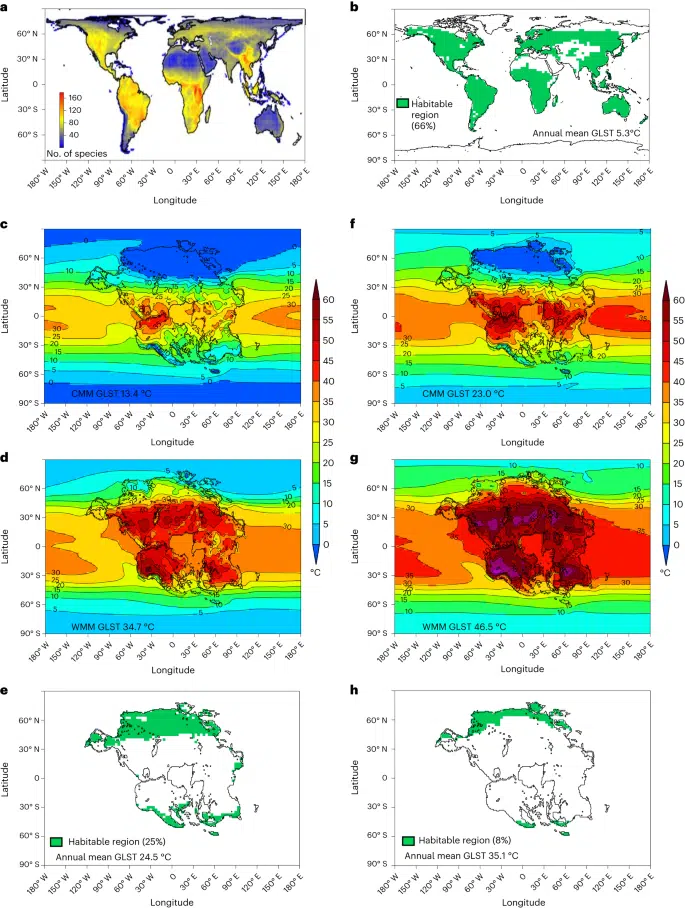 PU temperature and habitability. (Nature Geoscience)
The Urgency of Today: Why Immediate Action on Climate Change Matters
Despite the study, published in Nature Geoscience, focusing on a timeline of 250 million years, Dr. Eunice Lo, a research fellow at the University of Bristol and co-author of the study, emphasizes the critical importance of addressing today’s climate crisis. She warns that while the study predicts an uninhabitable planet in the far-off future, the extreme heat and environmental degradation we are already experiencing are dangerous signals for the present.
Dr. Lo explains, “While we are predicting an uninhabitable planet in 250 million years, today we are already experiencing extreme heat that is detrimental to human health. This is why it is crucial to reach net-zero emissions as soon as possible.”
Human emissions of greenhouse gases are already causing widespread environmental damage, from rising temperatures to more frequent natural disasters. These events are not distant possibilities but present-day realities that require urgent action. By focusing on reducing emissions and moving toward net-zero, we can help slow down the impacts of climate change and potentially mitigate some of the worst outcomes foreseen for the planet. The future of Earth and its ability to support life depends not only on geological processes but also on the decisions made today.