
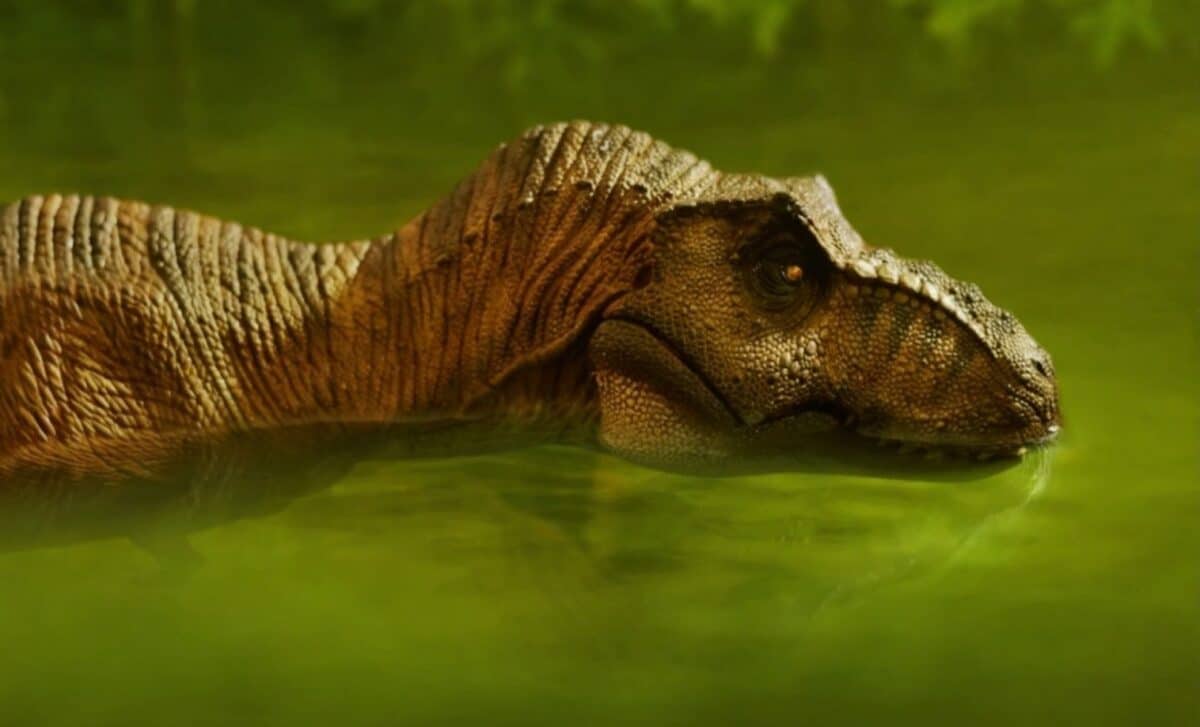
It’s easy to picture T.rex stomping through forests, roaring at the top of its lungs as it hunted down its prey. But what if this terrifying predator was also capable of swimming? It might sound strange, given its massive size and those tiny arms, but recent fossil discoveries suggest T. rex could have spent some time in the water.
It’s a new twist on an old idea, and it could change how we think about this iconic dinosaur. This theory is supported by a study published in Zoological Journal of the Linnean Society, which examines fossilized “swim traces” left by similar dinosaurs. This isn’t just idle speculation, it’s based on actual physical evidence found in ancient sedimentary deposits.
Fossilized Swim Traces: A Clue to T. rex’s Aquatic Skills?
The first major hint that a Tyrannosaurus rex could swim comes from ancient “swim traces”—markings left behind in the sediment by dinosaurs as they moved through water. These traces have been found in places like the Cameros Basin in Spain and various sites in Utah. The interesting part? The traces seem to cut through other dinosaur footprints, suggesting that these dinosaurs were forced into the water when the environment changed.
“On the basis of this evidence, we think that T. rex would have been an excellent swimmer,” Dr Darren Naish, scientific consultant for Prehistoric Planet, clarified in a YouTube video. “It would’ve used this behavior to expand its feeding opportunities.”
It’s like finding the footprints of a creature that was once walking and then suddenly had to wade through a flood.
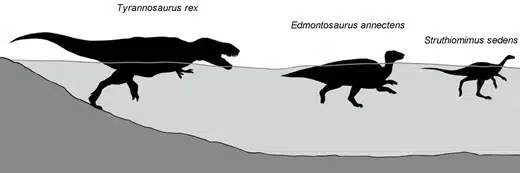 A simplified illustration of the hunting scenario. Credit: Zoological Journal of the Linnean Society
Why T. rex’s Bones Matter?
As mentioned by National Geographic in an article, one of the key factors lies in its bones—specifically, the pneumatic (hollow) bones that were filled with air pockets. This feature is typically associated with modern birds, who use their air-filled bones to stay light and buoyant in the air.
For T. rex, those same bones would have made it easier to float in the water. Instead of sinking straight to the bottom, the dinosaur would have been more buoyant, giving it the chance to stay afloat.
“These heavier bones helped the dinosaur avoid being too buoyant, so that it could more easily use its muscle power to move through the water rather than actively working to stay submerged like we do when we go under water with lungs full of air”, according to the same source.
Swimming Like a Modern Relative?
According to the study, if T. rex was indeed capable of swimming, what might that have looked like? To get a better idea, paleontologists often turn to modern animals with similar characteristics. One creature that comes to mind is the emu. These large, flightless birds can swim, using their legs to paddle and keeping their heads above water. The movement resembles what we think of as a “doggy paddle”.
It’s likely that T. rex, with its powerful hind legs, would have done something similar in the water. While the thought of a 10-ton dinosaur paddling like a bird might seem funny, the mechanics of it are actually quite plausible. T. rex might have used its strong legs to push itself forward, with its large body and head kept above the surface, just like an emu.
“With current evidence available to us,” said Cassius Morrison from University College London, “I would suggest that swimming may have been a way for Tyrannosaurus to navigate its environment.”