
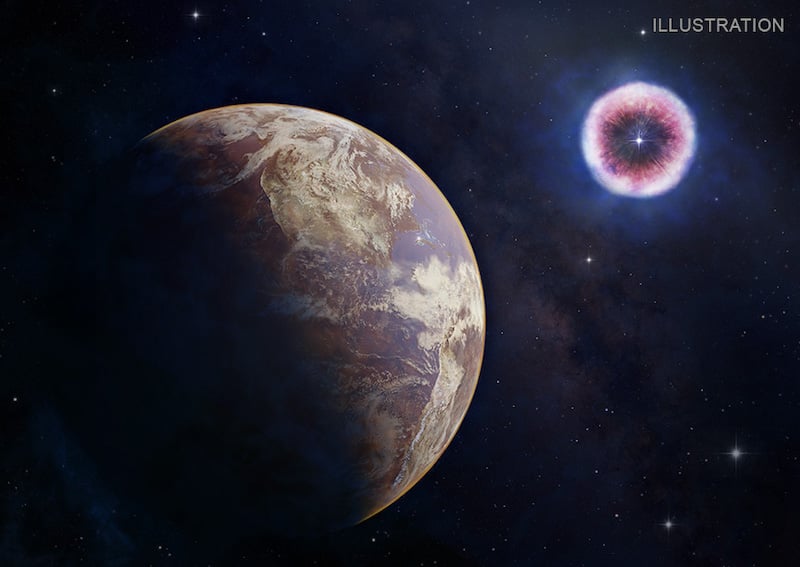
What can an ancient supernova teach scientists about Earth and celestial objects? This is what a recently submitted study to *Astronomy & Astrophysics* hopes to address as a team of scientists investigated the interaction of the remnants of supernova that occurred 10-million years ago with Earth. This study has the potential to help scientists better understand how Earth is influenced by celestial objects and what this could mean for the future of life on Earth, along with potentially habitable worlds beyond Earth.
For the study, the researchers compared samples of beryllium-10 (10Be) obtained from the central and northern Pacific Ocean to an open cluster catalog containing thousands of star clusters based on the Gaia Data Release 3 (DR3) astrometric data, which is a catalog that contains more than 1.8 billion stars. The reason 10Be is important to study is because it forms from cosmic rays, along with having a half-life of 1.39 million years, meaning this is the time it takes half of its components to deteriorate. Therefore, its presence could indicate a recent supernova within the last several million years potentially interacted with Earth.
In the end, the researchers found that the explanation for the 10Be found in the Pacific Ocean, which they estimate occurred between 9.0 to 11.5 million years ago while potentially peaking approximately 10 million years ago, could be explained by a supernova that occurred between 35 parsecs (pc) (114 light-years) and 100 pc (326 light-years) from Earth. They conclude potential origins could be the Orion star-forming region that was located much closer to Earth long ago.
The study notes, “In conclusion, we find that a nearby SN [supernova] remains a possible explanation for the 10Be anomaly, especially given the Solar System’s proximity to the Orion region during that period. The estimated SN probability is nonzero at 35pc and increases with distance, with ASCC20 and OCSN61 emerging as the most promising candidate clusters. ASCC20 is the primary contributor up to 70pc, while OCSN61 becomes more relevant beyond that distance. Future investigations of 10Be records from terrestrial archives outside the Pacific Ocean will be crucial to determine whether the observed anomaly reflects a global signal or a regional effect confined to this basin, helping to constrain its terrestrial or astrophysical origin.”
Studying how supernova interacts with Earth is crucial for understanding how life has been impacted over time, while also helping astronomers better understand where to search for life beyond Earth. This is due to the short- and long-term effects of a supernova, starting with its distance. For example, astronomers estimate that supernova more than 150 parsecs (489 light-years) from Earth pose zero impact for life on Earth. However, closer distances not only could result in cosmic rays impacting life on Earth, but also the long-term radiation bombardment, which is estimated to last between 10,000 to 100,000 years. Along with impacting life, supernova could also cause atmospheric and geological changes across the globe.
Along with the 10-million-year-old supernova discussed in this study, other supernova events include evidence of events that occurred approximately 2.6 million years ago and approximately 6-8 million years ago, of which were discovered based on samples of iron-60 (60Fe). Along with better understanding their interaction with Earth, past supernovae also help astronomers gain insight into the evolution of the Milky Way’s star formation. Additionally, they also link several scientific fields, including astrophysics, planetary science, atmospheric chemistry, geology, climate science, biology, and cosmochemistry.
What new insight into ancient supernovae will researchers make in the coming years and decades? Only time will tell, and this is why we science!
As always, keep doing science & keep looking up!