
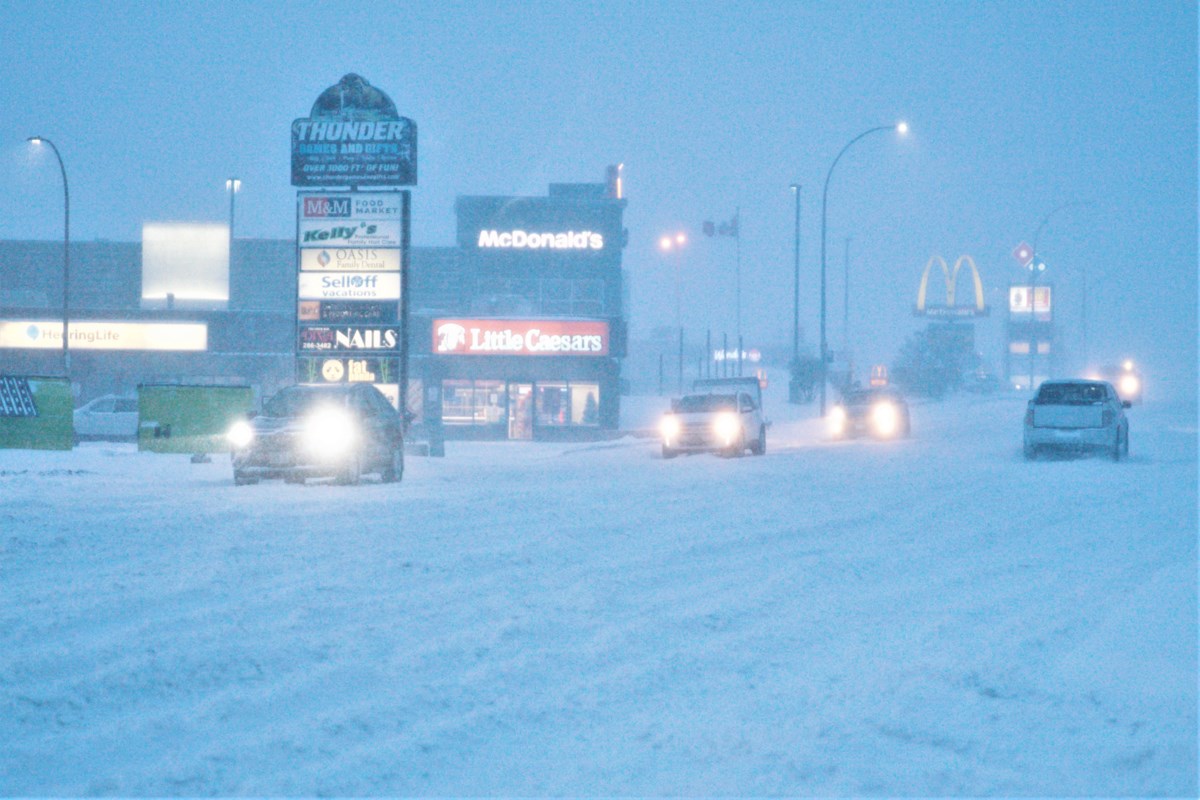
The new yellow, orange and red coded warnings, advisories and watches are designed to more accurately reflect what impacts more severe weather could have.
OTTAWA — A swath of orange and yellow marks the major winter storm stretching from the North Shore to the James Bay coast on Environment Canada’s severe weather alerts site.
It’s among the first uses of a new system that will see more colours in the federal agency’s severe weather alerts.
The national meteorological service launched a new series of alerts on Wednesday. Instead of its maps and forecasts denoting watches as yellow, warnings as red and statements as grey, the weather office now has three colour-coded levels — based on severity — for each type of notice.
“It’s taken years of planning,” Gerald Cheng, a warning preparedness meteorologist with Environment and Climate Change Canada, told reporters at a virtual press conference Wednesday afternoon.
“We want to implement, colour-coded weather alerts because we know it works and it’s recommended by the World Meteorological Organization,” he continued, adding that other countries like the United Kingdom, France, Switzerland, South Africa, New Zealand and others already do this.
“For them, it’s very effective in communicating risks to the population, risks from weather hazards, and that’s why we are implementing it.”
The colours which can be applied to weather watches, advisories and warnings are as follows from least to most severe, according to Environment Canada’s website:
Yellow
Hazardous weather may cause damage, disruption or health impacts
Impacts are moderate, localized and/or short-term
Yellow alerts are the most common
Orange
Severe weather is likely to cause significant damage, disruption, or health impacts
Impacts are major, widespread and/or may last a few days
Orange alerts are uncommon
Red
Very dangerous and possibly life-threatening weather will cause extreme damage and disruption
Impacts are extensive, widespread and prolonged
Red alerts are rare
“The same weather can have different impacts, depending on timing, location and population,” the weather office’s website says. “That’s why each weather alert has a colour — to tell you the level of impact possible in your area, so you can prepare appropriately.”
An example of a “red alert” weather event would be the early-January 1998 ice storm in Ontario and Quebec that was blamed for over 30 deaths, hundreds of injuries and massive power outages, Environment Canada said.
Watches are to alert residents to prepare for potential severe weather and are issued when it could develop, based on conditions at the time. Advisories are for specific types of weather that are less severe than those that get upgraded to warnings, but still significant — like blowing snow, fog, freezing drizzle and frost.
Finally, weather officials say warnings are issued when people should act immediately and are “urgent messages that severe weather is either happening or will happen.”
Special weather statements are still denoted as grey on maps and forecasts; Cheng said those continue to be for “information about weather events or phenomena that is potentially significant and or of interest.”
“When we issue a colour alert, the colour represents a risk level,” Cheng said. “We hope that Canadians will understand their risk level from these weather hazards better.”
“And, of course, when we escalate the colour, that means escalating risk.”
The new alerts are part of “the ongoing modernization of our public weather program,” said a media release issued Wednesday by Environment and Climate Change Canada.
“We continue to experience more frequent and extreme weather in Canada, which makes it more important than ever for Canadians to have access to clear, accurate and easy-to-understand weather alerts,” Julie Dabrusin, the federal Minister of Environment and Climate Change, was quoted saying in the release.
“By improving how severe weather is reported, we are helping Canadians better understand and prepare for potential impacts, so they can make informed decisions about how and when to protect themselves, their loved ones and their property.”